"Government don't live together, people live together"
Whoever wrote this dialogue deserves serious recognition.
Clint Eastwood did a masterful job directing this film.
Most people miss an important thing in the automation debate, whether it is robots or AI agents.
These machines make things. They do not buy them. And consumption is what turns a productivity gain into actual growth.
The argument can be heard in two different places.
One is the AI gospel, loudest in the US, preaching that AI will take most of the jobs. The widely praised @citrini memo gave it a name: an "Intelligence Displacement Spiral". AI displaces workers, those workers spend less, firms under margin pressure buy more AI, which displaces more workers.
The output still shows up in the national accounts. It just stops circulating through the real economy. Citrini calls that "Ghost GDP". But as @timoreilly puts it, you cannot sustain trillion-dollar valuations on a customer base that is going broke.
The other place is China, making spectacular inroads in robotics, partly because it is about to fall off a demographic cliff. It installed more industrial robots last year than the rest of the world combined.
So let's ask the question that everyone skips. What happens if the productivity gains from robots and AI never turn into extra consumption?
The sequence goes as follows. Output rises. The wage share does not keep up. Demand lags supply. Capacity sits idle, or debt piles up behind it. At that point a country has two exits: sell the surplus abroad, or correct at home through falling output and lost jobs.
China takes the first exit. It runs household consumption at around 40% of GDP, against 60 to 70% almost everywhere else, the legacy of years of repression that move income from savers to industry.
China cannot buy what it builds, so it exports the gap. That lets it appear as a manufacturing powerhouse rather than a consumption laggard. But the export surplus is camouflage. It holds up the growth figures while hiding the demand problem underneath.
The US sits in a different spot. Wages there stopped tracking productivity decades ago, but consumption kept going, propped up by household debt and rising asset prices. The political scientist Colin Crouched once called it privatised Keynesianism: borrowing does the work that pay cheques used to.
America can run this longer than anyone because it issues the reserve currency, so steady demand for dollars lets Washington carry deficits no one else could. It works until the borrowing does not.
Europe is slightly better placed, but keeps trying to make itself worse. Germany is the model everyone wants to copy. The Hartz reforms of 2003 to 2005 held wages down while GDP kept growing, so the household share fell and business profits surged. Lower domestic consumption, larger export surplus. The trouble is that not everyone can be Germany at once. When the whole continent represses wages to defend "cost competitiveness", the South ends up stuck below potential on weak demand, whilst the North ends up repressing domestic consumption, which fuels discontent and harms economic growth.
As stated by @michaelxpettis, a country that externalises its internal imbalances forces the adjustment onto its trading partners. They absorb it as higher debt or higher unemployment, and either way they lose manufacturing, whether they like it or not.
Left alone, this ends in one place, which is well known because America already ran the experiment once.
Through the 1920s, output per manufacturing worker rose 43% while wages barely moved. The income that never reached workers funded overbuilt capacity, speculation, and finally the market bubble. By 1928 sales lagged and factories cut output. The crash turned a distribution problem into a decade-long depression.
What broke the loop was FDR's Second New Deal: the Wagner Act, Social Security, and a deliberate move to align wages with productivity. For the first time the income captured through the 1920s flowed back to households. Demand recovered. The imbalance resolved.
That is the lesson for the robot and AI age. Productivity makes growth possible, but consumption is what actually delivers it (cc @CarlotaPrzPerez). The task now is to get the gains to households, through wages that track output and institutions that give people the security to spend, or through newer ideas like handing displaced workers an equity claim on the machines that replace them (cc @izakaminska).
Automate all you like. Someone still has to be able to buy the output.
Some things never change. If you don’t understand this one, you don’t understand what’s happening AI.
Marcus, 1998: neural nets have trouble generalizing far beyond the data.
Marcus, 2001, 2012, 2019, 2022, etc: neural nets have trouble generalizing far beyond the data.
Apple, 2025: neural nets have trouble generalizing far beyond the data.
Meta/Stanford/Harvard, 2026: neural nets have trouble generalizing far beyond the data.
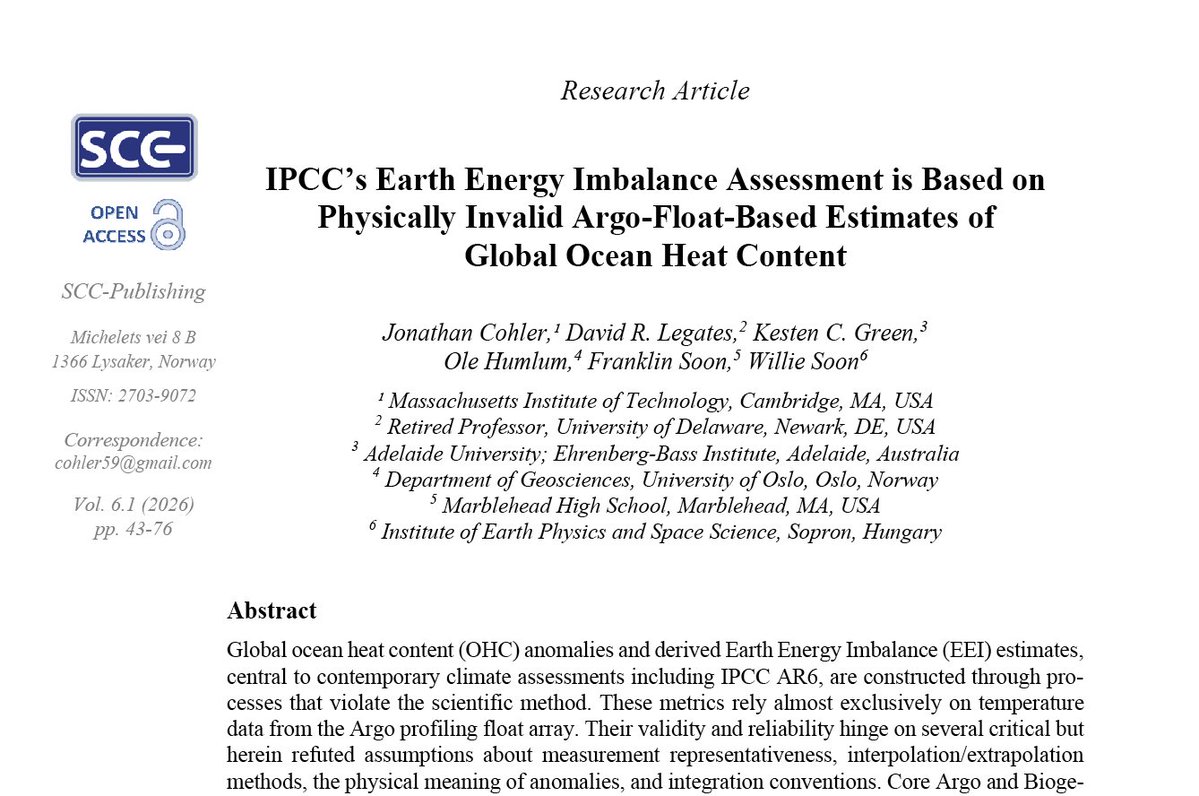
As promised, the climate science obliteration has arrived TODAY.
The IPCC's central claims have now been torn apart.
The oceans are not “warming” let alone “boiling.” That claim is false.
The claimed Earth Energy Imbalance is false. It's no different from zero.
Full demolition:
Cohler et al. (2026)
IPCC's Earth Energy Imbalance Assessment is Based on Physically Invalid Argo-Float-Based Estimates of Global Ocean Heat Content
https://t.co/s4JzeAQGyP
Press Release:
https://t.co/nhofkX1Rxj
Easy-to-Read Summary:
https://t.co/gZI0p1GopP
Countless Energy Experts like myself have harshly criticized your ideology-driven, virtue-signalling approach to Energy Security.
Back in 2022 the Nuclear Energy discourse was alien from the words spoken by your former Energy Commissioner as DE de-nuked.
https://t.co/BfljpuPvcV