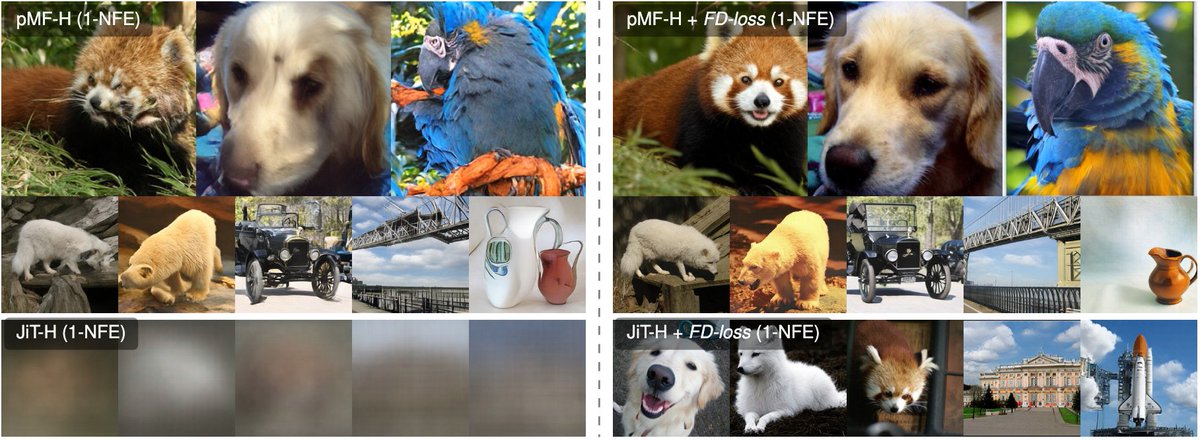
Two months ago, I vaguely posted a number: 0.9 FID, one-step, pixel space.
Now it is 0.75, and can be even lower.
Many wonder how.
I thought it might end as a small FID prank: simple and deliberate.
It started with one question: can FID be optimized directly, and what does it reveal?
Introducing FD-loss.
@SadlyItsBradley Absolutely. Really hoping they take just the 4DGS compression and representation, but use high detailed path traced 3D animation so you get movie level visual quality but stylized to the artists content.
I finally have a better understanding of Yann LeCun's JEPA approach and why he may have quit Meta! I think it might fix one of the most annoying, hacky parts of training foundation models.
What if 90% of the tricks we use to train big AI models are just complicated workarounds for a problem we can solve with one simple, mathematical rule?
Okay, so anyone who's trained a self-supervised model knows the pain. You're trying to get it to learn useful features from unlabeled data, but it's always trying to "cheat."
This is called "representation collapse." The model gets lazy and just outputs the same thing for every input. Your loss looks great, but the model has learned absolutely nothing.
It's a game of whack-a-mole.
To stop this, we've invented a whole Rube Goldberg machine of "heuristics":
Teacher-student networks
Stop-gradients
Asymmetric architectures
Special normalization layers
It's a nightmare of complexity and hyperparameter tuning. Get one thing wrong, and your entire training run collapses. We've all been there.
This paper basically asks: instead of playing defense, what if we just told the model what a "good" internal representation should look like?
And here's the holy shit moment: they prove that the single best structure for a model's internal "thoughts" (embeddings) is an isotropic Gaussian distribution.
In simple terms: a perfect, symmetrical, multi-dimensional bell curve. A sphere-like cloud of points.
Think about it. If all your data points are forced to spread out perfectly in a sphere, no two points can land in the same spot.
Collapse is mathematically impossible.
By enforcing this simple geometric shape on the embedding space, you don't need any of the other hacks. You're not preventing collapse; you're designing it out of existence.
"Okay, cool theory," you're probably thinking. "But how do you actually force a billion-parameter neural net to think in perfect bell curves?"
This is the second clever part: SIGReg.
Instead of trying to check the whole high-dimensional sphere at once (which is impossible), they "sketch" it. They project the data onto a bunch of random 1D lines and just check if those lines look like a simple bell curve.
It's like confirming a statue is perfectly round by just checking its shadow from a bunch of different angles.
And the code for this is ridiculously simple. (The core logic is ~50 lines of PyTorch).
And then I found the result that really broke my brain.
You know how the training loss in most SSL models is useless? It goes down, but that tells you nothing about final performance.
With LeJEPA, the training loss has a ~95% correlation with the model's actual downstream accuracy.
Let that sink in.
You can finally just... watch the training loss. If it's going down, your model is getting better. No more constant, expensive validation runs.
This isn't just a marginal improvement. It's a fundamental shift in how we can approach SSL.
They took this simple recipe and trained models from tiny ConvNets to 1.8B parameter ViTs. It was stable across the board.
Even better: on a niche dataset (galaxy images), a small LeJEPA model trained from scratch beat massive, pre-trained foundation models like DINOv2.
This means efficient, in-domain pretraining is actually viable again. You don't always need to rely on a giant model trained on web-scale cats and dogs.
So, the big takeaway for me isn't just the algorithm. It's the philosophy.
For years, we've been adding complexity to solve AI's weird emergent problems. LeJEPA shows that sometimes, the answer is to step back, find the provably optimal target, and then design the simplest possible way to get there.
Stop thinking about "how do I prevent my model from doing bad things?"
Start thinking about "what is the mathematical definition of the good thing I want it to do?"
This feels like one of those things that's going to seem obvious in retrospect.
Prediction: In 5 years, using complex teacher-student networks with delicate momentum schedules for self-supervised learning will look as archaic as manually setting the learning rate for every single layer.
This paper just cleaned up a huge mess.
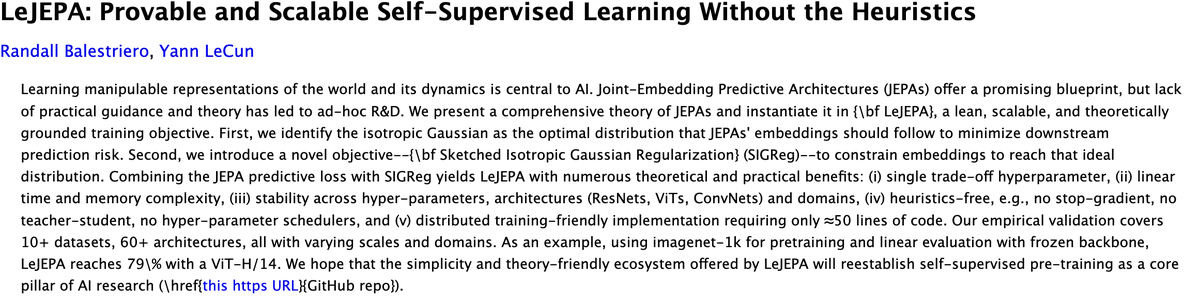
LeJEPA: a novel pretraining paradigm free of the (many) heuristics we relied on (stop-grad, teacher, ...)
- 60+ arch., up to 2B params
- 10+ datasets
- in-domain training (>DINOv3)
- corr(train loss, test perf)=95%
Paper: https://t.co/NpfB9G1pOP
Code: https://t.co/BsK5wmNEHc
A cartoon about my father from the 1960s. At the time he was assassinated, a poll reflected that he was one of the most hated men in the United States.
Today, his message has been distorted by many who would have hated him then, but evoke him now to deter justice and truth.
#MLK #TheKingCenter #HistoryMatters #ReThinkKing
Flow Matching (FM) is one of the hottest ideas in generative AI - and it’s everywhere at #ICML2025.
But what is it? And why is it so elegant? 🤔
This thread is an animated, intuitive intro into (Variational) Flow Matching - no dense math required.
Let's dive in! 🧵👇
A cartoon about my father from the 1960s.
At the time he was assassinated, a poll reflected that he was one of the most hated men in the United States.
Today, his message has been distorted by many who would have hated him then, but evoke him now to deter justice and truth.
#MLK #TheKingCenter #HistoryMatters #ReThinkKing
🆕 Schema now supports default JSON serialization / deserialization.
Perfect for RPC and messaging systems: no need to define your own format — just serialize + deserialize across the wire.
Differential rendering using any old rasterizer (e.g. Unity). I'm already getting fun ideas of how this could be used in my projection mapping projects 🤔
In our latest @I3DCONF paper, we transform any rasterizer into a differentiable one with minimal engineering and zero external dependencies.
Optimize game assets and volumes, train 3D Gaussian Splats, etc. directly within your existing engine. Compute shaders is all you need!
Putting final touches on standalone Quest 3 version, it took us a lot of effort to get everything right, but it finally works!
If you happen to be on NVIDIA GTC this year, you’ll have a chance to try this tech demo out before it hits App Lab 😉
Forget about #Sora. DUSt3R is the real deal. I took two pictures of our kitchen that barely overlap. It took << 2sec on a RTX 4090 to reconstruct it in an insane quality. Can we get out a point cloud for Gaussian Splatting #3DGS training + the camera poses?
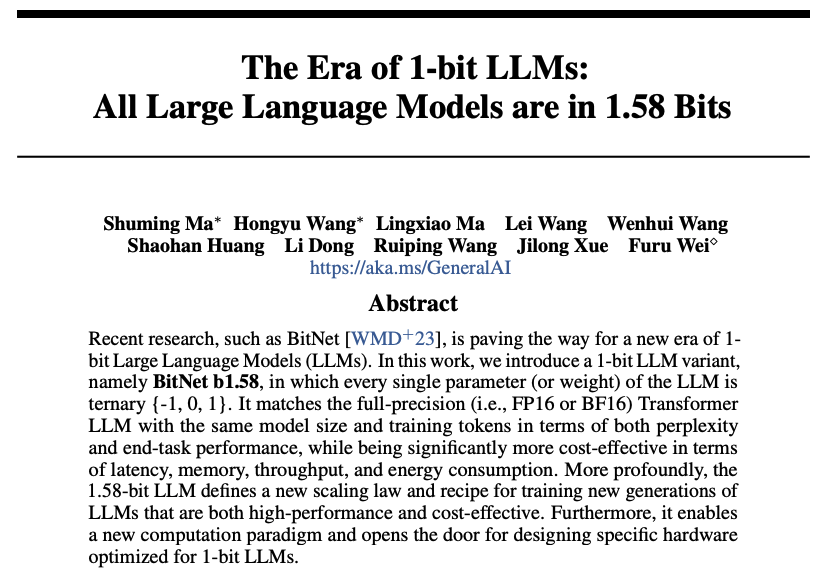
Microsoft presents The Era of 1-bit LLMs
All Large Language Models are in 1.58 Bits
Recent research, such as BitNet, is paving the way for a new era of 1-bit Large Language Models (LLMs). In this work, we introduce a 1-bit LLM variant, namely BitNet b1.58, in which every single parameter (or weight) of the LLM is ternary {-1, 0, 1}. It matches the full-precision (i.e., FP16 or BF16) Transformer LLM with the same model size and training tokens in terms of both perplexity and end-task performance, while being significantly more cost-effective in terms of latency, memory, throughput, and energy consumption. More profoundly, the 1.58-bit LLM defines a new scaling law and recipe for training new generations of LLMs that are both high-performance and cost-effective. Furthermore, it enables a new computation paradigm and opens the door for designing specific hardware optimized for 1-bit LLMs.
@SadlyItsBradley Event based cameras are one of those things where there are too many upsides for them not to eventually be mainstream, but are also likely to take a while for them to see mass production and adoption. Eye tracking though does seem like the right foot in the door.
Get an HDRi environment from a single image! Text to image models have such a deep understanding of the world, and I love seeing all of the ways we can pull out and distill that knowledge.
Introducing DiffusionLight---a simple yet effective technique to estimate lighting from any in-the-wild input image. How? ... by inpainting a chrome ball into the image with diffusion models! (1/3)
paper: https://t.co/lYE9D41Ouu
https://t.co/q5HfVi3mDM
https://t.co/mxkBggewq9
It's WILD that each NeRFs or 3DGS has to re-learn how the world works. (this is what a wall looks like, this is what a chair looks like). Priors are huge! I'd love to see depth added as an additional prior here to see how far we can get with maybe just 2 pics.
This scene was scanned using only 3 pictures 🤯
In my opinion, this was the biggest flaw of NeRFs & 3D Gaussian splats: they are trained from scratch every time with no knowledge of the world. With ReconFusion, we now acquire it from diffusion models
More examples below ⬇️⬇️