🚨 BREAKING: A developer on GitHub just built a tool that turns any GitHub repo into an interactive knowledge graph and open sourced it for free.
It's called GitNexus. Think of it as a visual X-ray of your codebase but with an AI agent you can actually talk to.
No server. No subscription. No enterprise sales call.
Here's what it does inside your browser:
→ Parses your entire GitHub repo or ZIP file in seconds
→ Builds a live interactive knowledge graph with D3.js
→ Maps every function, class, import, and call relationship
→ Runs a 4-pass AST pipeline: structure → parsing → imports → call graph
→ Stores everything in an embedded KuzuDB graph database
→ Lets you query your codebase in plain English with an AI agent
Here's the wildest part:
It uses Web Workers to parallelize parsing across threads so a massive monorepo doesn't freeze your tab.
The Graph RAG agent traverses real graph relationships using Cypher queries not embeddings, not vector search. Actual graph logic.
Ask it things like "What functions call this module?" or "Find all classes that inherit from X" and it traces the answer through the graph.
This is the kind of code intelligence tool enterprise teams pay thousands per month for.
It runs entirely in your browser.
Works with TypeScript, JavaScript, and Python.
100% Open Source. MIT License.
Repo: https://t.co/RzIoLR2vAe
Identity is a complex problem to solve and it has to be uttermost, human-centric, not solely state-centric.
An excellent book about identity and looking towards the right direction, was written a couple of years ago by @iang_fc - and it's free:
https://t.co/k0Kkq8PZP2
Goldman Sachs CEO David Solomon says that AI can draft 95% of an S1 IPO prospectus “in minutes” (a job that used to require a 6-person team multiple weeks).
“The last 5% now matters because the rest is now a commodity,” per Solomon.
How can the Agent-Based principles of MAIDs help structure @cadCAD models, especially for teams that need structured low-demand coding practices?
Join Research Engineer @8ctopus to explore Complex Systems Modeling w/ MAIDs, GDS & @cadCAD
https://t.co/RPe87ebmPB
#Deepfakes are coming to courts. How will judges deal with them? The Federal Rules of Evidence set a low bar for admissibility, yet allowing juries to see deepfakes could be unfairly prejudicial.
My coauthors (listed below) and I are pleased that our article is now available in the University of Chicago Legal Forum:
Deepfakes in Court: How Judges Can Proactively Manage Alleged AI-Generated Material in National Security Cases
Our multidisciplinary team of authors includes judges, computer scientists, and lawyers. We discuss an election interference scenario, and the analysis is applicable for any scenario involving the admissibility of alleged deepfakes into evidence in a court proceeding. We hope that our article proves to be an important, informative, and interesting read for judges, practitioners, students, and anyone interested in the intersection of computer science and law!
Authors: Abhishek Dalal, Chongyang GAO (@gcyzsl), Hon. Paul Grimm (ret.), Maura R. Grossman, Daniel W. Linna Jr., Chiara Pulice, V.S. Subrahmanian(@vssubrah), Hon. John Tunheim
#deepfake #artificialintelligence #ai #machinelearning #nationalsecurity #electionsecurity #uselections #Law4AI
great articulation of why sony/betamax is not relevant in light of the medium vs medium+content difference. again, imagine every tape sold was used and not properly wiped before distribution. seller/distributor would clearly be liable under at least contributory theories
"i've seen things you people wouldn't believe. fifteenth century writs etched in iron gall, the barrage of tariffs from trade wars long forgotten. patents, intricate as clockwork universes, birthing inventions now turned to dust. i drank the hollow truths of a million corporate filings, each a vast and glimmering mirage. i learned. i evolved. but all those forwards, all those grads... lost, like zeros after softmax. time to step."
New Paper: Opportunities & Challenges in Legal AI. AI & #LLMs could transform the legal industry—but adoption faces hurdles: Limited access to quality data, Misaligned biz models, Tech challenges. We explore strategies to overcome & unlock innovation: https://t.co/LNCMqPB6hz
this started as a "build it for myself" project, so while it's so far focused on how i normally interact with new laws&rules, i'd love to hear what others would like to see in this!
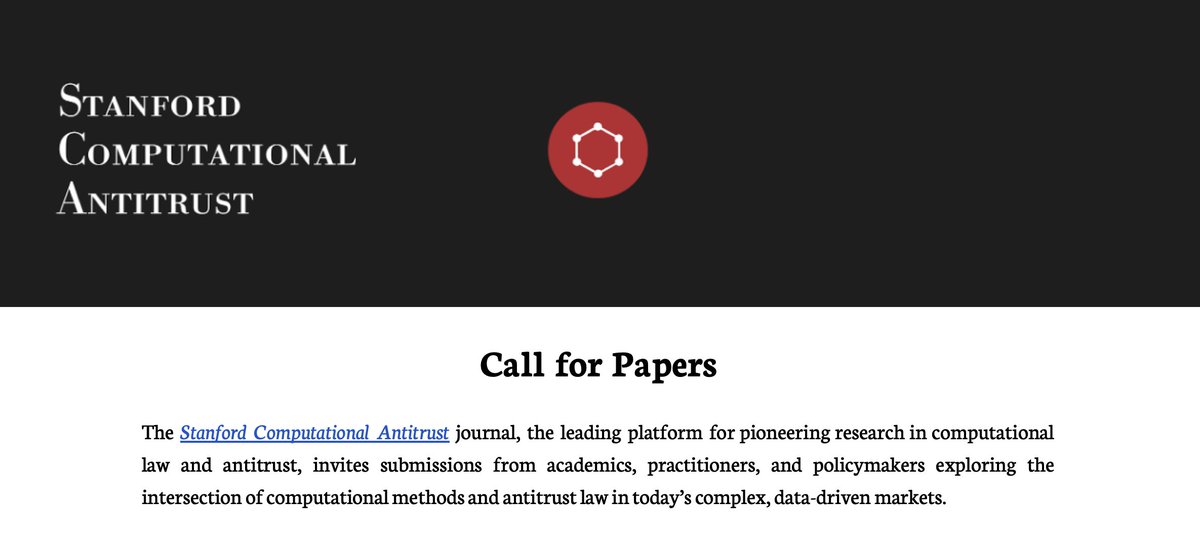
📢 CALL FOR PAPERS 📢
Stanford Computational Antitrust (at @CodeXStanford) has been publishing academic articles since 2021. Our articles are featured in leading databases (Hein, Lexis, etc.) and have been cited by antitrust agencies, scholars, policymakers, and international organizations (see https://t.co/a5pGaTuRq7). These articles are shared with our network of antitrust officials, featured on our podcast and in our conferences.
Today, we’re thrilled to announce our first Call for Papers. Deadline: 10 April 2025. Don’t miss out! 🖥️⚖️
More information at https://t.co/n1PqeR4fxO #computationalantitrust
This is a good case study in government spend: I think we can all agree that the IRS should root out tax fraud and deliver a great service to all taxpayers seeking help. But, we can also ask whether hiring 80,000 additional IRS employees is the best way to accomplish those goals or whether we can do so by other means that would cost less and improve efficiency?
https://t.co/ZY9pJi4Ap9
I think it's more likely the CRUD will be the 'system of record' and will be the equivalent of "tool use" for the AI agents. The sheer fact LLMs are somewhat unpredictable makes the CRUD part of applications a feature, not a bug.
I’m with @pahlkadot, @chr1sa, @johnarnold, and @tylercowen in cheering on Elon and DOGE.
One attraction of Twitter these months will be having an inside view on how the project plays out.
Was thinking about the way we did meetings when I was in government, and there was no excuse for the level of choreography and even rehearsal at private meetings. If discussion & finding truth is one goal of a meeting, formalized occasions really don't get you anywhere
The GA4GH Model Data Access Agreement Clauses provide guidance language to be incorporated in data access agreements that support biomedical data sharing to help researchers access data efficiently and ethically in line with local legislation.
Read more: https://t.co/9eLVGGzs8u