The starter home that previous generations experienced has gone extinct, and almost no one is building what entry level buyers can actually afford in communities they want to live in.
In the early 1970s, the median new home was ~1,500 square feet with 3 beds, 1.5 baths, a single car garage, and basic finishes.
Today, buyers expect 2,400 square feet, granite/quartz countertops, a 2 car garage, and multiple en-suite baths.
Even when a builder wants to deliver an entry level house to sell at $240k, the cost stack makes it nearly impossible to produce profitability in most markets:
1. Land and site development (finished lot costs): consume a massive share of the budget before vertical construction begins.
2. Impact fees and municipality regulations / zoning requirements: local fees, minimum lot sizes, and mandated exterior standards drive up baseline expenses.
3. Labor shortages and wage costs: subcontractor wage rates remain elevated across trades.
4. Materials and supply chain / tariffs: price inflation across framing, finishes, and equipment creates a high cost floor.
5. Financing and carrying costs: compound every week a project sits in inspection queues.
6. Insurance and entitlement friction; premiums and municipal delays add overhead to project budgets.
When total development costs on these starter homes produce slim margins, builders pivot toward luxury spec or custom builds to capture margin.
Yet millions of Americans still need the exact starter homes we talked about. And truth be told, there is still opportunity there, it's just much harder to figure out.
The major upside belongs to builders who figure out how to crack the attainable housing code:
- smaller footprints, efficient layouts
- nimble, infill parcels
- streamlined capital stacks
The demand for entry level housing is massive and solving the unit economics on attainable builds creates an enduring business! It's just very, very hard to nail!
As requested:
Underwriting 101 for non-finance folks
If you know how to design or build a building, but don’t how to judge whether a project is a good financial investment or a waste of time, read on!
1.The Proforma
2.Underwriting
a. Market Study
b. Yield Study
c. Profitability Metrics
d. Sources and Uses
3.Fundraising
a. Debt – Local/regional banks vs private lenders
b. Equity - Self Funding vs taking on investors
Section 1 – The Proforma
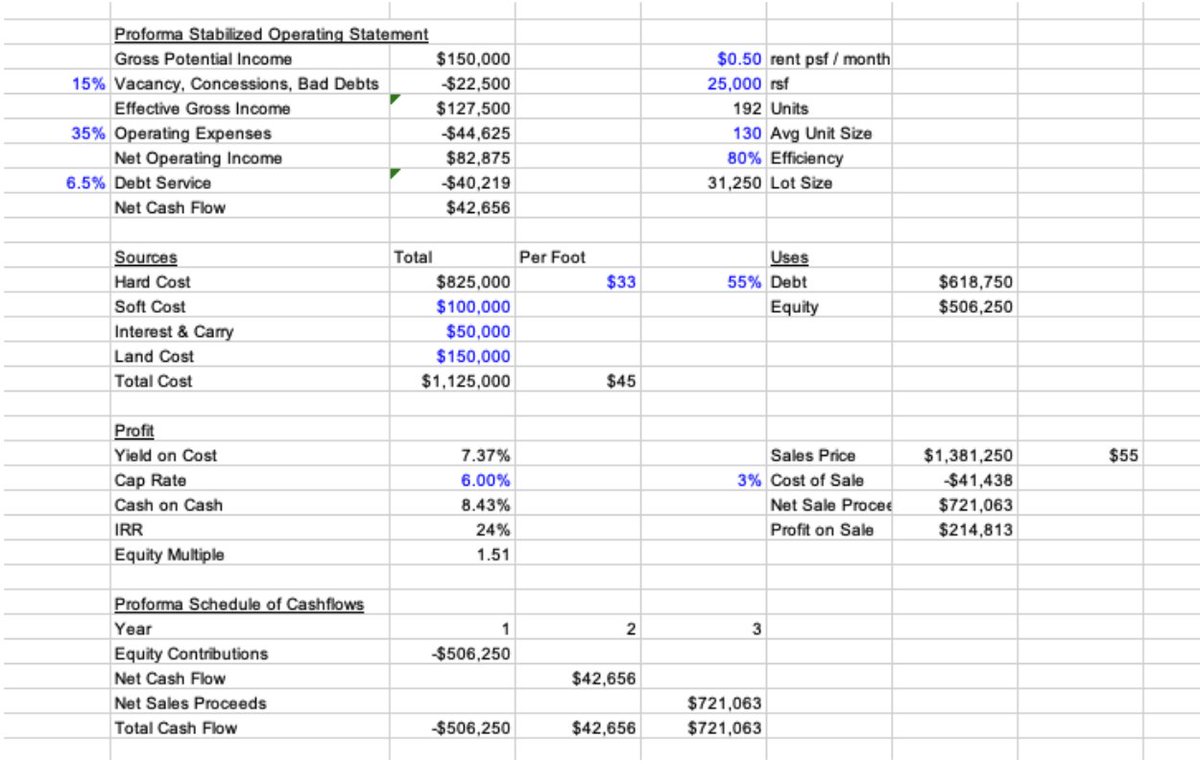
Below is a simplified proforma for a small development project. Don’t let the numbers scare you – we will break it down section by section, using simple examples.
To start, let’s pause and understand the mechanism for value creation in real estate development:
Yield on Cost - Cap Rate = the Development Spread
(Net Operating Income aka NOI / Cap Rate) - (NOI / Yield on Cost) = Value Created
Here’s a simplified example showing the development spread in action–
https://t.co/KMNomxsDk0 build a $600k project all cash, lease it up, and clear $60k per year (10% yield)
https://t.co/oLXWtFaEH9 find a buyer who is willing to pay $1mm for a leased building that clears $60k per year (6% cap)
3.Congratulations, you created $400k of value.
(60k NOI / 6% cap rate) - (60k NOI / 10% Yield on Cost) = 1,000,000 - 600,000 = $400,000
For those who haven’t seen these terms before, they are defined below:
Stabilized Net Operating Income is the annual net income received from your rentals after deducting vacancy costs and operating expenses.
Stabilized Net Operating Income = Rent at full
occupancy (aka Gross Potential) – Stabilized Vacancy - Expenses
Yield on Cost measures the investment yield of the asset to the developer, or how much annual profit the stabilized project will generate relative to its Total Cost.
Yield on Cost = Stabilized Net Operating Income /
Total Project Cost
Cap Rate measures the investment yield of the asset for the end buyer, or how much annual profit the buyer is receiving relative to their Purchase Price.
Cap Rate = Net Operating Income /
Purchase Price
Was this worth the headache? That ultimately depends on what you and your investors are looking for. But here are a few metrics we use to determine that:
Section 2 - Underwriting
Underwriting is the process of running the numbers to gauge the profitability of a potential investment and see if it's worth the brain damage and the risk
Your goal in underwriting is to identify all of the assumptions necessary to make a profitable project that is worth the brain damage and risk it takes to do it.
The first step in underwriting a development project is to calculate the yield on cost and compare it to the cap rate.
Calculating Yield on Cost
The first step for calculating the yield is defining your rent and occupancy assumptions by commissioning a market study. This report should define the boundaries of your market and assess the rents and occupancy within it. If the market study shows there’s a ton of vacancy, then you may want to skip that project.
Once you’ve confirmed the rents and determined you have a reasonable chance at leasing up, the next step is to define how much square footage you can build by commissioning a massing study. This study should determine how much rentable square footage (rsf) you can squeeze out of the site. Generally speaking for infill markets - the more density you can build, the more your property will be worth.
Next, get out in the market and talk to people. The fun part about real estate is that it’s a people business – you have to talk to people to learn the market. Here are some things you’ll need to find out to complete your underwriting:
1.Vacancy and expense assumptions for your asset
type in your market.
https://t.co/8EX7dUaIt5 cost to build (including fees).
3.Cap rates for similar projects
With this info in hand, you can finish your underwriting. Multiply rent by total rsf to get gross potential rent, then subtract vacancy and op ex to calculate NOI (Net Operating Income).
Divide NOI by Cap Rate to get your projected sales price, and compare to your all in cost. This is your total projected profit. Is it worth your time? That depends – to learn how to answer this question, please read on below.
Determining if a project is worth pursuing
To determine if a project pencils, you need to consider the following things
1.Who will the investors be (if any) and how long are
they comfortable holding the asset for?
https://t.co/Tp7kBcvz9X long is the holding period?
3.What are the returns?
4.What is the risk?
Defining your Hold Period
Your business plan can vary dramatically depending on you and your investors goals. Here are the two primary plans:
1.Long term hold – Hold the property for cashflow,
enjoy the tax benefits, and ride out long term rent
growth. This is best for HNW folks who don’t need
their equity back anytime soon. This maximizes
total proceeds.
2.Merchant build – Sell the property as soon as it’s
leased up (or sooner). You will be selling for a lower
price / ft than if you hold it a long time, but you will
get your money sooner.
Calculating the returns
Once you know your goals, here are 3 metrics you can use to gauge the profitability of your project.
1. Cash on Cash: Net Cashflow / Total Investment.
This is your actual cash yield from the asset. You can
compare this to owning a bond – it’s the actual %
return you are earning on your money while it’s tied
up in the asset. Depending on your situation, you
may be able to include tax benefits in the numerator,
further driving cash on cash for your investment.
2. IRR: total cashflows annualized over the hold
period. The shorter your hold, the higher your IRR.
Shortening hold period drives IRR more than
increasing sales proceeds does. Most Real Estate
Private Equity Firms derive their compensation from
how well they perform on this metric.
Most investors want to see 16%+ IRR for
development projects, but some huge developers
find investors willing to accept as low as 12% for
trophy assets.
3. Equity Multiple: Total Distributions (net cashflow
+ proceeds from sale) / Total Investment. Generally
speaking, the longer you hold the larger your
multiple will be. Fully leased and seasoned
properties generally command a higher price per
square foot than newly delivered product because
they have less lease up risk. Rents also tend to go up
over the hold period, and each $1 of net rent can add
$10 or more in sales value. (Remember, NOI / Cap
Rate = Sales Price)
Most investors want a 1.4 minimum multiple, or else
it’s just not worth the brain damage and the risk.
You can compare this figure to 10 year treasuries.
Most investors want to earn a spread over
the treasury (T+ 1% at least) to make development
worth the risk.
For long term holds, you are focused on maximizing
cash on cash return and total multiple.
For merchant builds, you are focused on IRR subject
to a minimum multiple.
Risk analysis
Here are some questions I like to ask in order to determine if the returns are worth the risk
https://t.co/2uYLbhq5Pu much is my total investment?
https://t.co/Tp7kBcvz9X conservative are my underwriting assumptions?
https://t.co/5nfvA2ne7i long will the project take to reach profitability?
https://t.co/hk3bTyf7dZ a worst case scenario, how bad can the deal get?
Be careful when you are underwriting high IRR projects with big budgets and short holds. The total multiple might be low, meaning there’s a risk of asset value being lower than your total cost to build should the market turn on you.
Section 3 – Fundraising
Once you’ve underwritten a project that appears to meet your team’s goals, the next step is putting together the Sources and Uses. This table summarizes the total project budget as well as the total sources of capital for funding the budget.
Sources, AKA total budget:
You can put a bracket on these figures by asking for data points from architects, loan brokers, and GCs.
Uses, AKA capital stack used to fund the total budget:
Generally, development projects are funded using a combination of both debt and equity. A loan broker can provide data points on how much you will be able to borrow to fund your deal.
Sources of Debt
1. Local bank / Credit Union – lowest rates but will
require you to personally guarantee repayment of
the loan (aka recourse).
This is typically the best execution available for
loans of under $5 million, but they aren’t always
open to funding construction costs.
2. Private lenders – high rates and high fees. This is
sometimes the only group willing to make small
construction loans.
Sources of Equity - the example attached proforma assumes you are self-funding. Many sponsors raise Other Peoples Money (OPM) through syndications or joint ventures (JV), which greatly reduces the sponsor’s total capital investment. Structures using OPM could be the topic of their own post, but I will provide a simple comparison of OPM vs self funding below
1. OPM: spread the risk, spread the reward. This
requires complicated legal documents and a higher
admin/accounting workload than if you fund the
deal yourself.
2. Self-Funding: all your money, all your risk, all your
reward. Simplest execution, least amount of legal
and admin headache.
If you liked what you read I’d appreciate if you gave me a follow, retweet, or signed up for my newsletter
Follow me @DeveloperDude_ for frequent content on development, deal structures, and running an SMB
Sign up for my newsletter for longer pieces like this: https://t.co/EAkAaASEYM
Hope that helped you better understand how to analyze real estate investments. Thank you for reading to the end!
@MasterStudent9
@beingjameson
@AmandaBuildsUp@SMBfella@k_thos
@scarrolsean
@sjwpeaceful
My dad and I played catch every day as a kid. He’s 70-years-old now and we haven’t played catch in years. But today, we took out the old gloves and something amazing happened. I became that kid again. And he was the young dad I remember. Just playing catch for no reason at all.
I just came upon a wild ass lawsuit. HACLA (LA housing) apparently paid $10 million to buy the Rosslyn Lofts SRO on Main St out of foreclosure. But HACLA purchased the wrong APN - the wrong property. 👀 They bought the worthless ground lot but not the actual building?⤵️
The older I get, the more I realize that anxiety comes from trying to live in two places at once. Replaying yesterday. Rehearsing tomorrow. All while trying to live right now. It's exhausting. Come back to the present. Handle the two feet right in front of you. You don't need to fix your whole life today. You need to take the next right step. Then another. That's the recipe.
U.S. apartment loan originations are up 26% YoY and on track to make 2026 the second-biggest year EVER.
Not because of increased sales activity. But because of a burst of refinance/recap activity from apartment owners with maturing loans, trying to wait out better days (and better values) to sell.
The surge in refinancing has helped stabilize values, but compressed sales volumes as many would-be sellers refinance instead.
This isn't to say refinancing is cheap or easy or painless. But debt capital is widely available, and it's as much of a lifeline to current owners as it is a hindrance to would-be buying hunting for quality assets at distressed prices.
h/t to Newmark for chart below.
Really interesting TIC project in Atwater Village.
Developer bought an old beat up triplex for $1.01M in 2024 with three 1BR/1BA units. One was vacant and the other two were rented for $1,910 and $2,060.
Looks like they bought out the two tenants, gut renovated all 3 units and built an ADU to create a 4th.
They sold all 4 individually as TICs:
561 SF 1BR/1BA — $515K
561 SF 1BR/1BA — $560K
690 SF 1BR/1BA — $657K
862 SF 2BR/2BA — $750K
$2.482M total sellout at a weighted average of about $928/SF.
And 3 of the 4 are 1BR/1BA units with no parking 🤯
Assuming $600K–$700K in hard, soft and tenant buyout costs, that’s roughly $770K–$870K of spread before carry, financing and sales costs.
Pretty creative business plan. Buy tired small multifamily in a good neighborhood, add ADU, renovate everything and sell off relatively affordable starter homes.
Young buyers are obviously hungry for well-designed units in walkable, trendy neighborhoods. These sales are a pretty good example of that.
We tell young people in our society that end of the rainbow is retirement at 65.
We ought to tell them that "there is going to be this short but beautiful golden window from roughly age 3 to roughly age 12 where your kids are not only easy (comparatively to bottles & diapers), but are going to be these beautiful little creatures and it will pain your heart to be away from them for too long. So, prepare in your 20's, financially and career wise, to build that flexibility into that chapter of your life".
You don't get another shot at living the "golden window". And, for me, leaning hard into that golden window has made everything else in my life feel fairly insignificant in comparison. I have made plenty of mistakes as a father, but what I won't have is the regret of having been distracted and absent from these formative years. In some cases, that has required financial sacrifices (declining a particular career opportunity that would have required relocation), but I personally have zero regrets.
I also hear from some ambitious & successful people with a 4 year old that say "I've lost my ambition, I am so immersed in fatherhood". At least for me, and a number of my friends, it comes back. You can't keep an ambitious person down and if you have the fire, hanging at a playground on too many Tuesday afternoons is going to feel like torture after too long.
My three boys are approaching 13, 11 & 9, and it's much different than 7, 5 & 3. This summer, for example, they slept until 11am and I hard an unencumbered 6am-12pm to work (being on PT helps), then got another great window 7-11pm, but was able to be present in the heart of the day, then weeks when they were at basketball camp, etc. It gets easier, your time frees up again (there's a sadness to that too), but I'm back to working as intensely as I did pre-kids just because my day to day presence requires fewer hours than it did before (also, my wife is just superbly wonderful). And that is the beautiful gift of entrepreneurship (or at least my sort of business), the ability to deliver still a high level of output but work that around your life rather than the opposite.
TLDR, grind before, and grind after. Prepare for the golden window.
I’m in love with this sentence:
“Every pattern in your life repeats until you learn the lesson. The moment you choose differently, the loop ends and growth begins.”
Ro, I like you. You know that. But you need to read the state of the state.
The number of Deca Unicorns in Cali is growing by the day as investors chase amazing startups.
A unique feature of these 10b startups is that even if they raise a billion, little, if any of that money goes to the founders, who are now worth billions of dollars over night. They are the definition of cash poor, stock rich
How are you going to tax them ? Make them borrow money against their shares, if they can? They just raised money to grow their company and a bank will come along and loan them money ? A company that has been in business maybe less than a year ? lol
Will you take their stock if they can’t ?
Do you really think each of multiple founders, who started an amazing company in Cali and is now a billionaire, can each just pull out $250m per billion of net worth from their raise ? You know they can’t.
If this passes , and it doesn’t directly impact me at all, I won’t be a cali resident, but you can bet if I’m investing in a multi billion dollar startup, I’m asking them to move from California first.
IMO, if this passes, only idiot startup founders stay in Cali.
I’ve done it before and will do it again. Dallas. Pittsburgh. Indiana. I will make NOT being in California a pre requisite for an investment
Ideology is not a strategy Ro.
Here’s some advice for you young guys trying to make sense of money, career, and happiness.
I was 25 in 2008. There was little opportunity, people freaked. And yet, I emerged.
I empathize w/the younger gen. I know it’s scary.
Start here:
1) Get your mind right. Do not allow doom and fear to control you. It incapacitates and weakens you.
2) Understand that businesses are always hunting for positive people and hard workers. Focus on being great.
3) The ability to communicate and build relationships will lead to more opportunities than anything else, including a college degree.
4) How to improve communications? Read books. How to Win Friends and Influence People is a nice place to start.
5) Make it known to everyone in your life what you want and what you are trying to do. Ask for referrals and intros.
6) Not sure where do start? Get into sales. Or at least get adjacent to sales so you can position yourself for a sales job. Sell cell phones, cars, chemicals…anything.
7) Dress nicer than you think you should to job interviews and work. It does send a message.
8) Shaking hands firmly and making eye contact and smiling is wildly underrated.
9) Consumerism is for suckers, especially when you’re broke. You do not need to buy expensive stuff for any reason. Conserve your cash, keep expenses low.
10) Stop thinking about what you want, and start thinking about what you can offer to a potential employer (or biz partner). Comp will take care of itself when you perform.
11) Hard work, taking ownership, loyalty, results, receiving criticism well, and time will lead you upwards every single time.
12) Following your passion is terrible advice that has led millions of young people to functional bankruptcy because of college debt. Get your financial footing first unless you are a unicorn in your passion. Be honest with yourself.
13) Get roommates for as long as you need - or live at home if your parents will have you - to keep costs down. Again, conserve cash.
14) Cut people out of your life that have a victim mentality or lead you to make bad decisions, and do so aggressively. Align with people that have a core value fit for growth and goodness.
15) Do not try to get rich quick. This includes stock trading, crypto nerdery, and gambling - you will lose your money and be worse off.
16) Go back to church.
17) Don’t watch porn, it rots you from the inside out.
18) Don’t know what you want? Be curious. Schedule meetings, take notes, and get referrals. Go seek. Life isn’t required to come to you.
19) Be willing to change if something no longer suits you - a career, a relationship. Beware of the sunk cost fallacy.
20) Do not break the law or screw with the IRS. Jail is to be avoided.
First 20 things that came to mind. It’s not an exhaustive list, but if just one point helps you, it was worth writing.
A reminder from Atomic Habits by James Clear:
“It doesn't make sense to continue wanting something if you're not willing to do what it takes to get it. If you don't want to live the lifestyle, then release yourself from the desire. To crave the result but not the process is to guarantee disappointment.”
It’s 2043
the boomers have all sold their plumbing businesses to Harvard MBAs
It costs $15k to unclog your toilet
you call your dad but his “guy” isn’t around anymore
Home Depot doesn’t sell drain snakes to the public
seeing red but you click “pay over time” on the service tech’s iPad anyway
add it to your growing stack of consumer loans (govt backed 40 year financing on home repairs made possible by Trump in his 6th term)
you still don’t own a home
This particular ULA cause and effect was well known prior to this past June when transfer tax reform went down in flames. Many of us sounded the alarm.
The transfer tax money generated by ULA is mostly offset by the money lost by property tax revenue decline.
The empirically proven decline in property sales in LA has and continues to have the effect of preventing property tax assessment resets that grow the property tax base, which erodes annual property tax revenues.
Well run cities like SF have reduced transfer taxes. LA, being the dumbest city in California, left ULA unchanged.
Kobe Bryant once said:
“Everyone wants to be a beast. Everyone wants to be the best. But very few people are willing to do what it actually takes. Because what it takes is boring. It is waking up at 4:00 AM. It is shooting the same shot a thousand times. It is watching the film when you are tired. People fall in love with the result, but they hate the process. You have to fall in love with the boredom. You have to fall in love with the repetition.
If you can find joy in the mundane work that no one else sees, the lights will eventually shine on you.”