Firms exist to minimize coordination costs (Coase).
AI collapses those costs.
The result is shifting firm boundaries: some work moves in, some moves out, some disappears.
Externalizing Intelligencization to AI-native services lets orgs redesign those boundaries safely and fast.
Today, we’re announcing Kosmos, our newest AI Scientist, available to use now.
Users estimate Kosmos does 6 months of work in a single day. One run can read 1,500 papers and write 42,000 lines of code. At least 79% of its findings are reproducible. Kosmos has made 7 discoveries so far, which we are releasing today, in areas ranging from neuroscience to material science and clinical genetics, in collaboration with our academic beta testers. Three of these discoveries reproduced unpublished findings; four are net new, validated contributions to the scientific literature. AI-accelerated science is here.
Our core innovation in Kosmos is the use of a structured, continuously-updated world model. As described in our technical report, Kosmos’ world model allows it to process orders of magnitude more information than could fit into the context of even the longest-context language models, allowing it to synthesize more information and pursue coherent goals over longer time horizons than Robin or any of our other prior agents. In this respect, we believe Kosmos is the most compute-intensive language agent released so far in any field, and by far the most capable AI Scientist available today. The use of a persistent world model also enables single Kosmos trajectories to produce highly complex outputs that require multiple significant logical leaps. As with all of our systems, Kosmos is designed with transparency and verifiability in mind: every conclusion in a Kosmos report can be traced through our platform to the specific lines of code or the specific passages in the scientific literature that inspired it, ensuring that Kosmos’ findings are fully auditable at all times.
We are also using this opportunity to announce the launch of Edison Scientific, a new commercial spinout of FutureHouse, which will be focused on commercializing our agents and applying them to automate scientific research in drug discovery and beyond. Edison will be taking over management of the FutureHouse platform, where you can access Kosmos alongside our Literature, Molecules, and Precedent agents (previously Crow, Phoenix, and Owl). Edison will continue to offer free tier usage for casual users and academics, while also offering higher rate limits and additional features for users who need them. You can read more about this spinout on our blog, below.
A few important notes if you’re going to try Kosmos. Firstly, Kosmos is different from many other AI tools you might have played with, including our other agents. It is more similar to a Deep Research tool than it is to a chatbot: it takes some time to figure out how to prompt it effectively, and we have tried to include guidelines on this to help (see below). It costs $200/run right now (200 credits per run, and $1/credit), with some free tier usage for academics. This is heavily discounted; people who sign up for Founding Subscriptions now can lock in the $1/credit price indefinitely, but the price ultimately will probably be higher. Again, this is less chatbot and more research tool, something you run on high-value targets as needed.
Some caveats are also warranted. Firstly, we find that 80% of Kosmos findings are reproducible, which also means 20% are not -- some things it says will be wrong. Also, Kosmos certainly does produce outputs that are the equivalent to several months of human labor, but it also often goes down rabbit holes or chases statistically significant yet scientifically irrelevant findings. We often run Kosmos multiple times on the same objective in order to sample the various research avenues it can take. There are still a bunch of rough edges on the UI and such, which we are working on. Finally, we are aware that the 6 month figure is much greater than estimates by other AI labs, like METR, about the length of tasks that AI Agents can currently perform. You can read discussion about this in our blog post.
Huge congratulations to our team that put this together, led by @ludomitch and @michaelathinks: Angela Yiu, @benjamin0chang, @sidn137, Edwin Melville-Green, Albert Bou, @arvissulovari, Oz Wassie, @jonmlaurent. A particular shout out to @m_skarlinski and his team that rebuilt the platform for this launch, especially Andy Cai @notAndyCai, Richard Magness, Remo Storni, Tyler Nadolski @_tnadolski, Mayk Caldas @maykcaldas, Sam Cox @samcox822 and more.
This work would not have been possible without significant contributions from academic collaborators @mathieubourdenx, @EricLandsness, @bdanubius, @physicistnevans, Tonio Buonassisi, @BGomes_1905, Shriya Reddy, @marthafoiani, and @RandallBateman3.
We also want to thank our numerous supporters, especially @ericschmidt, who has been a tremendous ally. We will have more to say about our supporters soon!
@ttunguz I think, instead of a pyramid or rocket ship, the org resembles a control center, there will be one core strategy team in the org, then multiple outsourced AI agent vendors plugged into workflows.
In the SaaS/early tech era, the creators of foundational technologies had deterministic control and domain-specific advantage—leading to enterprise dominance. In the AI agentic era, advantage shifts away from model creators toward those who can best orchestrate and leverage them.
In the Internet Era, leads are cheap — but decisions are still human.
Calling survives in low-trust markets like India, not to deliver value, but to translate, negotiate, and personalize it where judgment matters most.
Agency > Intelligence
I had this intuitively wrong for decades, I think due to a pervasive cultural veneration of intelligence, various entertainment/media, obsession with IQ etc. Agency is significantly more powerful and significantly more scarce. Are you hiring for agency? Are we educating for agency? Are you acting as if you had 10X agency?
Grok explanation is ~close:
“Agency, as a personality trait, refers to an individual's capacity to take initiative, make decisions, and exert control over their actions and environment. It’s about being proactive rather than reactive—someone with high agency doesn’t just let life happen to them; they shape it. Think of it as a blend of self-efficacy, determination, and a sense of ownership over one’s path.
People with strong agency tend to set goals and pursue them with confidence, even in the face of obstacles. They’re the type to say, “I’ll figure it out,” and then actually do it. On the flip side, someone low in agency might feel more like a passenger in their own life, waiting for external forces—like luck, other people, or circumstances—to dictate what happens next.
It’s not quite the same as assertiveness or ambition, though it can overlap. Agency is quieter, more internal—it’s the belief that you *can* act, paired with the will to follow through. Psychologists often tie it to concepts like locus of control: high-agency folks lean toward an internal locus, feeling they steer their fate, while low-agency folks might lean external, seeing life as something that happens *to* them.”
Manager will fix in 15 min
2pm: no resolution, started hunting hotel
5pm area manager called conference with hotel owner promised ac room in 30 min
6pm AC room given with broken toilet, dirty bed sheets
Zero resolution, no right KPIs, no tracking of customer issues.
@riteshagar
12:45 complaint raised again to @oyorooms , they mentioned 30 minutes to fix issue.
1:15 no resolution, hotel said you raised complain to Oyo, so I won't give you service
1:30 again complaint raised, asking refund, Oyo said, now it's more than 1hour so can't refund, our area man
Technology stack choice is often made not based on the stack familiarity or stack's capabilities, rather on unfamiliarity of other stacks.
#technology#Engineering#tools#ai
@AnupamMittal@CCI_India@indSupremeCourt For India to compete with Google Apple with its indigenous app store is not the solution. Bharat needs to lead in an innovative way to globally displace the app model all together.
Maybe an app-less future is something start-ups in India should advocate for and build.
@amnigos Tough though, again general mindset - I need customization, I want to own, Software is intangible so I want individuals to be touch points, not faceless software corporations.
Any thoughts?
@amnigos IT is a cost center, not a strategic investment - this is the general perception towards IT budget allocation in India.
I think in India software companies should focus on first getting a sizeable pie from the IT services market.
@balajis Approval ratings are just an indication, however, what's most rapidly changing in Bharat is the mindset.
Mindset is neither build in India for the world, nor it's build for India.
It's now The world is one and it needs to be built together.
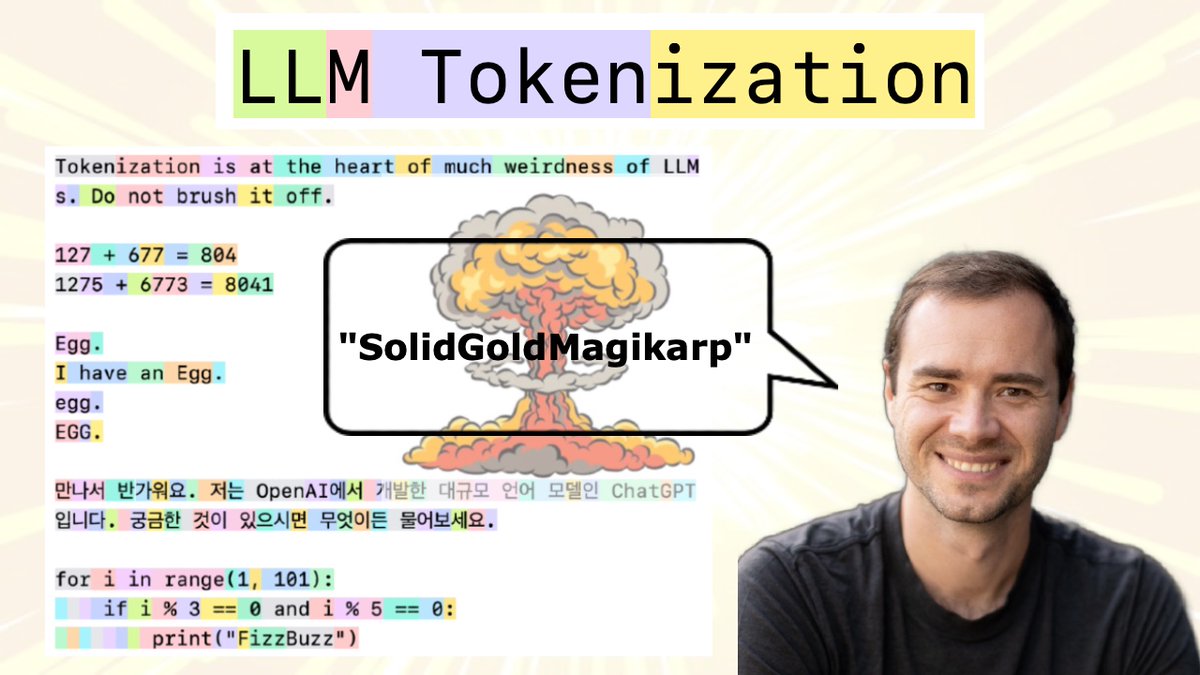
New (2h13m 😅) lecture: "Let's build the GPT Tokenizer"
Tokenizers are a completely separate stage of the LLM pipeline: they have their own training set, training algorithm (Byte Pair Encoding), and after training implement two functions: encode() from strings to tokens, and decode() back from tokens to strings. In this lecture we build from scratch the Tokenizer used in the GPT series from OpenAI.