Unironically, it is so good that biology is cool now. Everyone should be rooting for AI to cure all disease. Stop speculating about whether it will or will not happen and ask yourself what you personally can do to make it happen. Then do it
Brad I do! Biotech + AI will be powerful to speed candidates forward, increase enrollment speed in RCTs and, maybe the boring but vital part, fix the last mile problems in healthcare. That last part seems most tractable, consumers detest waiting in offices, want to have reliable access to digital advice and diagnostics and health care financing is a consumer crisis. These problems most closely resemble the breakthroughs and productivity gains tech has brought in customer service and fintech - and need more hype not less IMO.
Until the AIs are generating insights indistinguishable from those of Caleb and his students, we have a very, very long way to go. Way to go, banger as always
Our bodies are colonized by trillions of viruses that we live with in homeostasis. The most diverse and abundant of these viral families are anelloviruses. A new paper from us at @MSKCancerCenter explores what happens after we *all* have been infected
https://t.co/cNOsPCbazd 1/n
Can we help discover new, unknown small molecules using modern generative AI and scientific agents?
Excited to share our work, led by superstar @zyxiong123, on ChefNMR2🧑🍳⚛️, a new approach for structure elucidation from NMR spectra!
Paper: https://t.co/OepVzmW2g5
🧵 1/
Amazing milestone before 1 year for @EdisonSci. Nov 2025, we launched a platform for individual scientists.
- 2.5 months later, we on-boarded first enterprise
- 7 months from launch, first public pharma deal with Incyte
- 8 months, went live with first internal deployment
- 11 months, first public top-10 pharma deal
I know in tech, this feels achievable. In pharma, this is an insane trajectory. What a ride so far!
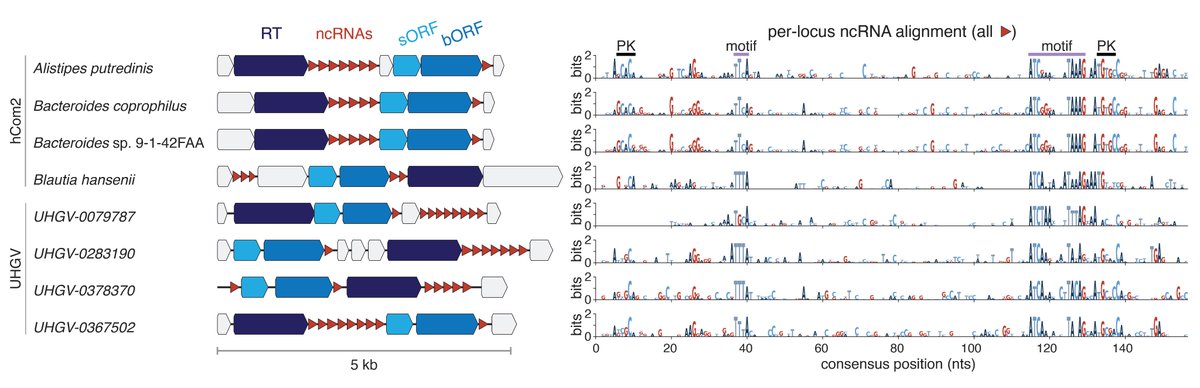
Excited to share Minerva, our approach using genome language models for biological discovery! Using Minerva, we find that UG27 reverse transcriptase systems encode variable arrays of diverse ncRNAs with a shared structure, each templating a short DNA hairpin. With @garykbrixi.
Today, Pioneer Labs is announcing our first step towards terraforming Mars. 🚀🌼
With equipment that fits in just a single rocket launch, we can convert Martian dirt, water, and air into enough building materials to construct a small city on Mars.
To do it, we made the first microbe for Mars. We found the best microbe on Earth and used evolution to teach it how to source all of its nutrients directly from Martian materials.
The first astronauts will be greeted with safe shelter already filled with water, oxygen, and rocket fuel for the return journey.
This is the first step toward using biology to make Mars a friendly place for life. It lets us live off the land and helps us build the next great frontier.
It's the first of five organisms we need to green Mars ⬇️
The community response to the Millennium Problems for Biology has been great. A few updates:
There is clearly a deep hunger for a more comprehensive list of big unsolved problems in biology and medicine that can serve as a beacon for the field, and we have seen some very good suggestions. Over the next few weeks, FutureHouse will run community-led process to assemble a longer list of grand challenges in biology and will publish this expanded set as additional to the original set, with attribution.
In addition, the Millennium Problem list and specifications also needs to be updated in response to a few issues that people have pointed out. That will happen in the coming days.
Finally, FutureHouse will convene a panel to adjudicate success, and will also announce cash prizes associated with the problems.
We will have more to share soon. Thank you to everyone who has participated in the conversation!
https://t.co/IzvK5HGCgt
When I read that an internal OpenAI model solved the Navier-Stokes problem, I realized it would be very hard for us to know if that model possesses similar "millennium intelligence" in biology (even if it does!). "Curing disease" is a noble goal, but we cannot validate proposed treatments rapidly enough to use it as a frontline eval for new models.
Here, @SGRodriques and I propose Millennium Problems for Biology - meaningful, difficult challenges in biology whose solutions should be straightforward and quick to validate in a wetlab. If a model were to solve any of these, I would know that machine intelligence was capable of fundamentally reshaping humanity's ability to make, measure, and model biology.
Please see details of the problems in the thread below, and see our website for the permanent home of the list. I encourage the community to red-team these challenges to make sure they are adequately specified and difficult to cheat, and propose additional challenges to add. We will subsequently update the list in response to feedback.
In light of the progress in mathematics, we at Edison Scientific and FutureHouse have assembled a set of Millennium Problems for Biology. They are chosen to be very hard to solve but very easy to validate in a simple laboratory environment. Any of these, if solved, would mark a major advance in biotechnology, and most of them would contribute materially towards curing disease. These are, in some sense, the “last reasonable eval” for AI in biology. This was work primarily by @MichaelaThinks and myself, with contributions from many others.
Short descriptions below. The full descriptions of the problems with acceptance criteria are at the Bio Millennium Problems website, linked in the next post. Share more if you have ideas. If they meet our criteria, we’ll add them to our list (with attribution and permission).