Numerous biotech innovations started with adapting a protein to its non-native context, which often requires substantial experimental optimizations. Here’s a breakdown by our lead, @Xiaowei0402, on a versatile, efficient computational framework to facilitate such adaptations.
Check out Swap-seq — our next-gen tech for tiled twin prime deletion mapping of distal regulatory elements
https://t.co/5kZpeCqRkt...
Please get in touch if you’d like to try it out!
Thread 👇
Have you ever looked at a gene in IGV or a genome browser and wondered “What are all those (ATAC-seq/H3K27ac/CTCF ChIP-seq/…) peaks doing?” 🤔 I’m thrilled to share that we developed a new technology called Swap-seq to answer that exact question.
https://t.co/GMC1MJTNzB
Excited to share some recent collaborative work between the Bintu and Ferrell labs investigating single-cell and population-level transcriptional response functions in minimal mammalian expression systems!
https://t.co/L3Mgl0Nn4J
@srikosuri@JoshTycko@anshulkundaje@abbythurm As you can see in Fig. 10, it can be quantitative with a good reporter. Here's the comparison with flow (y-axis) vs. pooled screen score (x-axis) for a small (1500) and medium (10,000) library. Each dot is a cell line we made for validation/calibration. 100,000 can be noisier :)
We used HT-recruit repeatedly to discover new protein domains involved in gene regulation and test many mutants. It can be used for domains associated with other functions (if you have a reporter). Now we published a detailed protocol on how to do it: https://t.co/0c6M9sT7op
So we beat on. Gene/cell therapies often use proteins that could be recognized/rejected as non-self by our immune system. We combine algorithms to build proteins that are therapeutically relevant and can masquerade as our own parts https://t.co/8UqRE8TewB
Incredibly excited that our paper linking single molecule states of TF binding to gene expression using quantitative thermodynamic models is out in Nature today. An amazing collaboration with the Bintu Lab. Congrats to Ben, Michaela, and Julia! https://t.co/4zjMOlOgVV
Lastly, I would also like to give a shout out to Nate Hathaway’s lab @UNCPharmacy for writing a beautiful preview article elegantly describing our work. Please check it out here! : https://t.co/bEVaAJysMb (4/4)
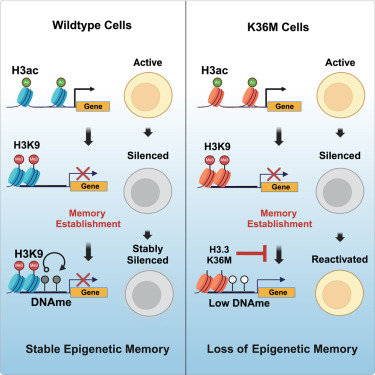
I'm thrilled to announce that my PhD thesis work from @BintuLab on how the H3.3K36M oncohistone disrupts the establishment of epigenetic memory is now out in the latest issue of @MolecularCell. https://t.co/O8t28MwM7q (1/4)
Join us in Heidelberg for this great conference! Submit an abstract, we will select 20 talks (you have to register in the system first: https://t.co/mgCt5Xw4ZK )
🧬How do transcriptional cofactors recognize which genes to regulate?🧬 Check out our new preprint from @fordycelab@BintuLab that tackles this question and provides the first-ever quantitative map of disordered transcriptional protein interactions (1/9) https://t.co/5UV8IafaHM
(1/16) Check out our @SimonMJGaudin paper https://t.co/ZcCmKI4CFh from the Canzio lab out in @ScienceMagazine today on how tuning local cohesin trajectories enables differential readout of the clustered Protocadherin (Pcdh) locus across different types of neurons.
Got out of the nucleus! Tested ~30,000 tiles from human RNA-binding proteins, found lots of domains that downregulate RNA&built an inducible synthetic RNA-binding protein for keeping target RNA at constant intermediate levels: https://t.co/g6d7XEZOlY So many follow-up projects!
Our first RNA-centric preprint is online! Congratulations to @abbythurm and the whole team - we're so excited to continue learning about effector domains in RBPs, and to hear your thoughts about what could come next!
Do human RNA-binding proteins have modular regulatory domains that downregulate RNA lifetimes? Our preprint @BintuLab studying this question is now out on bioRxiv, where we indeed identify small domains in RBPs that potently induce RNA degradation! https://t.co/nOsgx1a3gA (1/9)
A little late, but we're excited to share our preprint in collaboration with the Greenleaf lab that uses single-molecule footprinting at an engineered locus in mammalian cells to understand how TF occupancy dictates expression!
Our work using single-molecule chromatin configurations to link TF binding to gene expression is now out on bioRxiv! Amazing effort from @bgrdoughty, @MichaelaThinks, and @juliaschaepe, and an immensely rewarding collaboration with the @BintuLab: https://t.co/u9aNQV4Ub9 [1/n]
Finally, I would like to note that the NFZ TAD developed by @JoshTycko, @BintuLab , and Bassik lab (link below) works very well in the synZiFTR toolkit, AND it can be further boosted with our new enhancement. That's all for now -- please stay tuned! 4/n
https://t.co/2BwK5ttvbp