New preprint! We studied how single-cell 3D chromatin structure changes under targeted epigenetic perturbations using multiplexed DNA FISH and synthetic biology tools, and found an intriguing relationship between chromatin compaction and epigenetic memory. https://t.co/6UHi86c6E7
Incredibly excited that our paper linking single molecule states of TF binding to gene expression using quantitative thermodynamic models is out in Nature today. An amazing collaboration with the Bintu Lab. Congrats to Ben, Michaela, and Julia! https://t.co/4zjMOlOgVV
Our new paper on epigenome editing is out!
We mapped which effector domains regulate transcription across genomic, cell type and DNA-binding domain contexts. Then we built new gene repressor and activator tools with improved efficiency & deliverability
https://t.co/VqRLtNFey7
Lastly, I would also like to give a shout out to Nate Hathaway’s lab @UNCPharmacy for writing a beautiful preview article elegantly describing our work. Please check it out here! : https://t.co/bEVaAJysMb (4/4)
I'm thrilled to announce that my PhD thesis work from @BintuLab on how the H3.3K36M oncohistone disrupts the establishment of epigenetic memory is now out in the latest issue of @MolecularCell. https://t.co/O8t28MwM7q (1/4)
First preprint from the lab 🚨
How can enhancers regulate target promoters across vast genomic distances, and what is the role of cohesin loop extrusion in the process?
https://t.co/l7bwPsTSkd
(1)
I’m amped to share our new work to decrypt transcriptional repressors, now on bioRxiv: https://t.co/BeKDmg3rUy
We paired deep mutational scans with machine learning to predict and even tune repressor activity. (1/8)
Our paper is out! Congrats to Saori Takahashi, Hiro Kyogoku, Tomo Kitajima, and everyone involved! We discovered a 2-step transition in DNA replication regulation accompanied by transient genome instability in early mouse embryos.
https://t.co/45qOCNarlB
🧬How do transcriptional cofactors recognize which genes to regulate?🧬 Check out our new preprint from @fordycelab@BintuLab that tackles this question and provides the first-ever quantitative map of disordered transcriptional protein interactions (1/9) https://t.co/5UV8IafaHM
Do human RNA-binding proteins have modular regulatory domains that downregulate RNA lifetimes? Our preprint @BintuLab studying this question is now out on bioRxiv, where we indeed identify small domains in RBPs that potently induce RNA degradation! https://t.co/nOsgx1a3gA (1/9)
Apparently, you can subscribe to brain organoids and stimulate them through a Python API for $500/mo. What would you do with them?
https://t.co/N2xcRdAZ5J
A long sought after hypothesis has been that organizing biomolecules in and around nuclear bodies is essential for functional RNA processing. We now provide direct evidence of this in @Nature for nuclear speckles and mRNA splicing. Check out this thread!
https://t.co/DoXSB7SINt
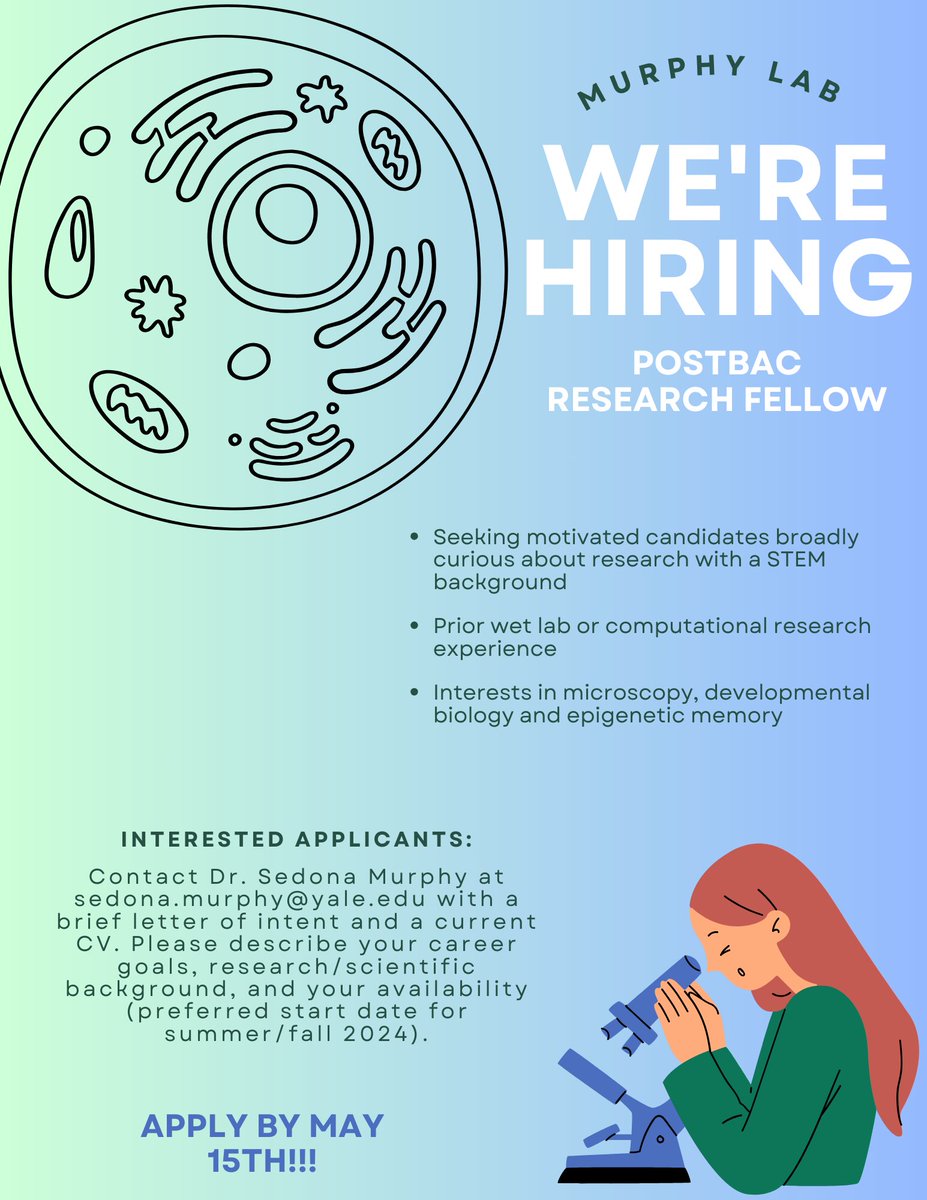
Seeking someone looking for a two-year postbac position to get my group up and running at Yale University! We will be utilizing chromatin tracing and other multiplexed imaging approaches to study the relationship between 3D genome organization and epigenetic memory in embryos!
Our first paper is out in @CellCellPress! Led by @born2raisecell, we present a programmable reaction-diffusion system that generates synthetic protein waves, oscillations, and patterns for spatiotemporal circuit design and FM data-encoding in human cells. https://t.co/lNRtRdJAxx
Just posted a preprint on our new spatial genomic recording system, baseMEMOIR.
https://t.co/ef5i8FnIOw
Motivation: Cells divide, differentiate, and migrate to form exquisitely organized tissues. Reconstructing the dynamic histories of individual cells, including their lineage relationships and ancestral states, is essential for understanding how intrinsic and extrinsic signals generate tissues during development and in regenerative medicine.
Engineered genomic recording systems can reconstruct cell lineage histories from endpoint measurements. However, existing methods either require sequencing (disrupting spatial organization) or have been limited in memory size and scalability.
To address this need, @ChadlyDuncan, Kirsten Frieda, and others in the lab created a high memory capacity image-readable recording system termed baseMEMOIR.
Our preprint on the development of PerturbView, an Optical Pooled Screening (OPS) technology, is out! Massive thanks to @eric_lubeck for driving the project with me, along with our fantastic mentors, Orit Rozenblatt-Rosen, @LeviAGarraway and Aviv Regev
https://t.co/MbijOGpwTX 1/
Thrilled to receive @SciLifeLabPrize in my category! Thanks again for the amazing support during my PhD @LongCai_Lab@Caltech. I am also super excited for the future of the spatial multi-omics field! https://t.co/tYDRUrCIUq