@IBassplayer@vixedsignals From the moment you decide to exchange your cash for equities, or sell TBills to buy Venezuela, or had enough from Bitcoin and switch back to utility stocks, you in effect trade volatility, either knowingly or not.
If there's one chart that frames the challenges to risk management right now, I think it's this one.
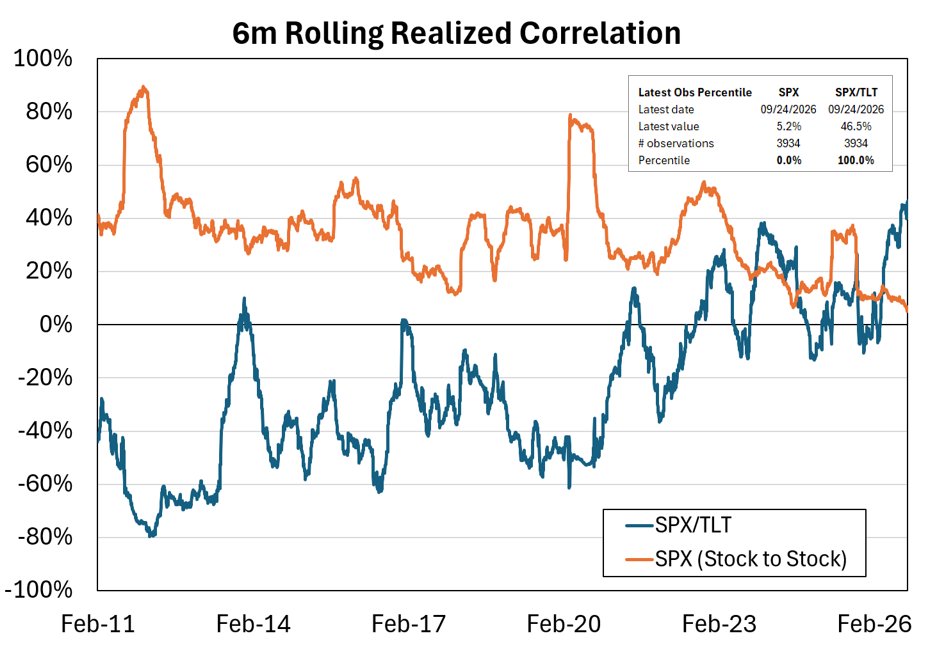
Going back 15 years, here's the rolling 6m realized correlation between the $SPX and $TLT as well as the correlation among stocks in the SPX.
In the "risk on/risk off" era, stocks and bonds were vastly negatively correlated. No longer. The latest reading is a positive 46%.
In that same era, stocks were consistently and meaningfully correlated to each other, reaching as high as 80% in crisis periods like the GFC, 2011 Sovereign Crisis and the Covid unwind. That's a thing of the past as well. The latest reading is 5%.
Stock to Bond: 100th percentile
Stock to Stock: 0th percentile
The correlation among risky assets is considerably lower than the correlation between risky and risk-free assets.
Many nominally different assets - utilities and tech stocks, for example - are not correlated today, but are linked to a common factor that could drive correlation in the future. As the bond market is as much a threat to the stock market as it is a flight to safety asset, the importance of finding real diversifying assets is critical.
Very saddened to hear of the passing of John C. Hull, whose book Options, Futures and Other Derivative Securities was a foundational text in finance. I purchased the second edition (the first of many editions I would buy) in a mall bookstore decades ago. Liar’s Poker showed me what trading was, and Hull’s book was my first practical resource on how to do it. In today’s world of massively available educational resources it’s difficult to express how critically important the text was at the time. And still is.
Educational tweet:
The biggest misunderstanding around selling volatility or options is the idea that the act itself is bad. It is not. Selling an option is no different from buying or selling any other security. The real issue is how most people implement the trade.
When people “sell options for income,” the missing piece is that the implementation is usually volatility agnostic. They hunt for a target premium rather than understanding the actual risk they are taking by selling that option. Which pretty much is derived from the implicit vol that exists from the birth of that position.
The equivalent would be someone saying they short the Nasdaq no matter what the price is. Whether it is at one dollar or three hundred, they just wake up and short it. That sounds ridiculous because it is.
There are times when it is a good bet to buy a security and times when it is a good bet to sell one. But taking a fixed stance regardless of price or market conditions is exactly what is wrong with the idea of “selling options for income.”
@right_tail avoid short tails (don't have risk that gets worse and worse for big moves). short near the money options or vol swaps, not far otm or ratios or variance swaps
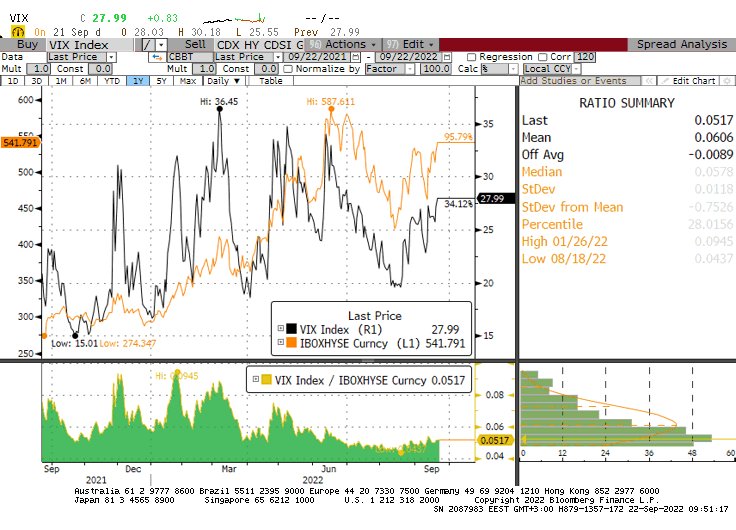
@yassa_13@lebas_janney@vader7x Yes, back up >540. If anything unlike the June episode, the VIX has not followed through the 30% level. Still, all observations withing usual ranges of basis spreads.
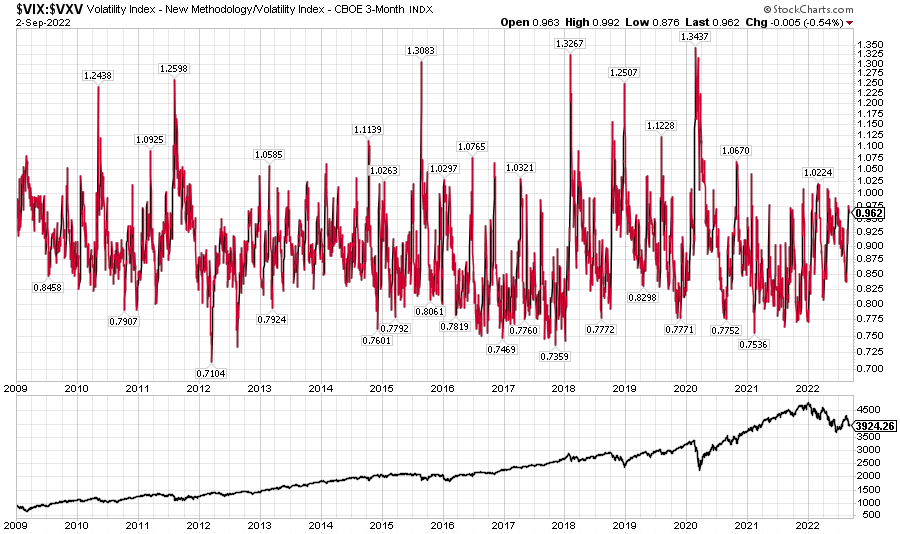
Finally, a signal to buy SPX whenever VIX:VIX3M > 1.20 does not rule out other meaningful SPX rallies occurring without this signal being triggered. A high print of this ratio might prove sufficient, but it’s not necessary.
OK, let’s go down the VIX/VIX3M rabbit hole. Dissecting this ratio means market implies very high SPX volatility for the next 30days, but not so for the next 90days. That’s it. Nothing fancy. How one interprets this is the art within the science. @CyclesFan gets this.
Based on the $VIX:$VXV ratio, the odds that SPX made a bear market low in June are slim to none. Since the 2009 low, there hasn't been any 10% decline, let alone a 24% decline like in 2022, in which the ratio didn't get to at least 1.24. There hasn't been any panic so far in 2022
It’s not uncommon to see such signals make quite a lot of money, and then enter a period where they cannot make money at all. Even if its edge is solid and stable, it will only be so within the bounds of probability -- and those margins can be pretty blurry.