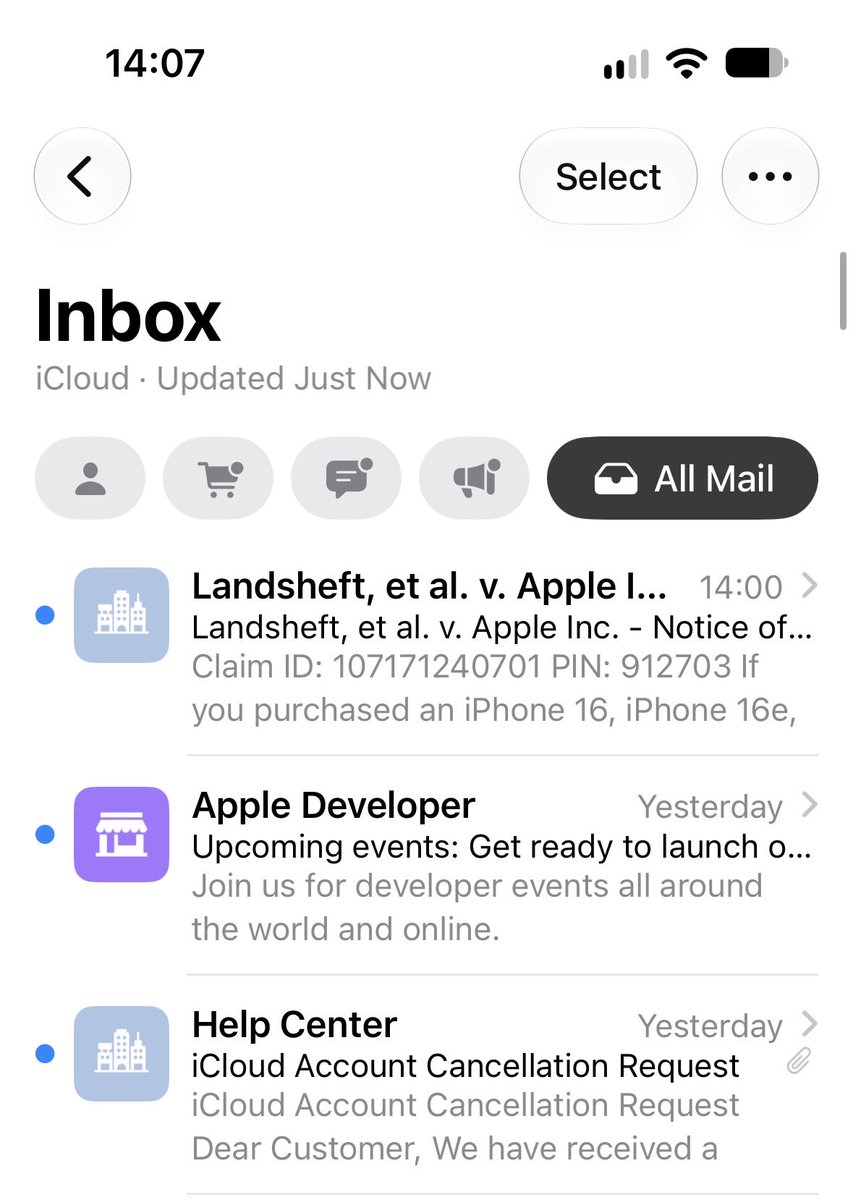
Its sad / hilarious how bad iCloud mail is. Apple can't even flag spam impersonating themselves in the inbox. I emailed @cue about this last year, and to his credit, got back to me. Sad to see spam still going to the inbox instead of Junk (and legin mail going to junk).
With 360 Bitcoin wrench attacks cataloged, it's time to take the archive to the next level. Over the weekend I clanked out this interactive dashboard; feedback is welcome!
https://t.co/bty25Jo05Z
Furniture & IT Equipment – Cape Town Liquidation Auction
BANXSO (Pty) Ltd (In Liquidation) – Master’s Reference Number: C000548/2025
Bids Close: 10 September 2026 from 11:00
Viewing: 08 & 09 September 2026 (09:00 – 15:00)
Casper – 082 459 8877
🇿🇦 Careers24 Database Allegedly Leaked — 472,000 Records Claimed
A threat actor is advertising a dataset allegedly originating from Careers24, a major South African employment and recruitment platform.
According to the forum post, the dataset contains approximately 472,000 records and is described by the seller as “fresh.”
The alleged database is organized around candidate contacts, job applications, and candidate interviews.
Exposed fields reportedly include:
* Full names and dates of birth
* Email addresses and multiple phone numbers
* Residential addresses
* Nationality and residency information
* South African identity numbers
* Gender and ethnicity fields
* Profile photographs and marital status
* Education and work-authorization information
* Employment history and résumé information
* Current and expected salaries
* Desired positions and work locations
* Driver’s-license information
* Work-permit identifiers
* Background and reference-check status
* Recruiter notes and candidate ratings
* Application and interview information
⚠️ The combination of identity, employment, salary, contact, and recruitment information could make the alleged dataset particularly valuable for targeted phishing, recruitment scams, identity fraud, and social-engineering operations.
🔎 Analyst Note:
The seller explicitly describes the dataset as fresh, but Daily Dark Web has not independently confirmed its recency, authenticity, provenance, or whether the information resulted from a new compromise of Careers24.
Until independently validated, this should be treated as an unverified breach claim rather than a confirmed new incident.
#DDW #SouthAfrica #Careers24 #DataBreach #DarkWeb
🚨 An eight-month operation targeting West African organized crime groups has led to 58 arrests and the identification of 263 suspects.
Groups such as the Black Axe pose an escalating global threat, responsible for a significant share of the world’s cyber-enabled financial fraud, including:
🔵 Romance scams
🔵 Cryptocurrency and investment fraud
🔵 Business email compromise
Bringing together 22 countries from six continents, Operation Jackal IV targeted high-value targets, money laundering schemes and illicit assets to support arrests and facilitate prosecution.
🔗 Details: https://t.co/lu7Cz90xVi
Thanks to @SAReserveBank and @sarstax, these goons has ready started showing up on our shores…a central register where your declared Bitcoin holdings and home address is stored is just waiting to be exploited by insiders like in France.
🇿🇦 South Africa now has its own Voice AI API.
CMT Voice Cloud — one key, all 11 official languages.
What you can ship with it:
🎙️ Voice assistants that speak isiZulu, Xhosa, Afrikaans, Sesotho & more
🧠 AI agents that think and reply in the user's own language
🤖 Humanoid robots that listen, detect language, and talk back
🌍 Real-time translation between any 2 SA languages
Real use cases already being built:
→ Bank & clinic kiosks that speak the customer's language
→ School robots teaching in isiZulu, Sesotho, Xitsonga
→ WhatsApp bots that auto-reply in-language
→ Call centre AI across all 11 languages
R20 free credit. No card required. Live right now.
👉 https://t.co/EuM3YBWvjH
A short story about Indian scammers who called the cops on themselves:
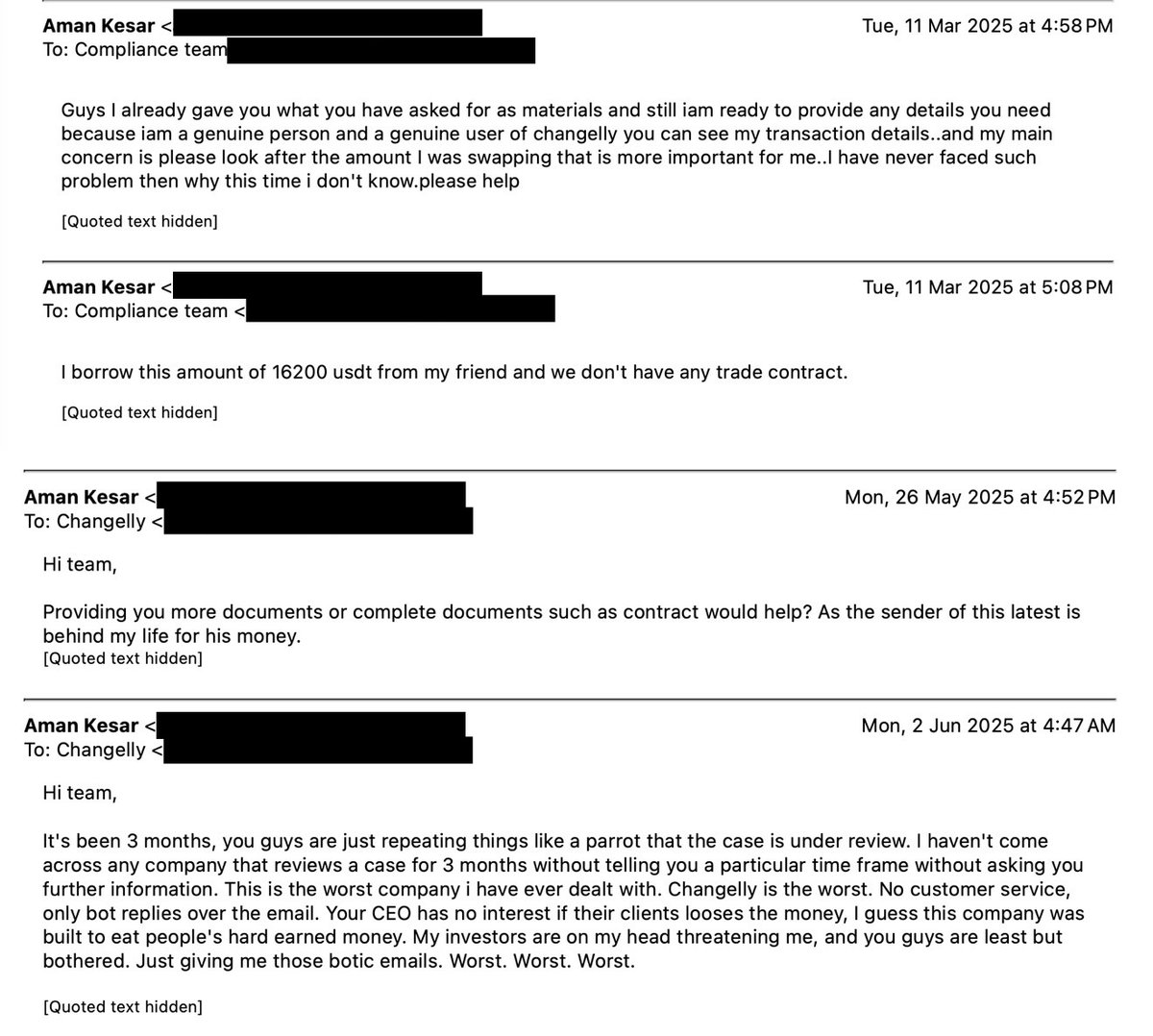
Earlier this week a follower DM'd me from his personal account complaining that 5.73 BTC ($475K) of his was 'unjustly' frozen at Changelly in Mar 2025.
So I went and plotted the Bitcoin transaction in my compliance tools.
The inflows trace back to illicit sources via social engineering thefts targeting Americans through US exchanges and Bitcoin ATMs.
The broader cluster of high confidence thefts has taken $1M+ from victims since 2025, with several of them elderly.
His story kept changing. It was a loan. No, his boss sent it. No, his boss invested in Bitcoin "during 2014 and 2015" through a friend in the US.
The best part? In Dec 2025 he claims to have filed a police report in India over these frozen funds (3207-P/2025).
In our DMs he shared email screenshots which I queried to surface more data points and map his group out.
I suspect AmanKesar11 is a mule for his boss 'Mr Parveen,' as the 'proof' he sent included bank statements under a different name / location.
While you can message me for help and I'll respect your privacy, at least use common sense and don't contact me with stolen funds.
5.73 BTC frozen order: fb931baac66bfc116deb10fa81417fb3da61e4362cd2997ee1eaa577e96272f3
AmanKesar11 BTC address: bc1q5yjxzcvfswvyx9y6cvlc3xe4laqqnqsjp3f9t2
AmanKesar11 Tron address: TQkEVXjtvSbigGa5fqFUpcYJnGvpKPPBEm
HTX sanctions have single-handedly undone years of work trying to get defi protocols and swappers to actually screen and block stolen funds.
Treating every user of a top 10 exchange as ~sanctioned is fucking retarded and has led to a lot of legit people being frozen and unable to access their funds.
Services shouldn’t serve thieves and money launderers and terrorists.
But….I can’t defend this shit. HTX users are an insanely diverse set of people. Some criminals. But *most* are legit.
The UK’s move here has had worse trickle down impact on legit people than Tornado did. It’s fucking insane.
If you live in South Africa, you need to read this. Your family might be in danger.
The South African government wants to hand criminals a comprehensive shopping list of every citizen who owns Bitcoin, gold, or other valuable assets.
This is not hyperbole. This is not paranoia about government overreach. This is what happens when bureaucrats create centralized databases of wealth while operating cybersecurity systems that cannot protect government servers from ransomware attacks, insider leaks, and just plain old corruption.
France provides the blueprint for disaster. So far in 2026, French criminals kidnap one crypto holder every two and a half days. Forty-one cases this year alone. One hundred and thirty-five incidents since 2023. The victims include an eleven-year-old boy kidnapped with his mother in Burgundy while criminals demanded four hundred thousand euros from the father's crypto holdings. David Balland, co-founder of hardware wallet company Ledger, lost a finger when kidnappers severed it and sent it to his associates as part of their ransom demand.
How do French criminals select their targets? Government data leaks.
A French tax official used government systems to identify wealthy crypto holders and sold that information directly to criminal networks. She worked inside the system designed to protect citizens and instead fed their personal data to the people who showed up at their homes with knives and demands for Bitcoin transfers.
Waltio, a French software company providing tax services, was hacked and exposed fifty thousand users' portfolio information on dark web marketplaces. Government employees selling data represents something far worse than mere cybersecurity incompetence. It reveals the inherent corruption that emerges when governments collect detailed wealth information about their citizens.
Pavel Durov warns that expanding government data collection on crypto holders expands the pool of kidnapping targets. Telegram's founder said the platform would rather exit the French market than hand private user data to French authorities.
South Africa's cybersecurity record makes France look competent by comparison. Hackers put 3.6 million Gauteng Provincial Government files up for sale on the dark web for twenty-five thousand dollars. Statistics South Africa suffered a breach in January 2026. Cell C leaked two terabytes of data belonging to 7.7 million customers. The Department of Justice lost control of over 1,200 confidential files in a ransomware attack that crippled systems for weeks.
These same people now demand that every South African declare their Bitcoin, gold, and alternative asset holdings within thirty days. Name, ID number, portfolio amounts. All stored in government databases operated by the same institutions that cannot even secure their own local servers.
The regulations extend beyond Bitcoin. Gold holders face the same mandatory disclosure requirements. Alternative investments fall under identical rules. The government wants comprehensive records of every citizen who owns assets outside the traditional banking system.
Free market economists understand why governments crave this information. Capital controls require detailed knowledge of citizen wealth. Currency restrictions need enforcement mechanisms. Confiscation demands target lists.
But the immediate threat comes from criminals. French kidnappers prove that government wealth databases become criminal targeting systems. The data will leak. Government employees will sell access. Hackers will breach the servers.
South African criminals will adapt French tactics to local conditions. Home invasions already plague wealthy neighborhoods. Adding detailed cryptocurrency and gold holdings data transforms random crime into precision targeting. Why rob houses blindly when government databases provide exact wealth information and home addresses?
The regulatory framework creates perverse incentives for corruption. Tax officials gain access to detailed wealth information about every compliant citizen. The temptation to monetize this data through criminal networks will prove irresistible for some percentage of government employees. France shows this corruption is inevitable, not theoretical.
Compliance rewards criminals while punishment awaits honest citizens. Those who declare their holdings create detailed target lists for kidnappers. Those who refuse face government penalties. The regulations trap law-abiding citizens between criminal violence and state punishment.
The solution involves rejecting the entire framework. No government database. No mandatory declarations. No centralized records of citizen wealth in Bitcoin, gold, or alternative assets. The French kidnapping epidemic demonstrates exactly why financial privacy matters for physical safety.
South African crypto holders should study French headlines carefully. Today's regulatory compliance becomes tomorrow's kidnapping victim list. The government promises protection while operating systems that guarantee data breaches.
Act now, or your family will be in danger.
https://t.co/o4xEomRIr2