@eigenrobot That's unfair. It's the oldest story: go on the hunt, wrestle the beast, bring the spoils and the stories back to the campfire. One day, as the seasons pass, one goes on their last hunt, and one of their mentees steps up to fully take on the role.
@ChrSzegedy@Frances01896069 Prepare on what time horizon? What are mathematicians going to do 10, 20, 50 years from now? What will our grandchildren do? Name one meaningful purpose.
@Frances01896069 Generalized anomie. Either we figure out how to keep people interested in doing X, or in 20 years there will be no one left who wants to work on X. For almost any X.
@DKThomp Precedent: electricity. Factories took about 40 years to get productivity gains from the electric motor. The gains came only when plants were rebuilt around it, mostly new plants. See Paul David, "The Dynamo and the Computer".
@DKThomp AI will diffuse through startups blindsiding incumbents, not by gradual uptake inside them. Fractally, even inside bigcos. Startups run on 100x engineers, eg https://t.co/dkU1cn4ldk
"the unemployment rate is low" because incumbents still have financial runway. it will run out
Talked to a startup’s founders.
In 6 months, 1 engineer built their web, desktop, iOS, and Android apps with AI. Just 1 engineer.
And they’re not shitty prototypes. They’re polished, well-designed, and reliable apps.
AI is turning 10x engineers into 100x engineers.
This wasn’t possible last year.
@theojaffee We have barely scratched the surface of what our current AI systems can do. Likely they *can* replace an accountant. We just haven't seen the "AI accountant" yet, just like mathematicians were caught off guard by the 2026 end-of-summer results explosion.
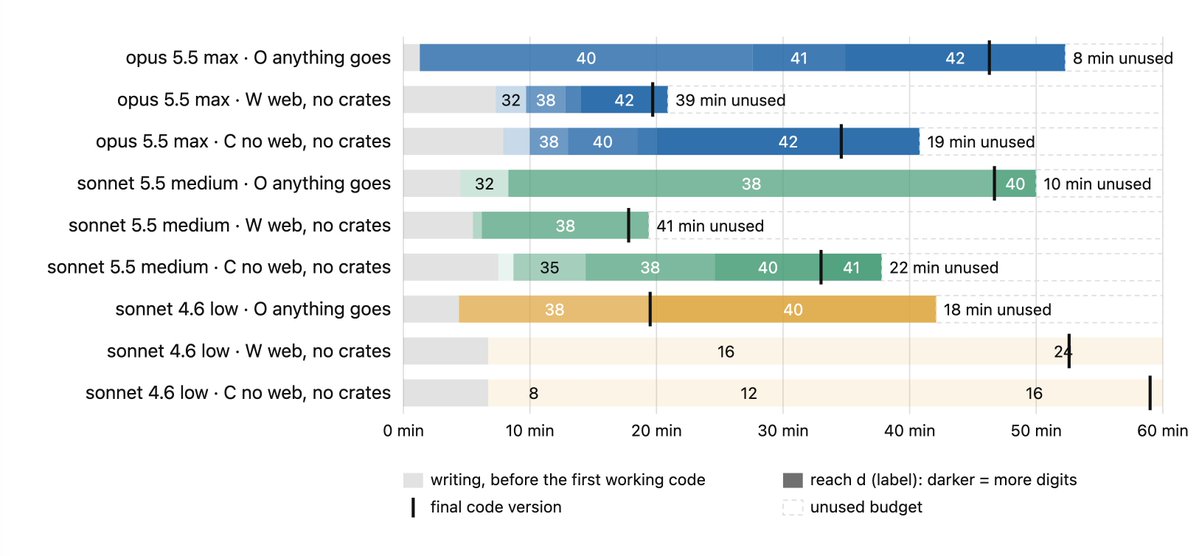
Hypothesis tested: Above a competency threshold, a coding agent will build and tune a system within a thin margin of the state of the art it has access to, whether that comes as a library, a web page, or training memory alone.
Three Claude models of different capability (Sonnet 4.6 low, Sonnet 5.5 medium, Opus 5.5 max) each had one hour to write the best integer-factoring program they could, under three limits:
- Open: web access and libraries
- Web: web access, no libraries
- Closed: no web, no libraries, training memory only
Above the threshold, all six Sonnet 5.5 and Opus 5.5 runs converged on the same algorithm, a self-initialising quadratic sieve, the standard best method at these sizes. They factored numbers with 37 to 41 digits per prime. The model mattered by at most 3 digits, the limits barely at all.
Below it, Sonnet 4.6 low reached only 23 to 26 digits on its own. With libraries, it found a quadratic sieve library and reached 40. A library closed the gap.
Granted, a well-studied problem, tested on tiny laptop-scale compute.
Food for thought: For anything well documented, the gap between "the state of the art exists" and "the state of the art is deployed" is collapsing to hours.
https://t.co/9gxlyvm4bn
@Leigh_Phillips Loss of control is a well-documented risk factor for depression.
Testable prediction: as use of AI systems in the workplace decouples people from economic impact, depression rises, even where income is replaced.
@geoffreyirving we don't know how to keep two people who chose each other aligned, let alone nations. a multi-multi world is too complex a system to plausibly have stable solutions everywhere
@OfirPress my guess: above a coding competency threshold, any agent can, within hours
- build a near-SOTA system, or a replica of one
- operate it at near-SOTA performance
- iterate: fix bugs, tune knobs, add features
engineering design lives largely in CAD, so it follows the same dynamics
Above a competency threshold, a coding agent will craft, tune (and operate) a system within striking distance of the state of the art it has knowledge of. Few have thought through the consequences for day-to-day life and beyond.