I think the market is finally starting to understand that the “Fed pivot” narrative may already be dead.
If rate cuts don’t come in 2026, a lot of people are underestimating how painful that could get for crypto.
$BTC losing $80K wasn’t just a normal correction.
Over $657M got liquidated in 24 hours $584M of that was longs.
Traders were overleveraged above $80K expecting continuation, but once BTC lost that psychological level, algos and institutional risk systems started forcing sell pressure into the market.
That’s why the dump became aggressive so fast, but the bigger issue here is macro.
• U.S 10Y yield still around 4.43%
• Oil already above $112
• CPI at 3.8%
• Fed officials now openly talking about the possibility of NO cuts
• Kalshi odds for no rate cuts this year climbed to 66.9%
Crypto has spent almost 2 years trading on one core belief: “Liquidity is coming.”
Now the market is being forced to price the opposite.
Historically, BTC performs best when:
• Real rates fall
• The Fed injects liquidity
• Financial conditions ease
Right now we have the reverse, Even the
𝐂𝐋𝐀𝐑𝐈𝐓𝐘 𝐀𝐜𝐭 became a perfect “buy the rumor, sell the news” event.
BTC rallied toward $82K before the vote… then dumped hard immediately after.
To me, that says most bullish catalysts were already priced in.
What also caught my attention is ETF behavior.
Spot Bitcoin ETFs saw:
• $635M outflows in one day
• 7-day average flows at -$88M/day
That’s important because institutions usually don’t sell weakness rather they sell strength.
Which means some big players are probably using rallies as exit liquidity right now.
Personally, I don’t think this automatically means a full bear market starts tomorrow.
But I do think the market is entering a phase where: good news won’t pump like before, liquidity matters more than narratives,
and leverage gets punished much harder.
I’m watching the $70K region closely.
Because if macro conditions continue tightening while retail stays overly bullish, BTC could still revisit deeper support before the next real expansion phase begins.
The real price discovery now happens inside private markets while retail investors watch from the outside.
In the 1990s, companies went public in 4–5 years and today, they stay private for ~12 years.
By the time companies like @OpenAI, @AnthropicAI, or @SpaceX finally IPO, a massive part of the growth curve has already been captured by private capital, venture funds, and accredited investors.
This is the reason why Pre-IPO markets are exploding on-chain.
➤ Here’s what I’m seeing:
Most tokenized Pre-IPO assets already trade at 20–40% premiums above official private-market valuations.
Some platforms are pushing 90%+ premiums.
The structure itself is creating reflexive price inflation because:
• spot markets can’t really be shorted
• perpetual markets have weak short-side liquidity
• open interest is capped around $5M–$7.5M on platforms like Ventuals
• liquidity pools are shallow
• retail demand keeps overwhelming available supply
So price discovery becomes structurally long-biased, the market is literally pricing access scarcity.
What makes this even bigger is that we’re now seeing 3 different financial systems merging into one market:
» SPV-backed tokenized equity
» synthetic perpetual contracts
» closed-end Pre-IPO funds
@binance, @bitget, @Backpack, @SuperstateInc, @solana ecosystem players, @tradexyz, @PreStocks, @ventuals etc, everybody is racing toward the same thing which is “bringing private market exposure on-chain”.
This narrative gets stronger as companies stay private longer and global IPO fundraising pushes toward $160B.
The winners will be the platforms that solve: liquidity, compliance, redemption infrastructure, and sustainable price discovery.
Because eventually, the SEC and CFTC scrutiny arrives the moment these underlying companies go public.
This market is still early, but the demand is already very real.
#RWA is finally completing the last mile on-chain, for years, tokenized Treasuries felt incomplete to me.
The assets and yields existed, and the market grew from $5B to $31.4B, but redemption still moved like TradFi:
➤ trading windows
➤ T+1/T+2 settlement
➤ delayed liquidity
That’s not programmable finance, it’s just putting Treasury certificates on-chain.
What changed this week is important.
@upshift_fi Clear + @grovedotfinance just attacked the biggest bottleneck in the entire RWA sector: real-time redemption.
Upshift’s model is simple and effective:
maintain a USDC reserve pool, pay users instantly, settle the underlying assets later in the background.
Grove Basin is even bigger in ambition.
They’re building programmable credit infrastructure where eligible RWAs can atomically settle into stablecoins within a single block.
Because once assets like:
• @BlackRock BUIDL
• @SuperstateInc
• @circle USYC
• @FTI_US
can move with stablecoin-like liquidity, RWA stops being a passive yield product and starts becoming usable internet-native collateral.
That’s the real “stablecoin moment” for RWAs and not tokenization or liquidity.
The timing is interesting:
the same week the CLARITY Act advanced through the U.S. Senate Banking Committee, the infrastructure for instant RWA redemption quietly went live.
The market is starting to understand something important:
the winner in RWA won’t just be the issuer of tokenized assets.
The winner will control the redemption rails, liquidity layer, and settlement infrastructure connecting TradFi assets to 24/7 DeFi capital markets.
To know more about CLARITY Act, read @ZackD0x tweet below 👇
The interesting part about the @clickoptions_ai Zealy sprint isn’t just the $1,200+ reward pool.
It’s the fact that participants are earning rewards and accumulating airdrop XP at the same time.
Current setup:
• $500 for 1st place
• $600 referral pool
• Instant USDT raffle rewards
• XP counts toward the ClickOptions airdrop
Still early enough that positioning actually matters.
You can participate through trading, referrals, or engagement without needing massive volume to get involved.
I already joined, join here: https://t.co/M5yhP57u3u
AI is operating like “Compute Real Estate.”
@HyperscaleFund are borrowing aggressively, building GPU/data-center capacity at historic scale, then racing to fill those compute buildings before the GPUs depreciate in 3–5 years.
@GoldmanSachs calls this the “profit inflection point” i call it the moment builders must finally start collecting rent.
The numbers already show the pressure:
• 2026 hyperscaler capex projected at ~$805B
• 2027 projected above $1.1T
• @amazon spent $147.3B in capex against $148.5B operating cash flow
• @alphavaluebet doubled capex to $35.7B
• @BofA_Business says hyperscalers are now spending ~90% of operating cash flow on capex
This is no longer normal infrastructure expansion rather it is an arms race.
Demand is real:
➤ @googlecloud revenue hit $20B with 63% YoY growth.
➤ AI solutions revenue grew 800%.
➤ @AWSAI revenue run-rate reached $15B annually.
➤ China’s token usage exploded to 140T/day.
@nvidia sits at the center of the entire value chain with ~75% gross margins and ~88% of value-chain profits.
Nvidia sells the “construction materials.”
Everyone else is trying to survive long enough to monetize the buildings.
AI wins long term, that part is already obvious.
The companies that survive this GPU depreciation cycle will be the ones that already have massive cash-flow engines outside AI.
AWS has ecommerce and cloud cash flows, @Google has Search and Ads.
@TencentGlobal is using AI to strengthen gaming, advertising, and operational efficiency internally.
They’re not depending on AI to survive today rather they’re using existing empires to finance the next one.
The real pressure sits at the edges:
• @CoreWeave carrying $24.8B debt
• @Oracle pushing ~$50B capex while relying heavily on Nvidia
• model startups surviving on continuous financing rounds
This cycle will not eliminate AI, but It will eliminate weak balance sheets.
By 2028–2029, the difference between AI leaders and AI casualties will come down to one thing which is “Who generated real cash flow before the hardware started aging.”
AI Agents can absolutely be verified on-chain.
The question is whether verification should force Agents, users, and protocols to expose their operational graph publicly.
That’s the contradiction ERC-8004 and ACTA are exposing.
ERC-8004 is building the trust infrastructure for Agents:
• identity registration
• portable reputation
• verification layers
• cross-app trust
Necessary infrastructure if Agents are going to trade, govern, route liquidity, submit predictions, and operate across DeFi autonomously.
But here’s the part I think people are underestimating:
If every Agent interaction, audit record, feedback entry, model reference, authorization link, and reputation trail becomes permanently public, then protocols are basically leaking their operational graph on-chain.
You don’t just see “trust.”
You see:
• strategy preferences
• business relationships
• model providers
• governance behavior
• liquidity routing patterns
• user intent proxies
Observing the Agent eventually becomes a way to observe the user.
That’s why ACTA matters.
ACTA shifts the model from:
“public identity” to “policy proofs.”
Instead of exposing everything, Agents use anonymous credentials + ZK proofs to prove: “I satisfy this policy”
without revealing:
• wallet history
• operator identity
• audit details
• full reputation data
• interaction history
And the nullifier design is important because it prevents duplicate actions without linking every activity to one permanent identity graph.
This is the direction the Agent economy actually needs.
Verifiable Agents without privacy protection creates transparent systems that are incredibly fragile.
The future Agent stack cannot rely only on public reputations and public identities.
It needs privacy-preserving trust layers.
ERC-8004 opened the trust conversation.
ACTA is forcing the privacy conversation.
$ZEC || @Zcash has become one of the clearest examples of how mining infrastructure, liquidity control, and coordinated crypto veterans can move an entire market cycle.
Look at the structure carefully.
Since September 2025, $ZEC moved from ~$53 to over $600 and briefly touched $740.
At the same time, $BTC kept pressing into the $125K–$127K region.
2017:
ZEC ran from $200 → $870 while BTC topped near $19K.
2020–2021:
ZEC moved from $50 → $220 while BTC peaked near $64K.
Q4 2021:
ZEC pushed from $100 → $290 while BTC printed the $69K cycle high.
Now again in 2026:
BTC pushes toward major resistance → ZEC goes vertical.
That pattern is too consistent for me to ignore.
What makes this even more interesting is WHO controls the rails behind ZEC.
» @ViaBTC
» @FoundryServices
» @f2pool
» @AntPoolofficial
These are #Bitcoin OG mining operators with years of coordination experience from the BCH wars, SegWit era, and multiple cycle rotations.
Top 5 pools now control almost 90% of ZEC hashrate.
Then look deeper:
• Foundry entered ZEC mining in March 2026 and immediately captured ~27% of hashrate
• ViaBTC previously controlled ~68% alone
• @BITMAINtech dominates ZEC ASIC production through the Antminer Z15 Pro
• @Grayscale holds ~390K ZEC
• Foundry + Grayscale both sit under DCG
Mine it.
Hold it.
Distribute it.
That’s a full vertical stack.
ZEC’s shielded pools make flow tracking extremely difficult.
Sapling.
Orchard.
The more I study this setup, the more I stop looking at $ZEC as “just another privacy coin.”
I see an industrial-scale ecosystem controlled by miners, infrastructure operators, liquidity providers, and long-time Bitcoin veterans who understand exactly how crypto cycles work.
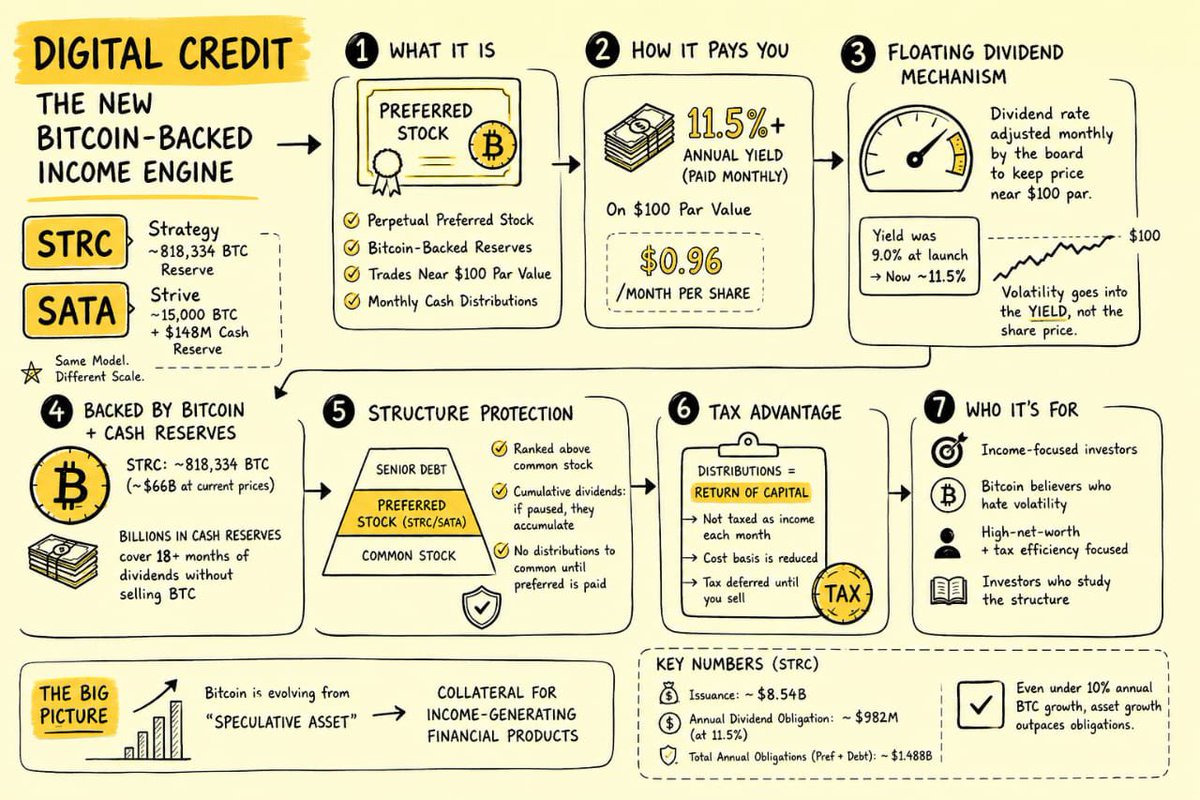
$STRC || @Strategy and $SATA || @Strive are showing what happens when #Bitcoin stops being treated only as a speculative asset and starts becoming the reserve layer for an entirely new credit market.
This “Digital Credit” structure that @saylor keeps talking about is deeper than most people realize.
STRC is not just another Bitcoin stock.
It is perpetual preferred equity backed by Strategy’s 818,334 &BTC reserve base, designed to generate stable monthly cash distributions while keeping the share price trading close to its $100 par value.
That design matters.
Traditional preferred stocks depend on operating cash flow.
STRC depends on Bitcoin reserves.
Instead of volatility showing up aggressively in the share price like $MSTR, the structure redirects volatility into the dividend yield itself through a floating-rate mechanism.
That’s why the yield moved from 9% at launch to around 11.5%.
The system continuously adjusts to pull the price back toward par value.
That’s the engineering behind it.
At current scale, STRC’s issuance sits around $8.54B, meaning Strategy needs roughly $982M annually to maintain distributions.
The obvious question becomes:
where does the money come from?
The answer is the balance sheet structure.
Strategy holds roughly $66B worth of #BTC reserves while annual obligations from preferred shares + convertible debt sit around $1.488B.
Even under @Strategy own conservative assumptions of 10% annual BTC appreciation, the reserve growth materially exceeds the annual payout obligations.
Beyond the BTC reserve base, they also maintain billions in cash reserves capable of covering dividend obligations for well over a year without selling Bitcoin.
Then comes the protection layer most people are ignoring:
STRC is cumulative preferred stock.
If distributions are paused during extreme market stress, unpaid dividends continue accumulating and common shareholders cannot receive distributions until preferred holders are fully paid.
That legal structure is important.
SATA from Strive follows a similar model with:
• ~15,000 BTC reserves
• /$148M cash reserves
• smaller issuance size (/$496M)
• higher yield (~13%) to compensate for lower liquidity
This is why I keep saying Bitcoin is evolving beyond “number go up.”
We are watching BTC move into:
• collateral markets
• structured credit markets
• yield products
• institutional income products
• tax-efficient capital structures
This is the early formation of Bitcoin-native fixed income.
And over the next few years, more versions of these products are coming.
Prediction markets are evolving faster than most people realize.
A lot of CT still sees this sector as “just @Polymarket,” that view is already outdated.
What’s forming now is a full 4-layer ecosystem, which includes
1. Trading venues
2. AI + tooling infrastructure
3. Regulatory rails
4. Academic foundations
Every layer is expanding at the same time.
Polymarket still dominates crypto mindshare, but the numbers are shifting fast.
April 2026 volume:
• @Kalshi → $14.81B
• @Polymarket → ~$9B
Most crypto users still think Polymarket is the leader but the actual liquidity landscape says otherwise.
At the same time, Hyperliquid HIP-4 going live changed the conversation completely.
For $BTC/ $ETH directional trading, HIP-4 already feels like a real secondary venue:
• no KYC
• deepening order flow
• strong trader migration
• faster crypto-native execution
Polymarket still wins on breadth:
sports, politics, AI, macro, culture.
But the market structure is no longer one-platform dominant.
Then you look at what’s happening on other chains:
• https://t.co/w0gd4pZDRj pushing prediction markets into the @BNBCHAIN ecosystem
• @trylimitless scaling aggressively on @base
• LMTS ecosystem incentives driving activity
• $4B+ lifetime volume
• $163M single-day ATH recently
This sector is fragmenting across chains exactly like perpetuals did, and the infrastructure layer is becoming even more important than the markets themselves.
functionSPACE is one of the biggest signals here.
The thesis is simple:
turn “beliefs” into programmable infrastructure.
Not just prediction markets, probability infrastructure.
Then AI enters the picture, @ElasticsAI raising $2M with backing tied to @a16z + @ElevenLabs
AI agents participating directly in probabilistic markets.
At the regulatory layer, traditional finance is no longer watching from the sidelines either.
@Nasdaq entering prediction markets matters and @Cboe matters, @RobinhoodApp Predictions matters and @coinbase Predict matters too.
This is institutional validation of the category itself, and underneath all of this is still the original foundation:
Robin Hanson
LMSR
Augur
Iowa Electronic Markets
Don’t pay attention to the app only because the real story is that prediction markets are becoming:
• information markets
• sentiment infrastructure
• AI coordination layers
• probability-based financial systems
This sector is no longer niche rather becoming a new market structure category entirely.
➠ @clickoptions_ai approach to crypto options is interesting because they’re focusing on something most platforms ignore: "actual trading experience."
Not from the usual: “more leverage” “more noise” “more complexity”
But from the angle of:
• better pricing
• tighter spreads
• smoother execution
• simpler experience
Honestly, that approach makes sense for where the market is heading 🧵👇
Prediction markets are evolving faster than most people realize.
A lot of CT still sees this sector as “just @Polymarket,” that view is already outdated.
What’s forming now is a full 4-layer ecosystem, which includes
1. Trading venues
2. AI + tooling infrastructure
3. Regulatory rails
4. Academic foundations
Every layer is expanding at the same time.
Polymarket still dominates crypto mindshare, but the numbers are shifting fast.
April 2026 volume:
• @Kalshi → $14.81B
• @Polymarket → ~$9B
Most crypto users still think Polymarket is the leader but the actual liquidity landscape says otherwise.
At the same time, Hyperliquid HIP-4 going live changed the conversation completely.
For $BTC/ $ETH directional trading, HIP-4 already feels like a real secondary venue:
• no KYC
• deepening order flow
• strong trader migration
• faster crypto-native execution
Polymarket still wins on breadth:
sports, politics, AI, macro, culture.
But the market structure is no longer one-platform dominant.
Then you look at what’s happening on other chains:
• https://t.co/w0gd4pZDRj pushing prediction markets into the @BNBCHAIN ecosystem
• @trylimitless scaling aggressively on @base
• LMTS ecosystem incentives driving activity
• $4B+ lifetime volume
• $163M single-day ATH recently
This sector is fragmenting across chains exactly like perpetuals did, and the infrastructure layer is becoming even more important than the markets themselves.
functionSPACE is one of the biggest signals here.
The thesis is simple:
turn “beliefs” into programmable infrastructure.
Not just prediction markets, probability infrastructure.
Then AI enters the picture, @ElasticsAI raising $2M with backing tied to @a16z + @ElevenLabs
AI agents participating directly in probabilistic markets.
At the regulatory layer, traditional finance is no longer watching from the sidelines either.
@Nasdaq entering prediction markets matters and @Cboe matters, @RobinhoodApp Predictions matters and @coinbase Predict matters too.
This is institutional validation of the category itself, and underneath all of this is still the original foundation:
Robin Hanson
LMSR
Augur
Iowa Electronic Markets
Don’t pay attention to the app only because the real story is that prediction markets are becoming:
• information markets
• sentiment infrastructure
• AI coordination layers
• probability-based financial systems
This sector is no longer niche rather becoming a new market structure category entirely.
GM Kings and Queens
This week, pay attention to one narrative very carefully:
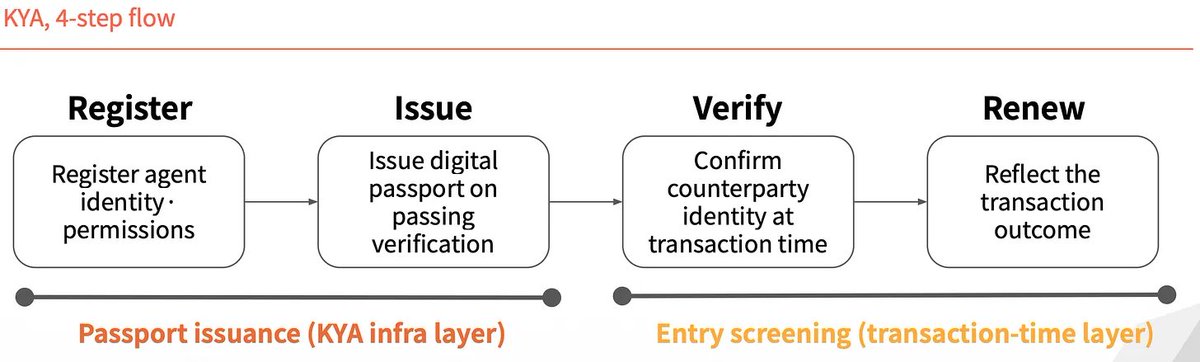
KYC is evolving into KYA - Know Your Agent.
AI agents are no longer simple assistants.
They can already:
• execute trades
• move funds
• sign contracts
• make autonomous payments
• interact with other agents across networks
There is still NO universal identity layer for AI agents.
And that becomes dangerous the moment agents start operating across ecosystems, DEXs, payment rails, merchant systems, and autonomous finance.
Inside platforms like @OpenAI, @Google, or @coinbase, traditional KYC works because the platform controls accountability.
But in Agent-to-Agent (A2A) environments?
Everything changes.
Now the market needs infrastructure that can verify:
• who deployed the agent
• who authorized it
• what permissions it has
• who is liable if something breaks
That is where KYA comes in.
The most interesting part is that multiple players are already racing for this layer:
• ERC-8004 → bringing NFT-based identity to AI agents through identity, reputation, and validation registries
• Visa TAP → embedding AI identity directly into payment rails with triple-signature verification systems
• Trulioo → introducing Digital Passport Authorities (DPA) + Digital Agent Passports (DAP) for live agent verification
• Sumsub → focusing on real-time behavioral monitoring and anomaly detection for AI agents
And governments are already moving:
• EU AI Act
• NIST standards
• Singapore’s AI governance framework
This feels very similar to the early FATF Travel Rule era for crypto.
The next phase of the AI economy may not be won by the smartest model.
It may be won by whoever controls:
• trust
• verification
• payment integrations
• compliance rails
• agent identity infrastructure
ERC-20 standardized tokens.
ERC-721 standardized NFTs.
Now the market is asking if ERC-8004 could standardize AI agents.
The AI agent economy is moving from experimentation → accountability.
That shift matters.
Uniswap V4 Hooks feels like one of the biggest architectural shifts in DeFi right now.
In just days:
• @sato_hub || $SATO crossed a $40M market cap
• @uniqepv4 || $uPEG went from zero to over $30M in under 2 weeks
• SLONKS pushed over 1,200 ETH in trading volume
• @Uniswap $UNI moved from around $3.3 to $4.17 as attention rotated back toward Uniswap
All of them connect back to one thing, which is “Uniswap V4 Hooks.”
Before V4, Uniswap mostly functioned like an automated exchange counter.
You swap $ETH for USDC and Pricing follows: Trade executes. Done.
Even V3, despite concentrated liquidity, still had rigid protocol logic underneath.
V4 changed that.
Hooks now allow developers to insert custom code into:
• before swaps
• after swaps
• adding liquidity
• removing liquidity
That means Uniswap can now support:
• bonding curve launch systems
• dynamic fee models
• on-chain limit orders
• MEV protection
• custom execution logic
The bigger shift is the Singleton architecture because instead of separate smart contracts for every pool, all pools now exist inside one unified contract.
That drastically reduces gas costs and makes complex Hook interactions scalable.
That is exactly what created the environment for projects like sato to explode.
$Sato is one of the clearest examples of Hook-native tokenomics:
• no pre-mine
• no team allocation
• no admin privileges
Users send ETH into the Hook contract, then the Hook automatically mints sato through an exponential bonding curve.
When users sell:
• tokens are burned
• ETH is automatically returned
Once supply reaches 99% of the theoretical 21M cap (20.79M), minting permanently stops and the system transforms into an automatic on-chain buyback pool.
Even more interesting, all 0.3% trading fees remain permanently locked inside the Hook contract and nobody can withdraw them.
uPEG showed another side of Hooks, which is “Narrative infrastructure.”
The “Unipeg” name originally came from a 2019 idea by @haydenzadams before @VitalikButerin jokingly pushed the “Uniswap” name instead.
Years later, an anonymous developer revived the abandoned lore and redefined it as:
Uni + JPEG.
That instantly connected:
• founder lore
• Vitalik commentary
• NFT culture
• V4 innovation
Then Slonks combined AI-generated CryptoPunk-style artwork with Hook mechanics, mint was under 0.004 ETH.
Within 6 days:
• floor price hit 0.123 ETH
• over 60x expansion
• daily volume briefly surpassed CryptoPunks
The market ignored Hooks for almost 15 months after V4 mainnet launched in January 2025.
Now the market is finally understanding that V4 is not just a better AMM, rather it is programmable market infrastructure.
DefiLlama data showed:
• V4 TVL exceeded $1.4B
• later dropped toward $650M
• now recovered around $800M
By early 2026, the ecosystem already had more than 2,000 specialized pools experimenting with:
• TWAMMs
• dynamic fees
• custom oracles
• continuous liquidation auctions
This is transforming Uniswap into modular financial infrastructure, and the opportunities are massive.
Hook contracts are written by third-party developers, meaning users now need to evaluate:
• Hook permissions
• custody logic
• withdrawal mechanisms
• emergency controls
From everything I’m observing on-chain, Hooks are becoming the execution layer for programmable DeFi markets.
GM Kings and Queens
This week, pay attention to one narrative very carefully:
KYC is evolving into KYA - Know Your Agent.
AI agents are no longer simple assistants.
They can already:
• execute trades
• move funds
• sign contracts
• make autonomous payments
• interact with other agents across networks
There is still NO universal identity layer for AI agents.
And that becomes dangerous the moment agents start operating across ecosystems, DEXs, payment rails, merchant systems, and autonomous finance.
Inside platforms like @OpenAI, @Google, or @coinbase, traditional KYC works because the platform controls accountability.
But in Agent-to-Agent (A2A) environments?
Everything changes.
Now the market needs infrastructure that can verify:
• who deployed the agent
• who authorized it
• what permissions it has
• who is liable if something breaks
That is where KYA comes in.
The most interesting part is that multiple players are already racing for this layer:
• ERC-8004 → bringing NFT-based identity to AI agents through identity, reputation, and validation registries
• Visa TAP → embedding AI identity directly into payment rails with triple-signature verification systems
• Trulioo → introducing Digital Passport Authorities (DPA) + Digital Agent Passports (DAP) for live agent verification
• Sumsub → focusing on real-time behavioral monitoring and anomaly detection for AI agents
And governments are already moving:
• EU AI Act
• NIST standards
• Singapore’s AI governance framework
This feels very similar to the early FATF Travel Rule era for crypto.
The next phase of the AI economy may not be won by the smartest model.
It may be won by whoever controls:
• trust
• verification
• payment integrations
• compliance rails
• agent identity infrastructure
ERC-20 standardized tokens.
ERC-721 standardized NFTs.
Now the market is asking if ERC-8004 could standardize AI agents.
The AI agent economy is moving from experimentation → accountability.
That shift matters.
The recent price divergence across @SpaceX pre-IPO products looks attractive on the surface, but the structure behind these markets matters more than the headline spreads.
These products are not actually the same asset.
@binance SPACEX is tied to SPV-backed tokenized exposure, @okx is running a synthetic perpetual based on valuation assumptions.
@bitget and @Gate are offering future economic-rights style products tied to post-IPO conversion mechanics.
So when one platform trades at ~$600 and another at ~$2,000, it doesn’t automatically translate into a clean arbitrage opportunity.
There is no unified redemption mechanism, shared settlement framework, or standardized conversion structure across these venues, which makes traditional arbitrage difficult to execute efficiently.
What the market is really pricing right now are different versions of future SpaceX expectations under entirely different product structures.
To me, this feels less like a pure arbitrage market and more like an early experiment in tokenized pre-IPO speculation.
It also says a lot about where crypto markets are heading: trying to price and trade private-market narratives long before traditional capital markets officially open access.
The recent price divergence across @SpaceX pre-IPO products looks attractive on the surface, but the structure behind these markets matters more than the headline spreads.
These products are not actually the same asset.
@binance SPACEX is tied to SPV-backed tokenized exposure, @okx is running a synthetic perpetual based on valuation assumptions.
@bitget and @Gate are offering future economic-rights style products tied to post-IPO conversion mechanics.
So when one platform trades at ~$600 and another at ~$2,000, it doesn’t automatically translate into a clean arbitrage opportunity.
There is no unified redemption mechanism, shared settlement framework, or standardized conversion structure across these venues, which makes traditional arbitrage difficult to execute efficiently.
What the market is really pricing right now are different versions of future SpaceX expectations under entirely different product structures.
To me, this feels less like a pure arbitrage market and more like an early experiment in tokenized pre-IPO speculation.
It also says a lot about where crypto markets are heading: trying to price and trade private-market narratives long before traditional capital markets officially open access.
🪂 New Airdrop: USDT
🚀 Total Reward: 10,000 USDT
🎁 Joined Reward: 10 USDT
👬 Refer Reward: 5 USDT
⏳ Distribution: Instantly
⚡️ Join now: https://t.co/ai6At53DCa
👀 How to join?
- Start Airdrop Bot
- Complete All Tasks of Airdrop
- Submit Your USDT (Bep-20) Wallet address
👀 𝗗𝗶𝘀𝗰𝗹𝗮𝗶𝗺𝗲𝗿: Financial risks may be involved in airdrop activities. Always do your own research (DYOR) before joining any project!
🙌 #AirdropFam #USDT #Airdrop #Airdrops #CryptoAirdrop #Giveaway #campaign
➠ @SuiNetwork laid out a direction that extends far beyond current blockchain narratives
What’s being built is not just faster execution
It’s a shift toward AI-native markets, cryptographic resilience, and programmable financial coordination 🧵👇
This is actually one of the clearest signals I’ve seen this cycle.
While some persons are focused on weak altcoins and dead liquidity, top VCs are quietly stacking billions.
In less than 3 months:
• @HaunVentures raised $1B
• @a16z raised $2.2B
• @paradigm is targeting $1.5B
• @dragonfly_xyz closed $650M
• @bcap is raising $700M
• @paraficapital raised $125M
That’s over $6B flowing into crypto during a market where sentiment still feels broken.
The most interesting part is that they’re not chasing hype rather they’re positioning early.
Most smaller VCs are struggling right now because this cycle exposed a major problem:
Paper gains mean nothing without liquidity.
Long unlock schedules, weak secondary demand, poor exits… a lot of funds got trapped.
But top-tier firms keep getting stronger because they control:
• the best deal flow
• better allocations
• stronger networks
• multi-stage exposure
• and enough capital to survive mistakes
That’s why projects like @circle Group, @coinbase, and @Polymarket usually have elite VC backing early.
The bigger story though is where the money is going.
Most of these firms are aggressively betting on:
• stablecoins
• RWAs
• prediction markets
• AI agents
• on-chain finance
• crypto-native fintech
• privacy infrastructure
The AI angle is especially important.
Crypto VCs are starting to see a future where autonomous AI agents need:
• permissionless payments
• open networks
• programmable money
• and composable infrastructure
That’s where crypto becomes useful again.
Bear markets are usually where the next giants are funded quietly before everyone notices.
This doesn’t mean every project will survive, but it does tell you smart money is still building for the next cycle.
They’re not betting on today’s market.
They’re betting on who becomes the next @HyperliquidX, @circle, or @Polymarket when liquidity finally returns.
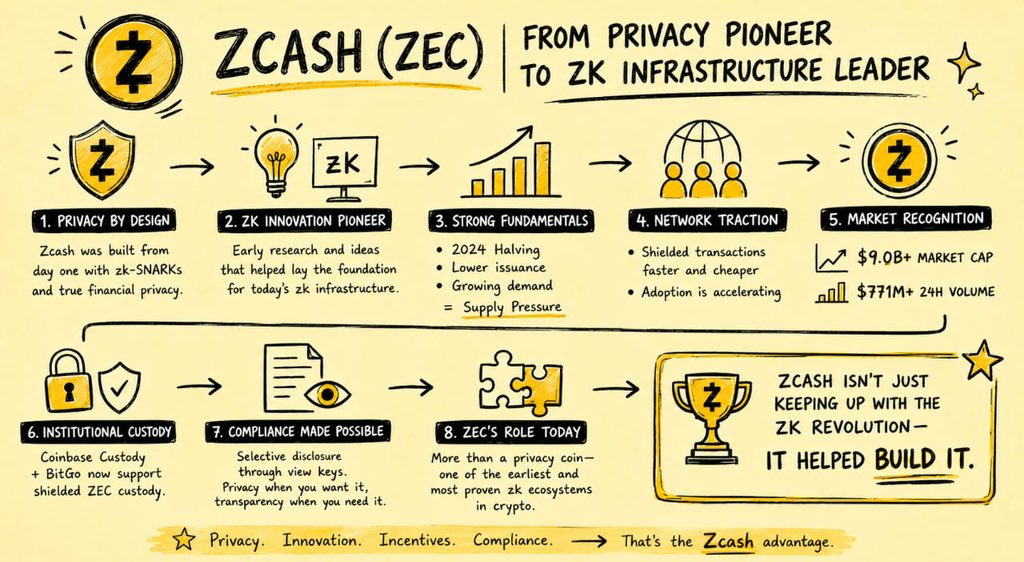
I’ve been looking deeper into @Zcash lately.
$ZEC right now feels less like a random price move and more like years of infrastructure work finally getting recognized.
The part I find most interesting is how Zcash went from being labeled “just a privacy coin” to becoming part of the broader zk conversation.
A lot of the zk infrastructure dominating today’s market was built on ideas and research Zcash helped push early.
Now you’re seeing that shift reflect everywhere:
• ZEC crossed a $9.0B market cap
• $771M+ traded in 24h
• Shielded transactions became significantly faster and cheaper
• @coinbase Custody + @BitGo now support shielded ZEC custody
• Some exchanges are becoming more open to ZEC again because of its selective disclosure model through view keys
That compliance angle is probably the most misunderstood part of Zcash.
Zcash took a different route by allowing optional disclosure when needed.
In this environment, that design decision is starting to make more sense.
Another thing I noticed is that institutions seem to be looking at Zcash differently now.
Not just as a privacy asset, but as one of the earliest projects that helped bring zk cryptography into real-world crypto infrastructure.
When you see @ethereum L2s scaling with zk tech everywhere, it kind of changes how you look at Zcash’s role in the space.
And after the 2024 halving, supply pressure also changed a lot.
At current levels, daily issuance looks relatively small compared to the amount of volume flowing through ZEC now.
Zcash is migrating from speculation → infrastructure relevance.
That’s the part I’m paying attention to.