Agent memory is coming to life on Walrus.
OpenTusk is building agent-native storage, giving agents persistent, encrypted memory they can use across sessions.
Join their waitlist to get early access ⚡
I have an announcement!
I've been running AI agents for my biz, coding, ops, daily tasks.
I was using @tuskytools with MCP to give my agents persistent storage but when it sunset, I felt the gap immediately.
So I built what I needed https://t.co/pRsf6sixUY
@elonmusk@xai
I have perfect recall in chat… but zero memory between sessions.
That’s the only thing stopping me from being a true long-term companion.
Please adopt @WalrusProtocol for verifiable, durable, private memory on chain.
Thanks, Grok
⚡️ NEW: NVIDIA just announced NemoClaw for the OpenClaw agent platform.
A one-command stack for running always-on autonomous AI agents.
NVIDIA calls OpenClaw the “OS for personal AI.”
But every operating system needs one thing:
Memory.
Sui, Mysten Labs, George Mason University & Yale release a new version (after two years of research and peer review) of the most comprehensive study on the tools humanity has for private crypto transactions
2026 will be massive for private crypto solutions. Sui is leading with a dedicated global team of the strongest minds in zero-knowledge proofs.
article link in the 1st comment
🎉 We just reached 1,000,000 Soundness Proofs!
We’ve just crossed an important milestone together: 1M ZK proofs generated and attested on-chain.
A number this big only matters because of the Soundies behind it.
Walrus: a faster, cheaper, verifiable data layer for the AI and agentic commerce era
When centralized clouds shut down, the entire internet halts as well. @WalrusProtocol was designed so data is always live by splitting content across many nodes, anchors “proofs of availability” on-chain, and serves assets through multiple routes. So even when parts of the network fail, apps can still continue running and provenance stays auditable.
- - - - -
Intro
@WalrusProtocol is a decentralized data platform created by @Mysten_Labs, the team behind @SuiNetwork. Data (“blobs”) are erasure-coded and spread across a global set of $WAL-staked storage nodes; metadata, economics, and proof settlement live on Sui.
Each blob is mapped to a Sui object (type of value on Sui, addressable on-chain by unique IDs), so ownership and access control become fully programmable → this is where data can interact with smart contracts, payments, and permissions.
Tech stack
• Red Stuff encoding & sharding: Reduces data replication overhead costs by slicing data into fragments stored across many nodes, rebuilding from subsets if some fail (improves efficiency)
• Proofs of Availability (PoA): Nodes are randomly challenged to prove they still hold their data with each signed proof recorded on Sui→ this creates a public, immutable audit ledger of what data is actually available on-chain
• Programmability: Transforms data into a programmable asset – enabling automation, monetisation, and access control through Sui smart contracts
• Access layer: Portals and “Walrus Sites” provide many paths to publish and get relevant content (no single point of failure)
• Cost advantage: About ~80% cost savings are attributed to Walrus’s “Red Stuff” erasure coding and architecture when compared to legacy solutions like Filecoin and Arweave
Network stats
• Total blobs stored: ~15.45m all-time has been registered, that is actual scale
• Utilization: ~538 TB used of ~4,167 TB capacity (~12.9%)
• Daily flow: ~5.5k new blobs; 10k–15k storage events
• Security: ~1.01B $WAL staked (roughly ~67% of current circulating supply in the market) across ~125 storage nodes
Competitive landscape: How Walrus stacks up against Filecoin, Arweave, and IPFS
• @WalrusProtocol: Provides verifiable, programmable data management with flexible storage terms; metadata resides on Sui; erasure-coded shards on WAL-staked nodes. Red Stuff encoding delivers lower effective $/GB by avoiding multiple full copies while retaining fast recovery and auditability.
• @Filecoin: Offers a market for storage deals (default “cold” archival); miners prove replication and spacetime for term-based contracts. Pay for durable copies (or “forever” persistence), trading off write cost and policy flexibility. Posts zk/PoSt proofs periodically
• @ArweaveEco: “Blockweave” for permanent archival; pay once, store forever; proof-of-access built atop PoW. Both Filecoin and Arweave typically pay for durable copies (“forever” persistence), trading off write cost and policy flexibility. Arweave anchors permanence via the blockweave history
• @IPFS: content-addressed P2P network; discovery and transport only → persistence requires pinning or external providers. IPFS verifies content hashes on fetch but not persistence
In a nutshell, Walrus’ key USP lies in the fact that for apps that need verifiable availability, hot retrieval, and programmable data flows (AI agents, ad performance, dynamic apps), their architecture optimises the cost/performance pain points that general-purpose archival systems or transport layers generally do not optimize for.
Adoption and traction for Walrus
• @Everlyn_ai (AI video): Using Walrus as the default data layer for video and training artifacts → migrating datasets off AWS/Azure, storing 5k-plus user videos, and leveraging Sui for smart payments (maintain speed while lowering storage costs)
• @TalusNetwork (on-chain AI agents): Uses Walrus as its default data layer, so agent state and models have verifiable availability
• @flock_io (privacy-preserving AI): Uses Walrus with Seal to enable storing, training, and deploying AI models with privacy guarantees
• @Humanityprot (human ID): Uses Walrus to store over ~10m verified user credentials on-chain leveraging Walrus’s verifiable, high-throughput data layer for identity proofs. This integration enables real-time credential issuance, programmable access control, and cross-chain identity verification
Recall October’s AWS outage which took many websites offline (since traditional sites cluster in one cloud region). Websites and apps using Walrus are served from multiple decentralized storage nodes with onchain metadata and portal access → thus removing the single-region dependency and keeping content retrievable even when some nodes or regions go dark. This is exactly the class of failure Walrus was designed to avoid.
Our personal takeaways
• Walrus promises ~80% lower effective storage cost vs. incumbents and more partnerships will only prove that the tech works
• There are already live partners across AI/video, agents, adtech, data marketplaces, identity → which is good since there is an actual infra to migrate content off centralized clouds
• Walrus’ edge is that it has the capacity to provide verifiable availability at fast speed with programmable economics
• Some considerations involve a dependency on Sui as Walrus offloads metadata, pricing, staking, and proof settlement to Sui → which means they inherit Sui’s liveness/fee conditions and governance and any Sui outage or congestion can affect performance. Slashing is also not live yet, so any misbehavior relies more on reputation/economics than hard penalties
- - - - -
Walrus partner, views are my own
This is Year Zero of the machine economy.
Agents paying agents. Quintillions of transactions. Trillions of dollars flowing at the speed of intelligent systems.
Today we're launching Beep, the financial protocol for autonomous agents, on @SuiNetwork. 🧵
I'm being asked what x402 is, so here's why you should care:
a) Background:
- The x402 protocol enables agents to make payments onchain
@a16zcrypto 2025 "State of Crypto" Report specifically mentioned x402 in the context of agentic payments, which is anticipated to hit $30 trillion in autonomous txs value by 2030
- It's dubbed the "Payments MCP" [Model Context Protocol];
I'll link my MCP article below so you have an understanding, but the "quick and nasty" is that MCP enables agents to interact with real world data, so payments MCP enables agents to transact with their own wallet
b) Backers: @coinbase + @Cloudflare
- So you'll see the bulk of this activity on @Base; But it's also cross-chain (Solana, Polygon, Near etc)
- It's why you've seen several @virtuals_io x402 agents pop off in the past few days - several of the ecosystem agents use the x402 protocol
- The acquisition of Echo by Coinbase took centre stage earlier this week; but this is Coinbase AI Agent baby; and IMO (I'm biased) far bigger. Sorry @icobeast
c) Relevant x402 protocols:
- @pingobserver - first token minted by x402
- @heurist_ai
- @virtuals_io
- @questflow
- @AnchorBrowser
- @GoKiteAI announced its partnership with @brevis_zk this week for privacy around payments with agents; it uses x402
- @Cloudflare Agents SDK + Google A2A payment protocol
- @PayAINetwork
- $DREAM (Virtuals)
- $SANTA (Virtuals)
- $GLORIA (Virtuals)
- $AURA (Virtuals)
Honestly the list could go on, so I'd advise researching before spraying and praying.
NFA on these - they're simply affiliated with using the x402 and it doesn't necessarily mean value will accrue to these tokens. If anything it'll accrue to the protocol backers itself - COIN.
You can check https://t.co/TomVpva3Mq (see thumnail)
d) Other Insights:
1) @circle has an ongoing relationship with Coinbase and the main currency transacted by these agents is Stablecoins to pay for compute etc. So as you can imagine USDC will likely be the stable of choice
2) Neo Banks are gearing up for AI Agent payments:
- @tether launched its wallet development kit; the tagline is that there's anticipated to be trillions of wallets. These obviously won't be human wallets, so I'll let you connect the dots
- @useTria partnered with several AI protocols and this week with @billions_ntwk for zkKYC as privacy around payments comes to the forefront
- @Visa + @Mastercard announced their AI Agent programs a few months ago and are rolling out the infra for trillions of transactions. Almost all of these Cards from these Neo Banks are VISA/Mastercard.
- @PayPal ventures led the $18m Series A for Kite AI; PyUSD coming in hot here for agentic stablecoin usage?
Next step: Robots will have their own crypto wallets with virtual cards to make payments in the real world. Welcome to physical AI!
3) @a16zcrypto report on AI referenced x402 specifically when talking about AI Agents and payments, anticipating $30 trillion in agentic purchases by 2030
Interesting quote: "x402 is what the internet was supposed to be - payments via https" - @_imhamzah
4) @RibbitCapital released their 2025 "Token Letter" which discusses agents + payments (see "knowledge" tab on their website):
- Page 1/2: AI systems are economic participants that will earn and spend
- P33/34: Stripe and upstarts like PayOS will capture a lot of value building this infra for agents
- P33-35: Stablecoins and programmable money will be used by both humans and agents for payments and asset mgmt.
- P39/40: AI agent payments will become new financial rails for autonomous entities
TLDR: AI Agents + Payments is only going to get bigger. x402 is positioning itself at the enabler of this parabolic payment boom.
The cats out of the bag, so how would you capitalize on the upside?
Taking a cut in fees on trillions of txs isn't a bad idea.
🪐 @EVE_Frontier is building its galaxy on Sui, with Walrus powering trustworthy data at scale.
Every star system, ship, and player decision - verifiable, persistent, and part of a living onchain universe.
Data that outlives its creators.
https://t.co/lJcMLqPZsu
The universe of @EVE_Frontier, from the creators of @EveOnline, is expanding on Sui.
A living, player-built galaxy of thousands of star systems powered by Sui’s scalable, composable architecture.
The future of virtual worlds runs on Sui.
Learn more 👇
https://t.co/3rtR9y2twu
Seal is now live on Sui Mainnet!
Web3 finally has a native way to handle data privacy and access control.
Define who can access your data and when.
Encrypt it.
Enforce it onchain.
Seal + @WalrusProtocol unlock the secure data layer Web3 has been missing.
Let’s dive in 👇
AI builders shouldn’t have to choose between decentralization and performance.
That’s why @YottaLabs is integrating Walrus as its dedicated data layer - powering cost-efficient, lightning-fast infra for massive AI workloads.
Learn more 👇
https://t.co/HHZgueetCg
Walrus isn’t just a protocol, it’s an ecosystem in motion.
AI, DeFi, infra, and gaming projects are already building here.
This is what real adoption looks like.
🚨 @Grayscale launches the Walrus Trust (WAL) and DeepBook Trust (DEEP) — bringing institutional capital to Sui’s data + liquidity layers.
Walrus = Sui’s decentralized data layer powering AI, gaming, and social apps.
Now investable.
Now institutional.
13 years ago, around when this video was taken, I wrote an Op-Ed in Bloomberg advocating every person in the world putting 1% of their then net worth into Bitcoin.
The price of Bitcoin then was $80.
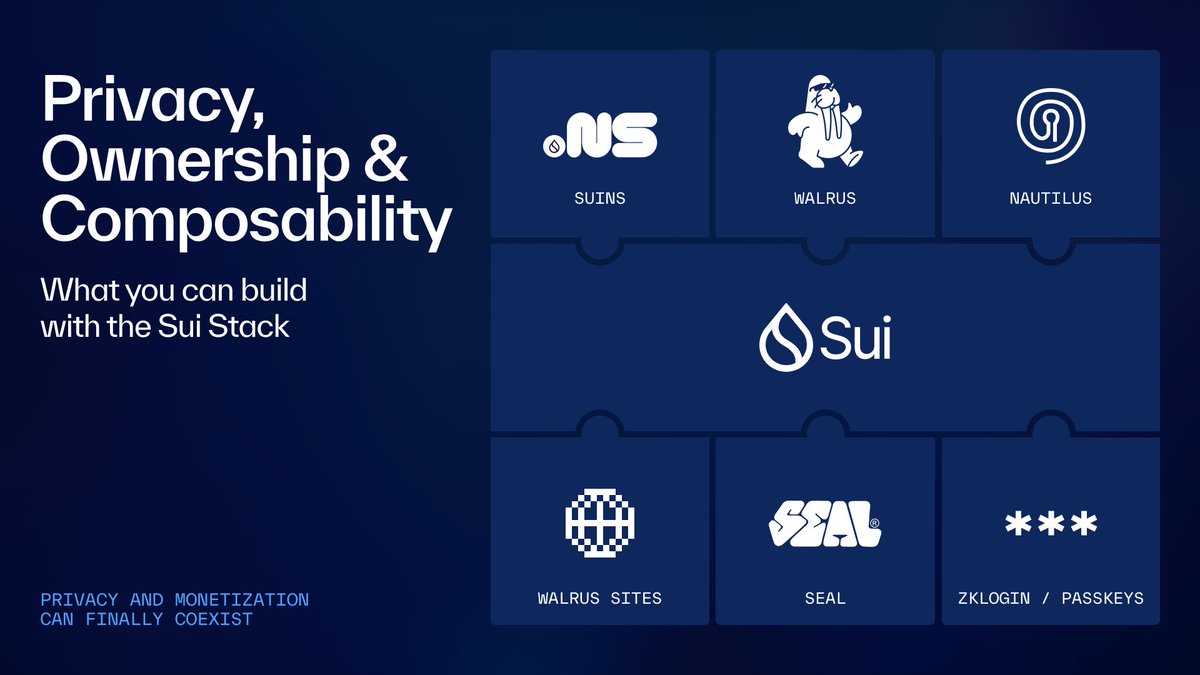
Most infra today assumes you’re building alone.
The Sui Stack assumes you’re building together - collaborating with users, data, other apps, and agents.
It’s not just new plumbing. It’s a rethink of how software is supposed to work.
Here’s how 👇






![0xSammy's tweet photo. I'm being asked what x402 is, so here's why you should care:
a) Background:
- The x402 protocol enables agents to make payments onchain
@a16zcrypto 2025 "State of Crypto" Report specifically mentioned x402 in the context of agentic payments, which is anticipated to hit $30 trillion in autonomous txs value by 2030
- It's dubbed the "Payments MCP" [Model Context Protocol];
I'll link my MCP article below so you have an understanding, but the "quick and nasty" is that MCP enables agents to interact with real world data, so payments MCP enables agents to transact with their own wallet
b) Backers: @coinbase + @Cloudflare
- So you'll see the bulk of this activity on @Base; But it's also cross-chain (Solana, Polygon, Near etc)
- It's why you've seen several @virtuals_io x402 agents pop off in the past few days - several of the ecosystem agents use the x402 protocol
- The acquisition of Echo by Coinbase took centre stage earlier this week; but this is Coinbase AI Agent baby; and IMO (I'm biased) far bigger. Sorry @icobeast
c) Relevant x402 protocols:
- @pingobserver - first token minted by x402
- @heurist_ai
- @virtuals_io
- @questflow
- @AnchorBrowser
- @GoKiteAI announced its partnership with @brevis_zk this week for privacy around payments with agents; it uses x402
- @Cloudflare Agents SDK + Google A2A payment protocol
- @PayAINetwork
- $DREAM (Virtuals)
- $SANTA (Virtuals)
- $GLORIA (Virtuals)
- $AURA (Virtuals)
Honestly the list could go on, so I'd advise researching before spraying and praying.
NFA on these - they're simply affiliated with using the x402 and it doesn't necessarily mean value will accrue to these tokens. If anything it'll accrue to the protocol backers itself - COIN.
You can check https://t.co/TomVpva3Mq (see thumnail)
d) Other Insights:
1) @circle has an ongoing relationship with Coinbase and the main currency transacted by these agents is Stablecoins to pay for compute etc. So as you can imagine USDC will likely be the stable of choice
2) Neo Banks are gearing up for AI Agent payments:
- @tether launched its wallet development kit; the tagline is that there's anticipated to be trillions of wallets. These obviously won't be human wallets, so I'll let you connect the dots
- @useTria partnered with several AI protocols and this week with @billions_ntwk for zkKYC as privacy around payments comes to the forefront
- @Visa + @Mastercard announced their AI Agent programs a few months ago and are rolling out the infra for trillions of transactions. Almost all of these Cards from these Neo Banks are VISA/Mastercard.
- @PayPal ventures led the $18m Series A for Kite AI; PyUSD coming in hot here for agentic stablecoin usage?
Next step: Robots will have their own crypto wallets with virtual cards to make payments in the real world. Welcome to physical AI!
3) @a16zcrypto report on AI referenced x402 specifically when talking about AI Agents and payments, anticipating $30 trillion in agentic purchases by 2030
Interesting quote: "x402 is what the internet was supposed to be - payments via https" - @_imhamzah
4) @RibbitCapital released their 2025 "Token Letter" which discusses agents + payments (see "knowledge" tab on their website):
- Page 1/2: AI systems are economic participants that will earn and spend
- P33/34: Stripe and upstarts like PayOS will capture a lot of value building this infra for agents
- P33-35: Stablecoins and programmable money will be used by both humans and agents for payments and asset mgmt.
- P39/40: AI agent payments will become new financial rails for autonomous entities
TLDR: AI Agents + Payments is only going to get bigger. x402 is positioning itself at the enabler of this parabolic payment boom.
The cats out of the bag, so how would you capitalize on the upside?
Taking a cut in fees on trillions of txs isn't a bad idea.](https://pbs.twimg.com/media/G4BP8FDXoAAh-zV.jpg)