Many of you have been waiting for a mobile version of OpenBot, now it’s here.
iPhone users can now use OpenBot directly on their phones.
Scan the QR code, join the public TestFlight beta, and start using.
Your AI assistant, now in your pocket.
Jev + SERV is actually insane. We are bringing Jev-powered Decision nodes into Graph Sharding with the upcoming SERV v3.
Instead of relying on a single model for every task, Graph Sharding breaks complex AI workflows into specialized execution paths: using different models for what they do best.
Graph Sharding can use LLMs where generation is needed and Jev where fast, consistent decisions are needed, with SERV Reasoning improving their accuracy and consistency.
We've already shown what happens when Jev meets SERV Reasoning. With v3, we're taking that further by bringing Jev-powered Decision nodes into Graph Sharding.
This combination is designed to deliver faster decisions, lower latency and costs, more consistent execution, and greater visibility and control over how agents reason, decide and act.
And that's part of a much bigger shift in how we see AI infrastructure evolving.
Enterprise AI will not run on a single model, but on systems built to orchestrate intelligence across specialized models and workflows.
As models continue to improve, more specialized intelligence will emerge and agentic workflows will become increasingly complex. As the agentic economy scales alongside them, billions of autonomous decisions will need to happen reliably, efficiently and at machine speed.
That makes the infrastructure connecting and orchestrating all of this intelligence increasingly important.
Our vision is to become the reasoning infrastructure powering enterprise AI, making increasingly powerful and specialized intelligence reliable, efficient and ready for the agentic economy.
v3 is the next step toward that vision.
SERV Reasoning is live: https://t.co/0d1Gqi55AU
GPT-6 Sol and Luna just landed in Astra’s orbit.
Both launch today with API prices 50% lower than GPT-5.6.
Build with Sol. Scale with Luna. To production and beyond.
$SERV @openservai
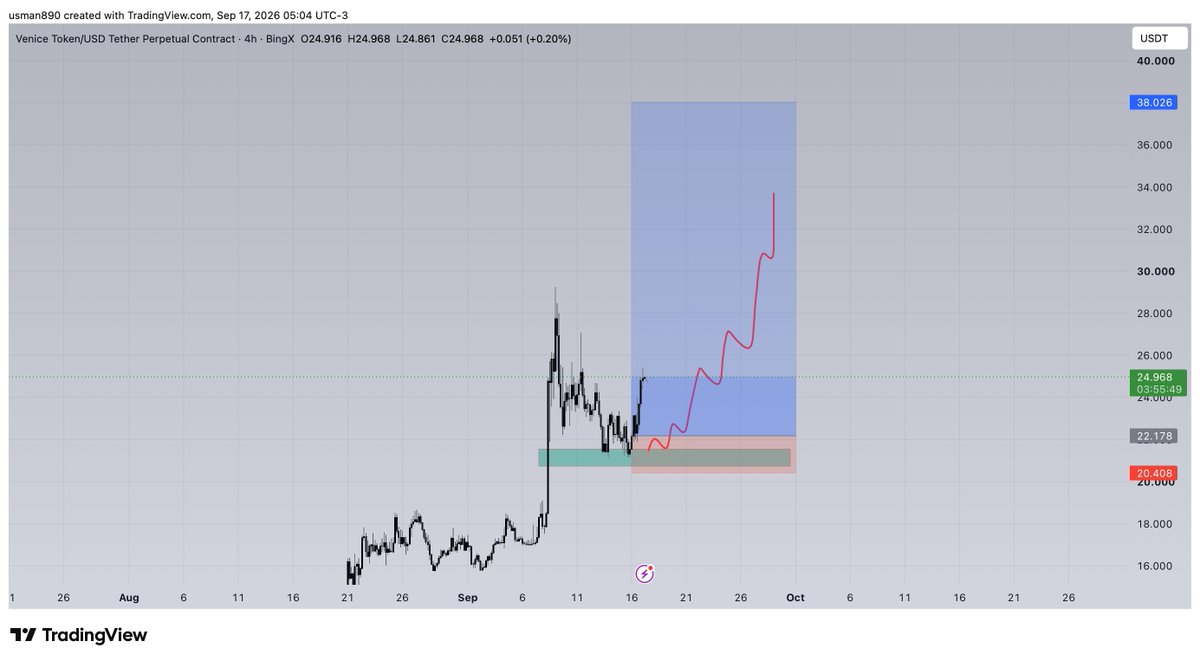
I think the real run will start soon.
Inverse Head and Shoulders on Weekly.
This can send it to $1 and beyond like $FET did in the past.
AI agent infrastructure.
Why i think that $SERV can run like $FET to $1 and beyond?
$SERV around $0.02 with ~770M circulating / 1B max means $1 is roughly 45–50×, or about $770M market cap / $1B FDV. That is a big move, but it is not an absurd crypto multiple if the product actually becomes default agent infrastructure and the token is the meter for that usage.
What $1 actually requires?
You do not need next OpenAI. You need the market to price SERV as the pick and shovel layer for production agents, with cash flowing through the token.
A simple way to think about it:
If 25% of Reasoning API + B2B revenue is used to buy and burn $SERV, then $1B FDV can be supported by a narrative of tens of millions in annual run rate, not billions if investors believe that revenue is recurring, growing, and mechanically tied to supply reduction.
Example $40M/year of platform revenue $10M/year of buybacks. On a $1B FDV that is a 1% annual sink, which is modest. The multiple comes from growth expectations (agents exploding, SERV becoming the default router) plus scarcity if burns start compounding while float stays sticky.
So the bull case is not $1 because of vibes. It is usage, revenue, 25% buy/burn, tighter float, multiple expansion because the asset is now a claim on agent inference, not just another AI ticker.
1. The product sits on a real bottleneck
Frontier labs sell raw intelligence. Banks, governments, and production agent stacks do not fail because the model is not smart enough. They fail because:
one user request becomes a chain of calls, retries, and tool use
cost explodes
outputs drift
there is no audit trail.
SERV’s pitch is a compiler/reasoning layer turn English into bounded graphs, force schemas, verify with shadow agents, keep an audit log, swap one base URL. If that works even partly as advertised, it is not competing with GPT/Claude. It is selling the missing production layer those models need.
Every agent framework (LangChain, custom stacks, n8n like tools, crypto agent platforms) becomes a distribution channel. SERV does not need to win the model war. It needs to become the default inference sidecar.
2. Cost is the wedge that can force adoption
If small models + SERV can approach frontier quality at a large fraction of the cost, procurement math changes:
startups stop burning cash on GPT class chains enterprises can run 10 to 100× more agent steps for the same budget open source models become good enough because the graph constrains them.
That is how you get volume. Agent workloads are not one completion. They are loops. A 20 to 90× better performance per dollar claim, even if discounted heavily, still points at a product that can steal inference share without winning a single brand-name model bake off.
At $1, the market is assuming this cost wedge is real enough that routing traffic through SERV becomes habit.
3. Regulated buyers pay for auditability, not demos
The bull case gets much stronger if SERV is not just cheaper ChatGPT.
Banks, payments, government, insurance, tax, robotics, and compliance need.
traceable decision graphs
no training on their data
injection/leakage controls
something they can show a regulator
That is a different budget. Those buyers pay for risk reduction. They also take longer but once in, they do not churn like crypto users.
Neol / UAE government style production claim. Thought Proof style third party benchmark. EPAA / bank working group proximity. Greg Ivanov (ex Google Play partnerships) as the enterprise door opener.
If even a handful of regulated deployments go from pilot, production contract, SERV stops looking like a $15 to 20M token and starts looking like vertical infrastructure. Comparables in crypto AI that only had memes and launchpads never got that second buyer.
4. Two sided flywheel the market can actually understand. Most AI tokens have a story.