TRUMP DIDN'T START THE IRAN WAR TO DESTROY IRAN. HE STARTED IT TO SAVE THE U.S. DOLLAR.
Before the first bomb dropped, the petrodollar was visibly falling apart, Fast.
Saudi Arabia publicly said for the first time since 1974 that it was open to settling oil in other currencies. Then the actions followed.
China and Saudi Arabia signed a 50 billion yuan currency swap. Saudi Arabia joined mBridge, the system built explicitly to bypass SWIFT and the dollar. The original 1974 petrodollar agreement was allowed to expire without renewal.
India was buying Russian oil settled in rupees and yuan. One fifth of all global oil trade was already settling outside the dollar by 2023.
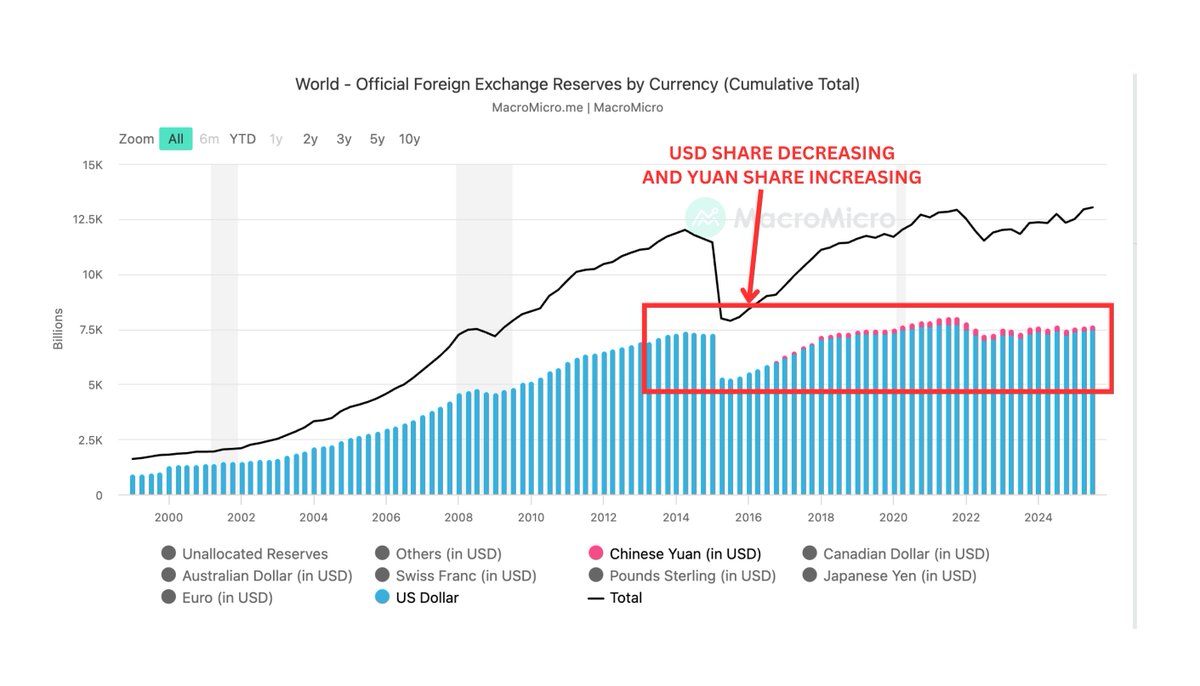
The dollar's share of global reserves had fallen to a 30 year low.
The petrodollar was dying already.
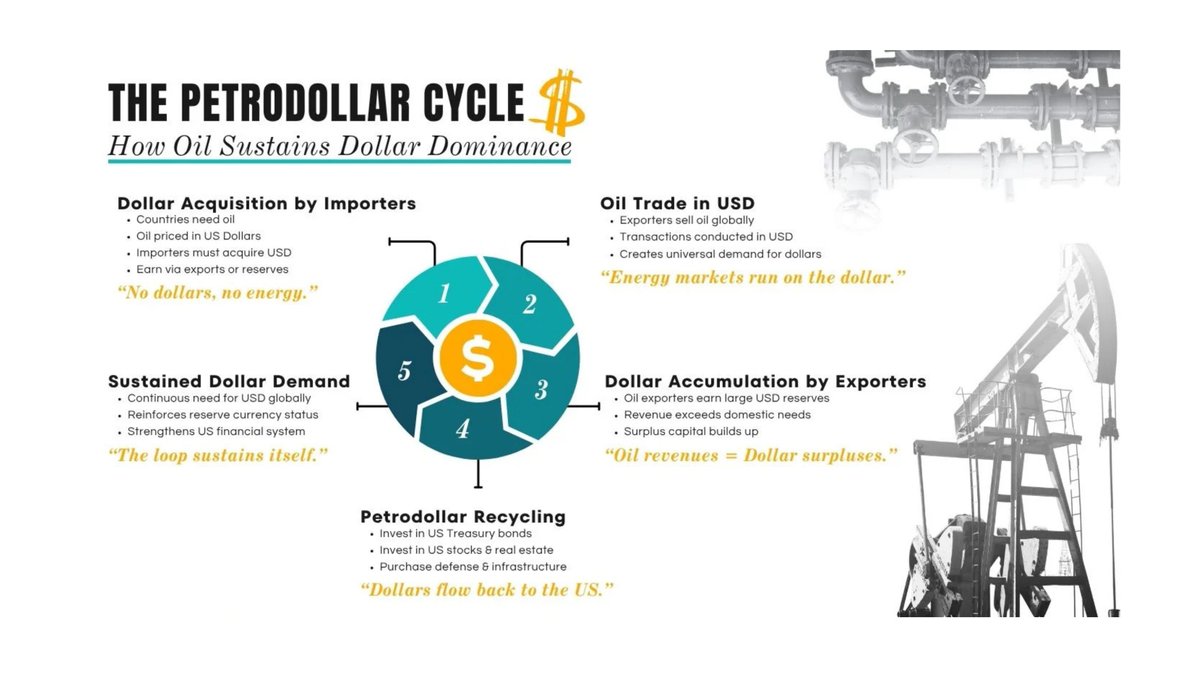
To understand why this matters you need to understand what the petrodollar actually is.
It is a protection deal.
In 1974, Kissinger flew to Riyadh and made a secret agreement with King Faisal. Saudi Arabia prices oil in dollars and recycles profits into US Treasuries. In return, America guarantees Saudi security.
Weapons, troops, and the promise that US military keeps the shipping lanes open. Every OPEC member followed within a year.
The arrangement gave Washington something extraordinary. A permanent buyer for its debt. The ability to borrow cheaply and run deficits indefinitely while maintaining the world's reserve currency.
For fifty years Gulf states believed this was a partnership. It was not. It was leverage. And when Gulf states started building their own exits, that leverage had to be demonstrated again.
On February 28, 2026, the demonstration began.
Iran closed the Strait of Hormuz. Kuwait has no bypass pipeline.
Qatar sends 93% of its LNG through it. Saudi Arabia exports 5.5 million barrels per day through it. Multiple Gulf energy companies declared force majeure simultaneously for the first time in history. Oil hit $120. R Refineries were shut.
The IEA called it the largest energy supply disruption in history.
And the same Gulf states that had been quietly building yuan settlement systems and joining Chinese financial infrastructure found themselves with their entire economic survival at stake and only one country capable of doing anything about it.
They went back to Washington and asked for help.
Saudi Arabia reversed its refusal to grant the US military base access. The UAE declared willingness to join a US coalition.
The GCC went to the UN and called for US-backed force to reopen the strait. Countries that had been distancing themselves from American dependence for two years were suddenly asking America to come back and protect them.
That is not a coincidence, That is the leverage being applied.
Now look at what happened to the dollar while all of this was happening.
DXY surged to a 10 month high. Gold collapsed 13 to 20%, its worst month since 2013. Investors sold alternative stores of value and bought dollars.
Every barrel of emergency oil released by the IEA was priced and settled in dollars. SWIFT data showed the dollar's share of global transactions at its highest level in years.
And Gulf states who had been accumulating yuan and building alternative payment systems ended up spending their crisis buying American weapons instead.
A $16.5 billion emergency arms package was approved during the war. The petrodollar recycling mechanism, dollars earned from oil flowing back into American defense industry, ran perfectly.
Now look at what Trump had been saying for years before the war.
He threatened BRICS nations with 100% tariffs if they backed any alternative to the dollar. He said directly that losing the world's reserve currency would be "like losing a war."
His National Security Strategy, published one month before the bombs fell, explicitly named preventing any power from controlling Middle Eastern oil chokepoints as a core US interest.
After the war started he posted publicly: "With a little more time, we can easily OPEN THE HORMUZ STRAIT, TAKE THE OIL, and MAKE A FORTUNE."
This is the part that should make every Gulf state rethink everything.
The system was sold to them as a partnership. America protects you. You price oil in dollars. Mutual benefit. But when Gulf states started building exits, a war appeared that destroyed their ability to use those exits and forced them back into dependence.
Gulf states spent two years building non dollar infrastructure.
Then a crisis arrived that made all of it irrelevant overnight and left them with no option except to ask Washington for protection. The dollar surged.
American weapons factories got new orders. And the countries trying to escape the system found themselves locked back inside it.
That is a reset. And the people who paid for it are the same ones who always pay, The Gulf.
The petrodollar was never a partnership.
It was always a system designed to make American power self financing. The Iran war did not threaten that system. It renewed it.
@RSymonsLTD I’m afraid when 90% of us will drive EVs , government will do new taxes & the only advantage will be cheap/free home charging .
The best time to drive EV is today
Historically, S&P 500 starting Shiller P/E ratios show an inverse correlation with subsequent 10-year annualized returns (based on data since 1880s from sources like Shiller and Vanguard analyses):
- Low P/E (<15): Average ~10-15% returns
- Moderate (15-25): ~5-10%
- High (>25): ~0-5%, sometimes negative real returns
Current Shiller P/E is ~39.8 (Feb 2026), pointing to potentially low returns (~0-3%), though factors like earnings growth can influence outcomes. Not a prediction; markets vary.