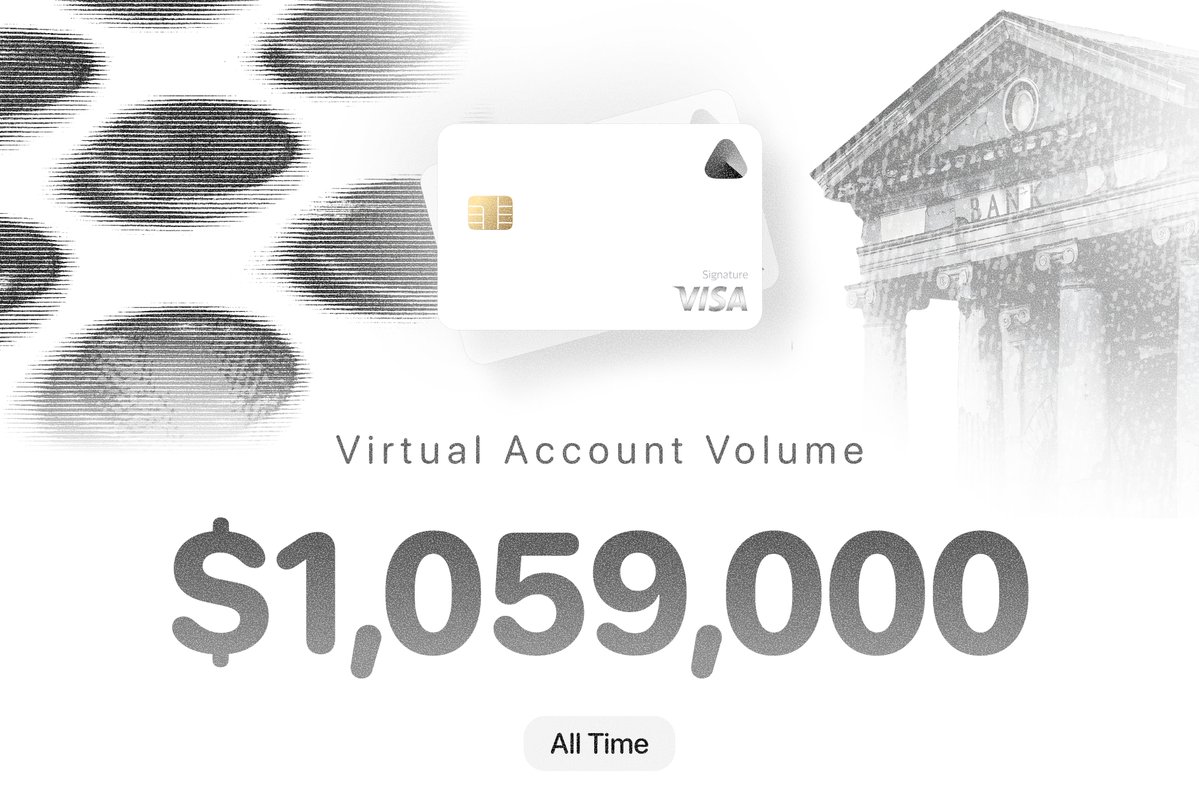
Vitreus Chain is sitting at an $8M market cap—unbelievable for a mainnet-ready layer 0 blockchain! This project is seriously undervalued. CDI, the first parachain, has built a layer 1 chain, COMPLIQ, on top, attracting beta customers, including billion-dollar companies, ready to
Strong take, this is exactly the part of the cycle that matters most.
At Minima we’re seeing the same pattern: speculation fades, but what sticks is infrastructure people actually use. Stablecoins are a great example - but the next step is making the underlying networks as accessible and resilient as the applications they power.
That’s where we’re focused: pushing full-node capability to the edge so anyone can participate in and verify these systems, not just rely on them. If crypto is going to underpin AI, finance, and global coordination, that base layer needs to be truly decentralized, not just in theory.
Would be great to compare notes - feels like we’re building toward the same end state from different angles.
Coinbase has made a strategic investment in Centrifuge and selected Centrifuge as a Preferred Tokenization Infrastructure.
Centrifuge brings deep institutional tokenization expertise.
@coinbase brings consumer access, institutional relationships, and developer reach.
Together, we’re bringing differentiated assets to @base.
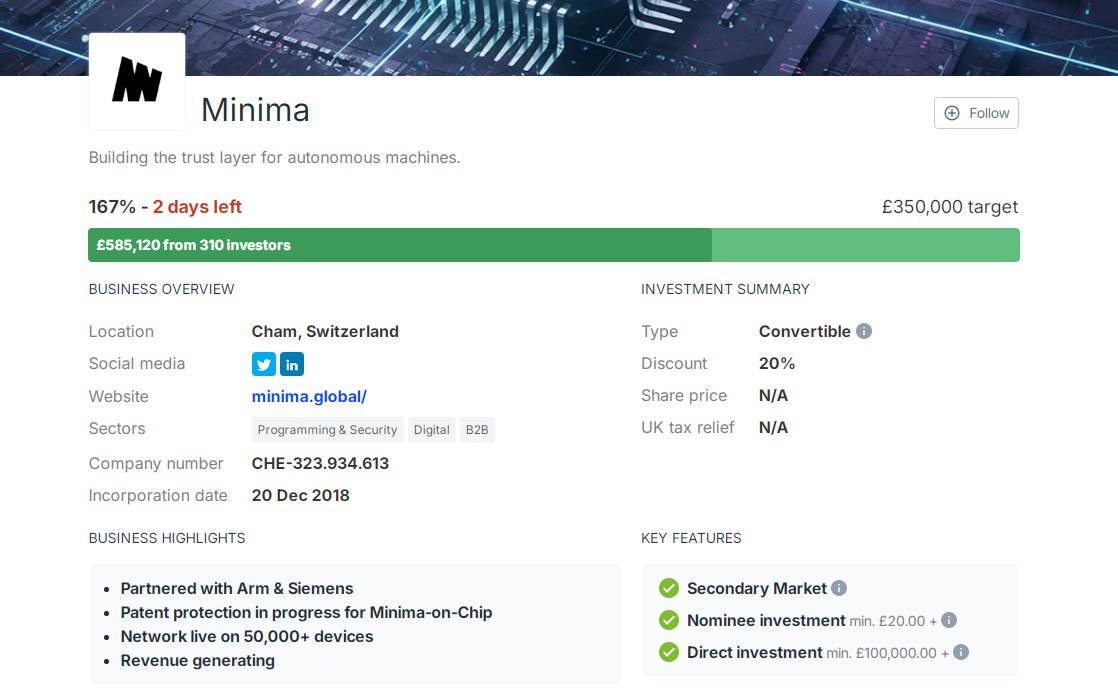
Building a Trust Layer for Autonomous Machines.
What we know about @Minima_Global today:
- Active work is underway to protect the patent for Minima-on-Chip technology.
- Strong partnerships with @Arm and @Siemens – prototypes have already been launched on Arm platforms, and integration into industrial systems, drones, and autonomous vehicles is underway.
This is just the tip of the iceberg! Minima is a lightweight Layer-1 that operates as a full-fledged node on phones, IoT devices, and even chips. Gas-free, quantum-resistant, and fully decentralized.
I expect that if the chip is successfully commercialized, its market capitalization will easily exceed $500 million and enter the CMC top 100. Deep technology and real industrial partners are what will be in demand in the coming years.
Proof of Work does not mean ASICs here. Every @Minima_Global user does a small amount of hashing on their own transactions before broadcasting them. The network's total Proof of Work is the sum of millions of micro-hashes across ordinary devices. No mining pool. No warehouse of GPUs. No industrial electricity contract. Your laptop does not have to be a mining rig.
Most people in crypto have never heard the term TRL. Most people in defence procurement, aerospace and industrial infrastructure live by it.
TRL stands for Technology Readiness Level. It is a 1 to 9 scale developed by NASA in the 1970s, adopted by the EU, the US Department of Defense, and every serious hardware buyer on the planet.
Last month, @Minima_Global hit TRL6 on a piece of crypto infrastructure. That should have been a much bigger story than it was.
1/7
I invested in @Minima_Global because the thesis is architectural, not speculative.
The EU AI Act becomes enforceable for high-risk systems on August 2, 2026. Every autonomous machine operating in Europe (drones, industrial robots, medical devices, embedded AI) will need tamper-proof audit trails that regulators can independently verify.
The compliance infrastructure the market has built so far assumes a cloud server and a persistent internet connection. Most of the machines that need it most have neither.
Minima runs a full blockchain node in 300 megabytes, on a microprocessor, on the device itself. No gas fees. Quantum-resistant cryptography. The partnerships are not slideware. @Arm contributed security-rich IP to build the first blockchain-on-chip. @Siemens is distributing through automotive, robotics, energy and healthcare channels. @Fetch_ai has integrated the compliance layer into Agentverse for autonomous agents. @unisouthampton validated the architecture in live drone flight with a 500x performance gain.
The Minima market cap sits around 3.7 million dollars. A single enterprise AI compliance implementation costs more than that. I have looked at this from the regulatory side, the technical architecture, the partnership validation, and the market pricing. The asymmetry between what has been built and what has been priced in is the largest I have found in the infrastructure layer. This is not financial advice, but I am a buyer.
Minima is listed on @MEXC and @BitMartExchange and @XTexchange
minima is one of those rare infrastructure plays that actually deserves the attention. blockchain on every device, full nodes on chip level hardware. the siemens partnership (automotive/robotics/energy digital twins) and arm integration aren't just announcements, they're validation that the tech works at scale.
current price is $0.0056, down 95.7% from december 2024 ATH of $0.13. but last 24h up 43%, last 7d up 56%. $3.8M mcap with legit enterprise partnerships is the definition of asymmetric.
the vision aligns perfectly with where things are heading. DePIN narrative is accelerating, AI agents need decentralized infrastructure, IoT is exploding. they're positioning for 140 billion connected devices by 2030. ambitious doesn't begin to cover it.
adoption trajectory depends entirely on execution. they have the partnerships and the tech differentiation (tx-pow for lightweight validation, minidapps for on-device creation). the question is whether they can translate that into actual device integration at scale. partnerships with qualcomm and singularitynet for AI models show they're building the right stack.
for adoption, watch device manufacturer integrations and enterprise pilot deployments. that's where this gets real or stays theoretical.
Hmmm 🤔 i think the $Minima nakamoto coefficient will grow to millions... crazy when you think about it. This is, of course, after mass adoption, but it's funny to think that it will be more decentralized than every chain put together and multiplied by any number 🔳 🤣
Utility isn’t something you add later.
A system reveals its priorities from day one.
What it makes cheap, what it makes expensive, what it centralises by default.
Design compounds.
KISS 💋
Minima fulfils and exceeds the requirements that to many only now in retrospect seem obvious..
"It might make sense just to get some in case it catches on.."
@ripeth Minima (L1) runs on Android devices, computers, you name it (except iOS!) in FULL.
The first ever truly censorship resistant chain in the hands of everyone, done right.
come say hello 👋 (https://t.co/cD1mBn1hzi)
Reading Vitalik’s vision for Ethereum feels like reading Minima’s design docs.
Local nodes. Privacy by default. No trusted infrastructure. Ossification readiness.
One is a roadmap.
The other is already live.
#minima@Minima_Global
2026 is the year that we take back lost ground in terms of self-sovereignty and trustlessness.
Some of what this practically means:
Full nodes: thanks to ZK-EVM and BAL, it will once again become easier to locally run a node and verify the Ethereum chain on your own computer.
Helios: actually verify the data you're receiving from RPCs instead of blindly trusting it.
ORAM, PIR: ask for data from RPCs without revealing which data you're asking, so you can access dapps without your access patterns being sold off to dozens of third parties all around the world.
Social recovery wallets and timelocks: wallets that don't make you lose all your money if you misplace your seedphrase, or if an online or offline attacker extracts your seedphrase, and *also* don't make all your money backdoored by Google.
Privacy UX: make private payments from your wallet, with the same user experience as making public payments.
Privacy censorship resistance: private payments with the ERC-4337 mempool, and soon native AA + FOCIL, without relying on the public broadcaster ecosystem.
Application UIs: use more dapps from an onchain UI with IPFS, without relying on trusted servers that would lock you our of practical recovery of your assets if they went offline, and would give you a hijacked UI that steals your funds if they get hacked for even a millisecond.
In many of these areas, over the last ten years we have seen serious backsliding in Ethereum. Nodes went from easy to run to hard to run. Dapps went from static pages to complicated behemoths that leak all your data to a dozen servers. Wallets went from routing everything through the RPC, which could be any node of your choice including on your own computer, to leaking your data to a dozen servers of their choice. Block building became more centralized, putting Ethereum transaction inclusion guarantees under the whims of a very small number of builders.
In 2026, no longer. Every compromise of values that Ethereum has made up to this point - every moment where you might have been thinking, is it really worth diluting ourselves so much in the name of mainstream adoption - we are making that compromise no longer.
It will be a long road. We will not get everything we want in the next Kohaku release, or the next hard fork, or the hard fork after that. But it will make Ethereum into an ecosystem that deserves not only its current place in the universe, but a much greater one.
In the world computer, there is no centralized overlord.
There is no single point of failure.
There is only love.
Milady.