1/ KPK USDC Prime RWA is live on @eulerfinance.
A non-custodial vault where USDC lenders earn yield from tokenised US Treasuries and investment-grade credit. Collateral issued through @Securitize, risk curated by KPK.
This Sunday in Tel Aviv 🇮🇱
Custody, compliance, onchain security: we're co-hosting an evening with @ColliderVC to bring together the teams solving the hardest infrastructure problems in DeFi.
Speakers from @Chainalysis, @StarkWareLtd, @HypernativeLabs, @addressableid, and @Utila_io.
May 31 · 5 PM
↓ Register (spots limited)
https://t.co/B8RjggrCCC
Coverage needs to be the default for institutional DeFi.
Now let’s talk about what that means for vaults, risk, and capital allocation on @ethereum.
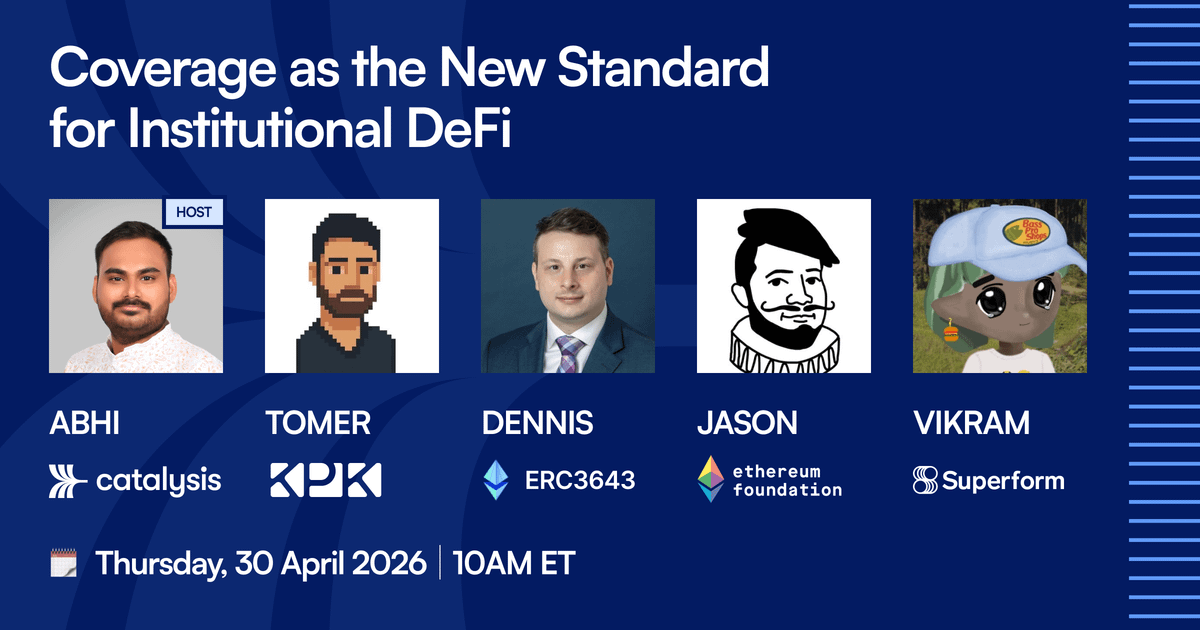
Tune in Thursday as Catalysis Founder Abhi (@xenowits) hosts,
> Tomer @kpk_io
> Dennis @ERC3643Org
> Jason @ethereumfndn
> Vikram @superformxyz
📅 April 30 | 10AM ET | Join us using the space link below:
When the Resolv exploit hit, our vault architecture worked exactly as designed.
Risk detected. New allocations blocked. Position recovered automatically the moment liquidity returned. Same block, no manual intervention.
Funds fully recovered. Zero loss to depositors.
@HypernativeLabs real-time monitoring was part of the stack that made this possible.
Update on the Resolv situation.
TLDR: kpk's vault architecture worked as designed under real stress. We detected the risk, paused new allocations, and the vault exited automatically the moment liquidity became available. The withdrawal queue design proved itself without requiring any manual intervention.
All Ethereum funds fully recovered. Zero loss to depositors.
Following the USR minting exploit on Sunday, our Morpho USDC Yield vaults on Ethereum and Arbitrum had limited exposure to the RLP collateral market.
When the risk was detected, we immediately set the risk tolerance on the affected market to zero and blocked new allocations. The vault's withdrawal queue was configured to recover the position automatically as soon as liquidity returned.
That's exactly what happened. The moment a borrower repaid, a depositor's redemption cascaded through the vault's withdrawal queue, recovering the full amount. Same block, no manual intervention needed. The vault's architecture handled the exit.
Result: all Ethereum funds fully recovered. Zero loss to depositors.
Concentration limits had already capped our maximum exposure to the market. This is a core part of how we curate: when an individual market fails, the loss ceiling is set at inception, not determined by the speed of the response.
Deposits into the Ethereum Yield vault have been re-enabled. The Arbitrum Yield vault is still paused, with ~$1k remaining exposure to Resolv markets. Withdrawals were available to depositors throughout, across both chains.
Where we go from here
We're using this as an opportunity to strengthen our monitoring and emergency response processes. This includes enhanced oracle divergence monitoring, faster automated exit triggers, and tighter integration with onchain security alerting services.
Full documentation of our vault risk framework, including how caps, tiers, and agents work: https://t.co/RVmT4xUkXc
Scaling DeFi returns during @EthCC. 🇫🇷
Thanks to our sponsors @eulerfinance, @GearboxProtocol, @Anchorage and @redstone_defi for making it possible.
Featuring speakers from leading DeFi protocols and institutional teams.
March 31 · Cannes
1/ Regulated tokenised RWAs are moving towards DeFi composability via structured, isolated lending markets.
Following @Securitize’s DS Protocol integration, kpk will curate isolated lending vaults for selected tokenised assets on @eulerfinance.
Built to scale, with clear controls. 🧵
kpk expands its curated vaults to @MorphoLabs, offering the same infrastructure that manages DAO treasuries to open markets.
Vaults operate autonomously through policy-defined agents that optimise performance and preserve liquidity.
Read more 👇🏻
https://t.co/Rq2mQye3xq
@cuntycakes123@kpk_io Definitely learn something today, not to argue with random retards that call others retards when they have absolutely no clue what they are talking about. HFSP bro
@cuntycakes123@kpk_io If you had any idea how their NAV calculations works, who validates it, and who updates the SC exchange rate, you would finally shut the fuck up and be a bit less arrogant and a bit less ignorant.
@cuntycakes123@kpk_io Available Liquidity Buffer - Fordefi 7 - 4.51M? Ya.. Na.. more like 1.8M
https://t.co/2sjV7Bu2qd
Safe 2 - 7.5M? Ya.. Na.. more like 0
https://t.co/I8dAFsMPR0
But all good bro, trust them bro, 60% APY on your USDC at the Hyperithm Morpho vault bro, deposit all you got bro
Stream Finance has announced the insolvency of its protocol. This statement aims to address Stream Finance’s position with mHYPER and provide clarity to holders.
Stream Finance is a yield-aggregating platform that allocates capital across various on-chain and off-chain strategies to generate returns for its LPs. As part of its yield-farming strategy, Stream Finance built a leveraged position in mHYPER over the past weeks. As of today, Stream Finance holds approximately $75M worth of leveraged mHYPER positions.
Hyperithm and the Midas team are working closely with Stream Finance to support a gradual and orderly unwinding of these positions and to ensure that any potential liquidations occur smoothly.
When a leveraged mHYPER position exceeds its LLTV on lending markets such as Morpho or Euler, any participant can take over and unwind the position through the instant redemption feature on Midas. mHYPER currently maintains over $75M in liquidity buffer to facilitate instant redemption, ensuring that liquidations are always executable and profitable for liquidators.
mHYPER holders remain unaffected, and the vault continues to operate as normal.
I strongly recommend withdrawing from mHYPER
They held a huge xUSD position just days ago
mHYPER is a Midas vault, it’s regulated as a security under MiCA / German law
If Stream committed fraud, mHYPER could face bankruptcy clawback risk
Courts could socialize the losses