Thank you, Michael @saylor.
A lot of thought and effort went into making this list that you generously share with us.
The world would be a much better place if leaders took the time to be prepared by studying these books.
Rosenblatt built a proprietary supply & demand model for the entire InP laser industry.
Buried in the table is the single most bullish $AAOI datapoint I’ve seen.
Every EML and CW laser for AI optics is made from indium phosphide, a rare compound so hard to grow that ONE 6-inch InP wafer costs thousands of dollars.
Only six names matter: $LITE, $COHR, $AVGO, Mitsubishi, Sumitomo, and $AAOI.
Their model’s findings:
▸ InP datacom supply exited 2025 running ~50% BEHIND demand
▸ The industry plans to scale capacity ~12x by 2030
▸ And even AFTER that 12x increase, demand is STILL ~50% ahead of supply exiting 2030
▸ Their words: an industry set to “grow in a non-cyclical manner well past 2030”
Read that again. A 12x supply expansion doesn’t close the gap. That’s how steep the demand curve is.
The kicker is that $NVDA asked the supply chain for a ~20x increase. The vendors agreed to ~12x.
The shortage is being locked in BY DESIGN, because nobody wants excess capacity.
Undersupply plus discipline equals pricing power for everyone who can actually make these lasers.
Now the $AAOI row of their capacity table (laser revenues):
▸ 2025 → $60M
▸ 2026 → $150M
▸ 2027 → $350M
▸ 2028 → $700M
▸ 2029 → $1.2B
▸ 2030 → $2.1B!!!
That’s ~35x growth, the steepest trajectory of ANY supplier in the model.
And separately, Rosenblatt sees AAOI roughly doubling its transceiver market share from under 5% to nearly 10%, while entering the ultra-high-power CW laser market for CPO.
This report is dated May 28, when $AAOI traded at ~$180. The model hasn’t changed. The stock is ~$100.
Execution decides everything. But when the axe on the sector maps a six-company oligopoly, a decade-long structural shortage, and puts your name on the steepest growth curve in the model… you pay attention.
Credits to @DjRusya for the image
TL;DR:
$SIVE needs to LARP as $LITE.
Same layer. Similar arc.
AI go brrr.
Lasers go pew pew.
My take: use Sol 5.6 Max, do the deep research yourself, and come to your own conclusion. Otherwise you'll never sleep easy.
$SIVE is doing exactly what the structure mapped.
Wave (2) ABC correction — nearly complete.
Entry Zone: SEK 25.80 (0.786 retracement). Price is knocking on the door right now.
This is the reload before Wave 3 launches.
Targets:
1.618 → SEK 203
2.0 → SEK 244
From SEK 25 to SEK 244. That's the mmWave semiconductor thesis playing out on a chart.
5G. Satellite. Defense radar. The demand doesn't disappear - it accelerates.
Are you watching the entry zone in $SIVE?
I agree with this information
Setting aside that there is direct confirmation that Ayar Labs and $SIVE are partners
It is good to technically emphasize that this is the case for the most skeptical:
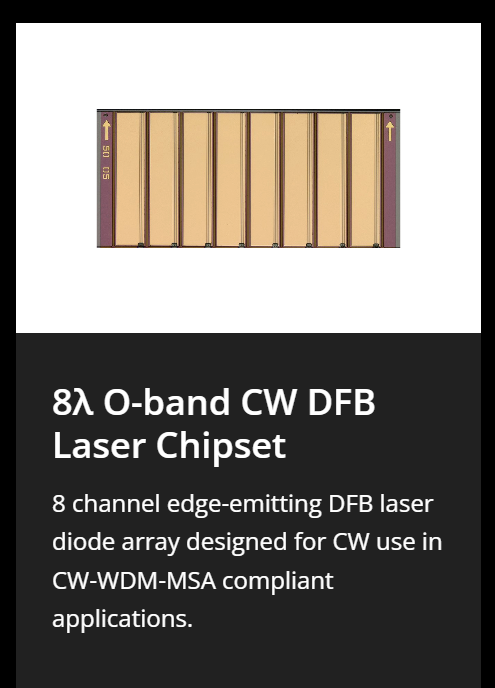
The 8λ O-band CW DFB laser chipset from $SIVE
An 8-channel side-emitting DFB laser array, CW-WDM MSA compliant, custom designed and supplied in high volume as a die for another company to integrate into its own module
The CTO of Ayar Labs cited this about SuperNova:
“Ayar Labs uses the DFB cell from $SIVE and has adapted it to create a module packaged laser array, with the lasers multiplexed and split into wavelengths”
An 8 or 16-port module, 16 wavelengths per port
Same wavelength architecture, same standard
$SIVE is a founding member of CW-WDM MSA, same business model
$SIVE sends the raw laser die, Ayar Labs packages it into its own finished light source
Just another piece of evidence showing the Ayar Labs and $SIVE connection is real. $SIVE's own product spec sheet against what Ayar Labs' CTO actually described, and the match is precise.
$SIVE's 8λ O-band CW DFB Laser Chipset. An 8 channel, edge-emitting DFB laser array, CW-WDM MSA compliant, custom designed and supplied in high volume as die for another company to integrate into their own module.
Ayar Labs' CTO's own words on SuperNova. "Ayar Labs uses Sivers' DFB cell and has adapted it to create a laser array packaged in a module, with the lasers multiplexed and split into wavelengths." An 8 or 16 port module, 16 wavelengths per port.
Same wavelength architecture. Same standard, $SIVE is a founding member of CW-WDM MSA. Same business model, $SIVE ships the raw laser die, Ayar Labs packages it into their own finished light source.
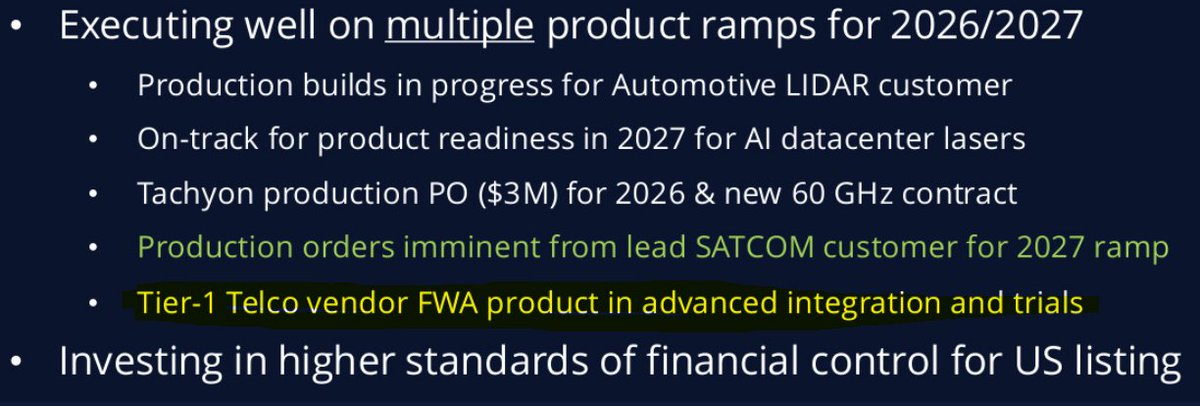
Looking at product ramps... On the Q1 2026 report $SIVE mentioned that their teir-1 telco vendor is in advanced integration and trials with a product they want to release end of 2026. I think its Nokia, many think its Nokia, and it's probably Nokia. $SIVE confirmed a $5.4 million chip development program for a next generation mmWave beamforming transceiver back in January 2025, product release targeted end of 2026, real revenue contribution expected 2027.
If it stays on track, expect some kind of announcement once it actually converts, $SIVE has put out a press release for basically every other real milestone this year, though they've historically kept these customers unnamed even then.
On timing for the financials, given the end of 2026 release date, the realistic window to actually see revenue show up is the Q4 2026 report on February 25, 2027, or more likely Q1 2027 once the ramp gets going.
I’m convinced that if you can withstand this market environment, you are invincible…
You will absolutely be successful in your life if you are able to push through this insanity and come out unscathed.
Dug into every possible optical linkage for $SIVE and MI500 after AMD's own executive confirmed optics will be used. MI500 launches 2027, and AMD confirmed it uses both copper and optical connectivity.
Here's is what I found from most to least likely.
Most likely = $GFS. TechPowerUp reported back in April that AMD is returning to $GFS specifically for CPO manufacturing on MI500 by name. $GFS's own SCALE deck lists AMD as an OCI MSA founding member alongside $AVGO, $NVDA, Meta, Microsoft, and OpenAI. The official June 2 $SIVE and $GFS press release confirms $SIVE laser arrays are integrated into reference designs on $GFS's silicon photonics platform, available in the SCALE platform for CPO and linear pluggable optics. No other laser company is named anywhere in that official announcement.
Second = Ayar Labs. AMD directly invested in Ayar Labs' Series E funding round. Ayar Labs joined Nvidia's NVLink Fusion ecosystem in June and already demonstrated a full CPO scale-up rack with Wiwynn at OFC in March. $SIVE has been Ayar Labs' confirmed laser supplier since 2022. No confirmation this specific relationship is tied to MI500 by name yet though.
Least likely, Lightmatter. Also joined NVLink Fusion, making them a direct competitor to Ayar Labs in that same ecosystem slot. One unverified source claims AMD backing here too. This wouldn't touch $SIVE at all, so would be the worst outcome. Lightmatter builds its own proprietary laser in-house.
Other real players in this space with no confirmed AMD connection. Celestial AI, now owned by Marvell. Intel Photonics. Nubis, Xscape Photonics, Ranovus, Scintil. $LITE and $COHR, both with confirmed $2 billion investments from Nvidia specifically, not AMD.
Recap.
Most likely, $GFS, $SIVE is the confirmed reference laser.
Second, Ayar Labs, $SIVE is the only laser supplier.
Least likely, Lightmatter, no $SIVE laser involved, bad outcome for the thesis if this is the one that wins.
This isn't particularly bullish for $AAOI but it is extremely bullish for $SIVE ,let me explain
Basically, contrary to what the Rosenblatt note from June 30th stated
$AAOI seems to have a slight/moderate delay regarding CPO
This is understandable, but the reality is that out of the photonics plays, $AAOI is the one that benefits the least from CPO in the short/medium term
It isn't overly concerning
The interesting part is that this leaves three specialized players for $AMD and other companies in the market
$LITE ($57B MC) $COHR (54B MC) and $SIVE ($1.1B)
If you see this and realize that only these three companies are going to handle the CPO demand on a broad scale
And you don't see $SIVE having a massive asymmetry, then you're missing something
It's simply ridiculous that a company over 50 times smaller is on the same battlefield as $LITE and $COHR
MI450 is a game changer
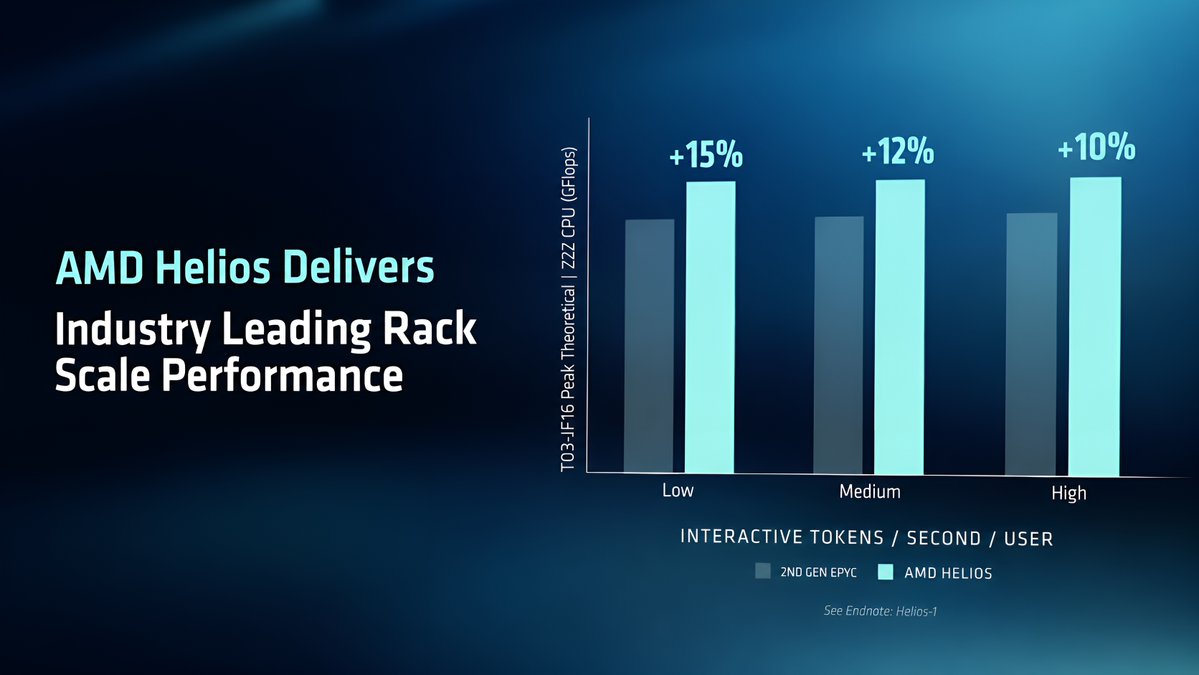
At the same rack power, MI450 delivers 10–15% more performance than $NVDA Vera Rubin NVL72
$AMD also expects Helios racks to deliver up to 30% more tokens per dollar than Vera Rubin
Looks like $AMD is beating $NVDA at this shit
But guess who doesn't care who does it better?
Exactly, $SIVE
If $NVDA wins through Ayar Labs, $SIVE is integrated into their ecosystem
If $AMD wins through $GFS , $SIVE is integrated into their ecosystem
It's a win-win no matter how you look at it
What great connections this company has, what a bright future awaits us
Not exactly for $AAOI (they're working on CPO too, just a little further behind in commercialization).
There's a podcast that featured the $SIVE CEO recently called: "Market Insights: Photonics & AI".
Most interesting take was:
"Pluggables will be around for the next 10 years".
There's a lot of CPO + RNG/MRC optimization TAM cannablization arguments for pluggables recently, but looks like it's here to stay.
And that there's going to be multiple architecture paths going forward (CEO also NPO alongside CPO as an major opportunity in the next 5 years).
As for challenges: Vickram stated manufacturing capacity + availability of raw material is the main bottleneck. Likely referencing the existing bottlenecks with upstream CW laser ramp.
From the podcast, seems like a large focus was on pluggable markets due to larger near-term TAM (which is understandable with $JBL + other players), with CPO being the north star.
So it might be interesting if $SIVE M&A ambitions were to acquire more pluggable optical transceiver IP, like what $LITE did with Cloud Light.
But TLDR:
Lot of different paths moving forward, pluggable here to stay, CPO seems like North Star for where industry is heading.
Feels like there's room for every qualified laser supplier given the industry demand is growing faster than what they can all collectively make.