🪇Disambiguating Pauli noise in quantum computers
https://t.co/vjFfFQkKjq
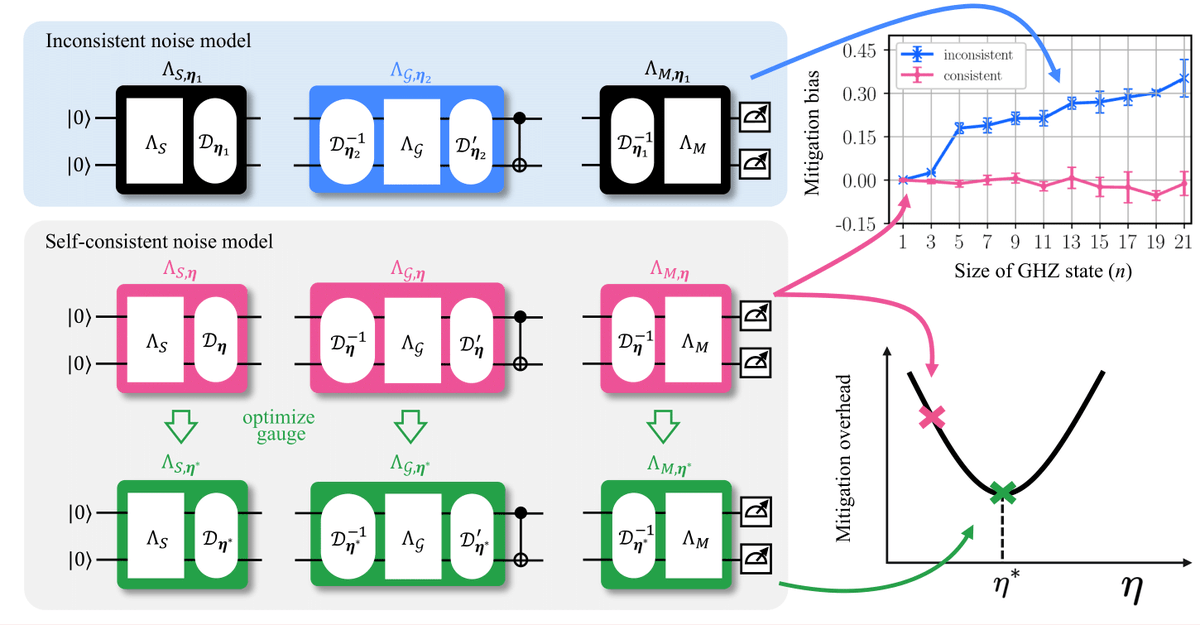
Quantum noise characterization suffers from "gauge ambiguity" due to noisy initialization and measurements. We show this does not stop us from correctly mitigating errors, with up to 92-qubit experiments
I am happy to see that two projects of mine have recently been published in Nature Communications and PRX Quantum. I would like to share what these two projects mean to me.
[1] Entanglement-enhanced learning of quantum processes at scale
We designed and experimentally demonstrated how entanglement can be used to enhance quantum noise characterization in practice, with a substantial speed-up and without sacrificing precision. This project initially stemmed from (and subsequently stimulated) a series of my theoretical works on exponential entanglement advantages in Pauli channel learning. This is also the project that took me the longest time to complete: it started in 2021, when I was a first-year PhD student, and was published in 2026, when I was in the second year of my postdoc.
[2] Disambiguating Pauli noises in quantum computers
We designed and experimentally demonstrated a scalable quantum error mitigation protocol addressing the issue of “gauge ambiguity,” achieving improved precision and efficiency over state-of-the-art protocols. This work is a culmination of the theory we developed around the learnability of Pauli noise over the past several years.
When we first started both of these projects, although I had some nice theoretical frameworks in mind, I had no idea whether those ideas would work in the real world. In fact, there were good reasons to expect that they wouldn’t work (as our Referee 2 also pointed out 🙂): for example, using entanglement in quantum noise characterization might introduce more noise than the advantage it provides. It is really thanks to close theory-experiment collaboration, and multiple years of failed attempts, debugging, and developing new ideas, that we were finally able to make those ideas work on real devices. These were very different experiences for me as a theorist, and I have learned a lot along the way.
Many thanks to my wonderful collaborators from @UChicagoPME, @IBMResearch, and other institutions, including Liang Jiang, Alireza Seif, Edward Chen, Laurin E. Fischer, Zlatko Minev, Swarnadeep Majumder, Haoran Liao, Derek S. Wang, Moein Malekakhlagh, Ali Javadi-Abhari, Andrew Eddins, Luke Govia, Bradley Mitchell, Andre He, Youngseok Kim.
Papers:
[1] https://t.co/MqCAdDU1PQ
[2] https://t.co/EMRfTXuFOt
The unavoidable “gauge” ambiguity in learning a quantum computer’s noise does not hinder error mitigation, and this remaining degree of freedom can even be optimized to make mitigation dramatically more efficient.
Learn more: https://t.co/xbfggqUamj
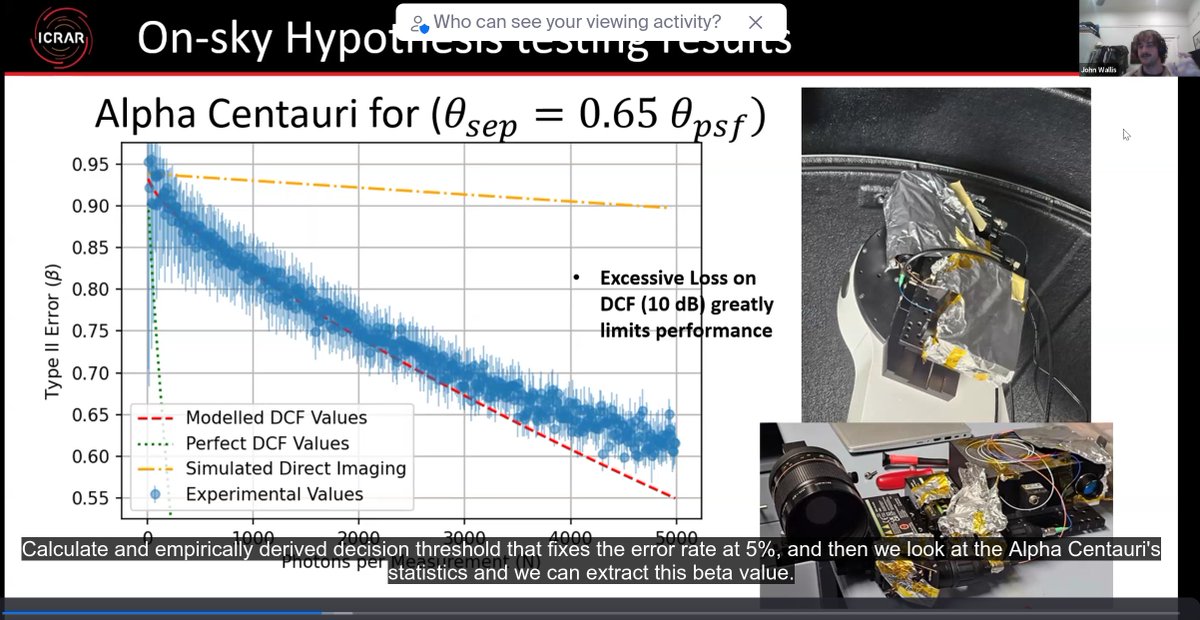
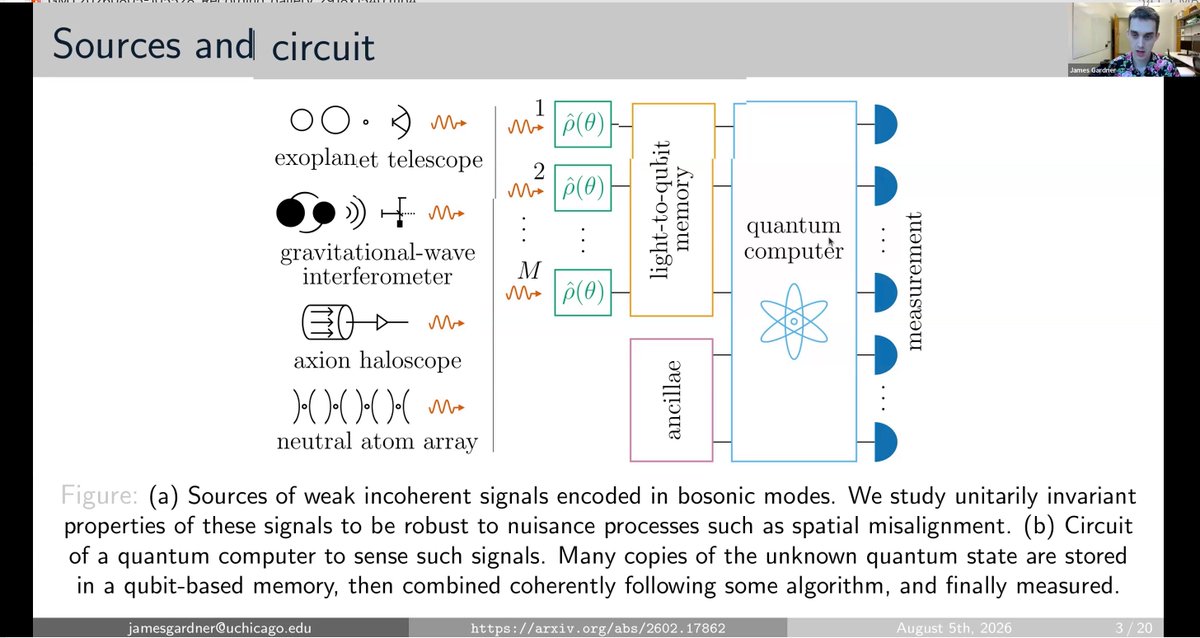
The QM-QISR workshop has been a wild ride so far. In one talk an astronomer reported an on-sky demo using an off-the-shelf fiber mode sorter. In other talks some fearless young theorists proposed that we couple starlight into a quantum computer. (1/2)
We're excited @Caltech and @TeamOratomic about mitten codes, which we hope will accelerate the journey to practical quantum computing. An extraordinary team worked on this project -- I especially appreciate brilliant contributions from Caltech students Aditya Bhardwaj, Richard Ma, and Nadine Meister.
https://t.co/eJ8nk9H6qf
❓Can just 1,000 physical qubits run practical quantum algorithms requiring 10+ billion logical operations without a single error?
Yes!
I am thrilled to share our new work introducing mitten codes: 20%-rate qLDPC processors with parallel fault-tolerant logic and real-time telescoping decoding, offering a practical path toward scalable, fault-tolerant quantum computation. ⚛️
Paper: https://t.co/5vuhGyKSyM
this is a timely talk with the whole research community (at least in QIP) currently pondering this very question:
"How to Respond to the Automation of Research"
by Hsin-Yuan Huang @RobertHuangHY (Caltech & @TeamOratomic )
Excited to share our new QudeLeap/HKUST-GZ work:
“Benchmarking Agents for Proving Theorems in Quantum Algorithms and Quantum Information”
Go towards reliable AI proof agents for quantum research. https://t.co/KrnHgPHhPK
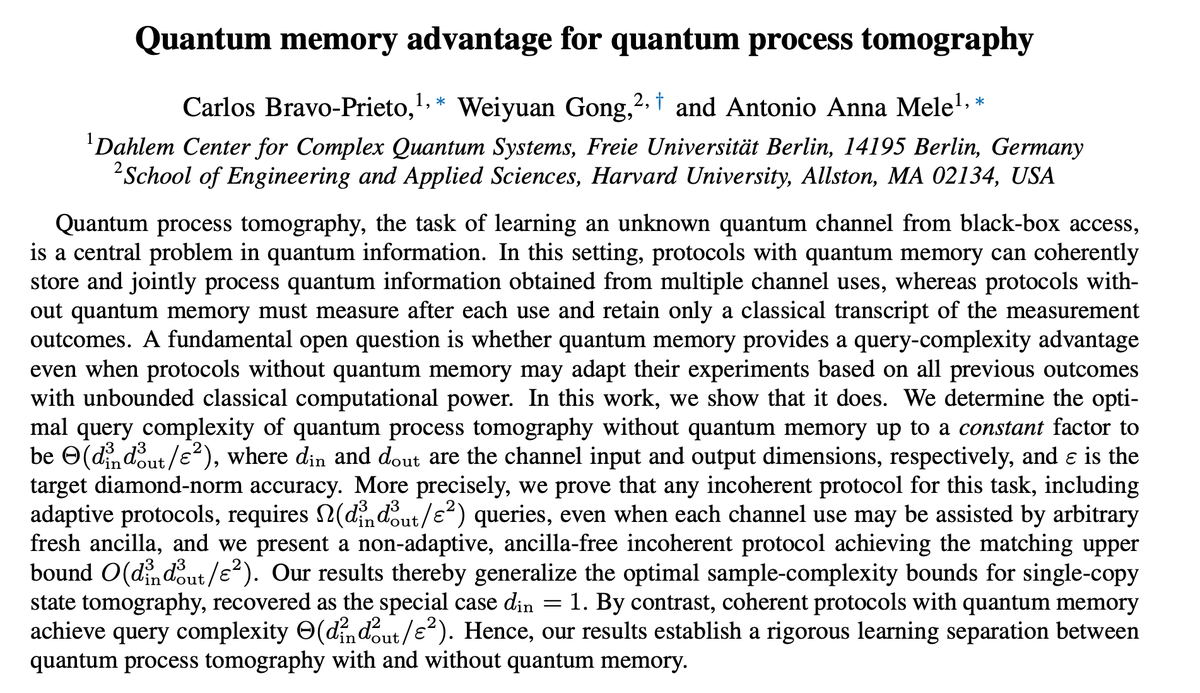
Happy to share our new paper "Quantum memory advantage for quantum process tomography", today on ArXiv! ⚛️
https://t.co/ZAiizwydBn
Thanks to @charl_bp and @gong_weiyuan for the great collaboration!
I would also recommend checking out Kunal Marwaha's paper that also solved the same problem independently and posted at the same time! Kunal is a PhD student, interning at Google. He also used AI assistance to solve the problem. Link below.
Honoured that our 2016 paper, Robust Estimators in High Dimensions without the Computational Intractability, w/ Ilias Diakonikolas, Daniel Kane, Jerry Li, Ankur Moitra, Alistair Stewart, was awarded the 2026 Gödel Prize
This is the highest award for papers in theoretical CS. 1/7
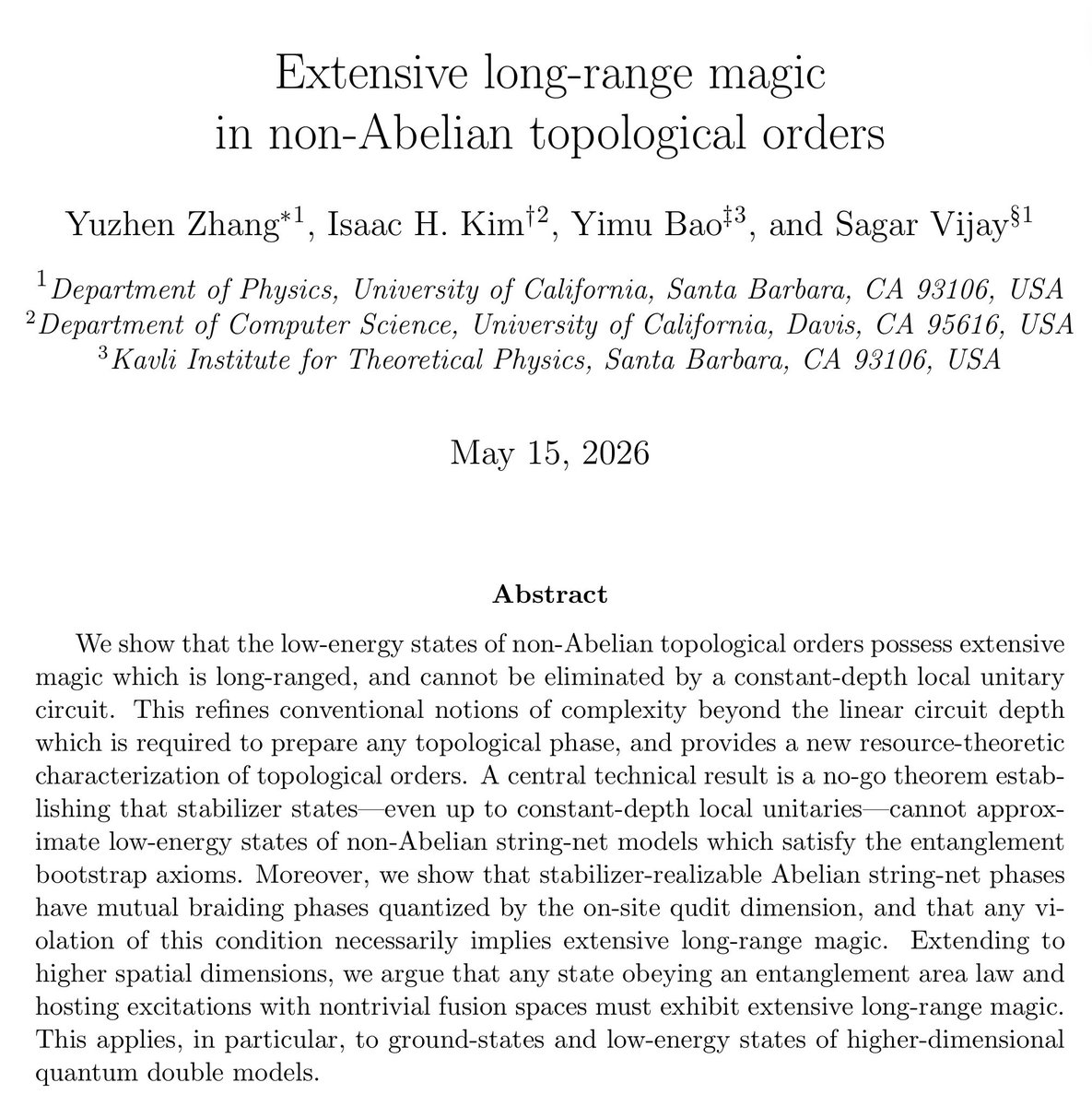
Are non-Abelian topological orders intrinsically hard?
In new work https://t.co/EUpmR2GKnm with @Isaac__kim, @yimu_bao and Sagar Vijay, we show extensive long-range magic in non-Abelian topological orders.
Can AI do Theory?
Some of my friends are hosting a workshop on this topic at #STOC2026 in Salt Lake City
Speakers include Scott Aaronson, @CarinaLHong, @MarkSellke, David Woodruff, @SebastienBubeck, & Prabhakar Raghavan (@WittedNote)
Call for posters ddl: 5/29
Check it out!
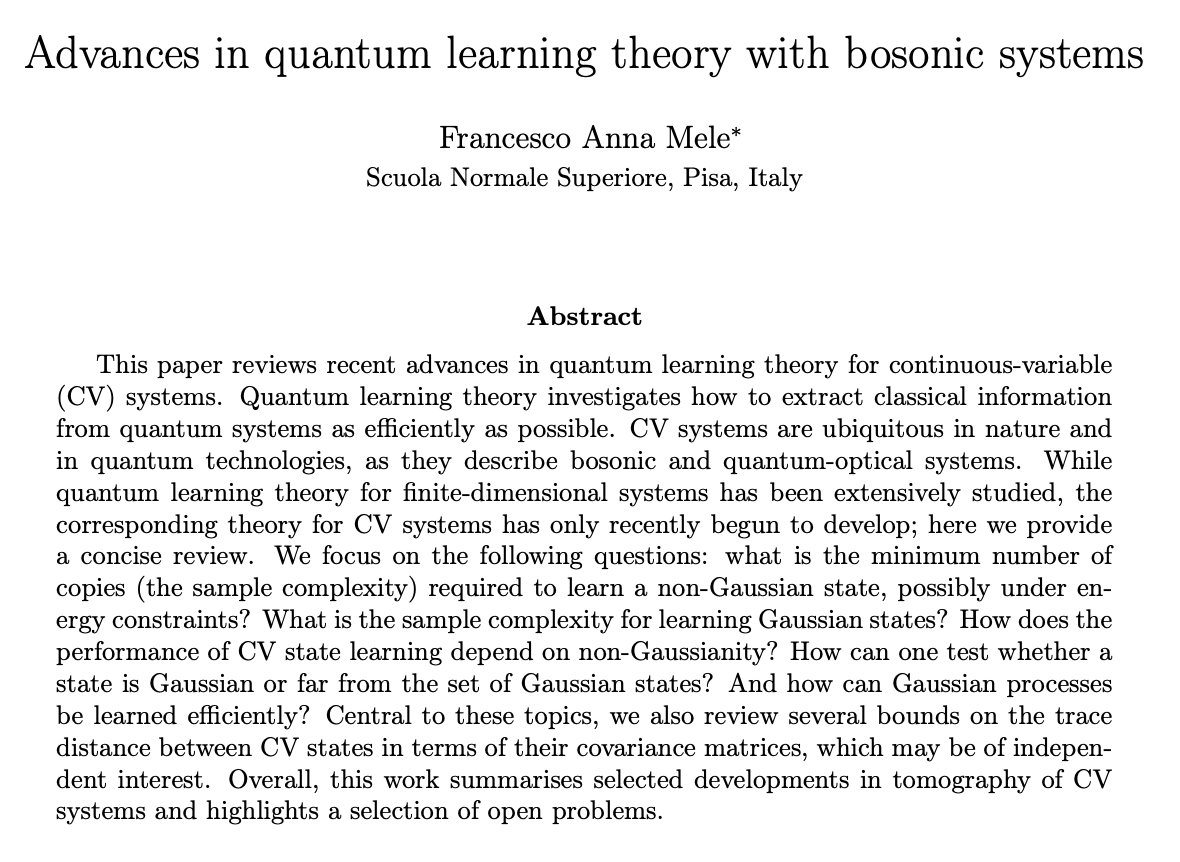
In this paper, I review recent advances in quantum learning theory with bosonic systems. I hope that it is a pedagogical start to get you up to date on this exciting new field, which unveils many fundamental research questions.
https://t.co/wniUJiWCPj
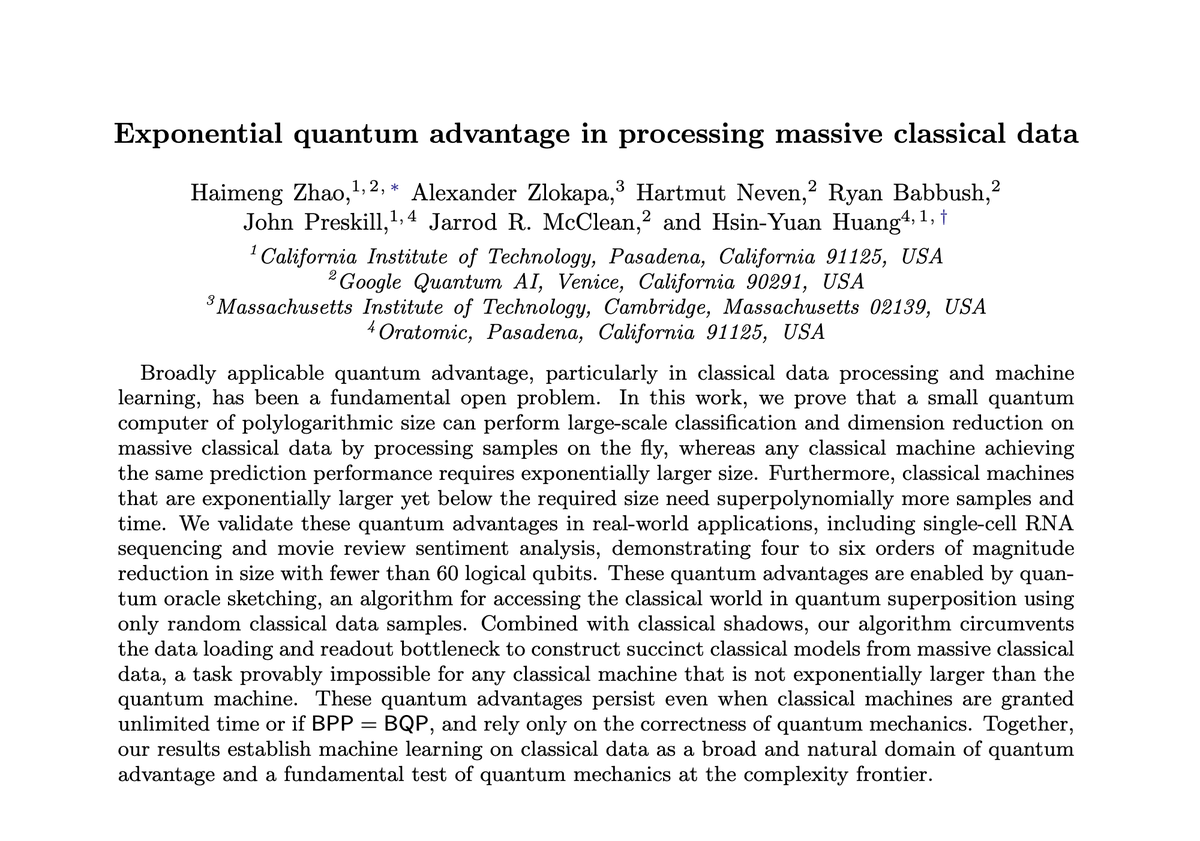
⚛ Can small quantum computers accelerate AI on massive classical data? Yes!
I am absolutely thrilled to share our new work proving *honest* exponential quantum advantages in broadly applicable classical tasks. 🧵👇
Paper: https://t.co/q1txrakSUJ
Blog: https://t.co/77svcuQ1Yl
Excited about this new paper: it subsumes the quadratic Goldreich-Levin [BC26] and algorithmic PFR [ACDG26] papers, and makes explicit a connection between quadratic Fourier analysis and symplectic geometry, as speculated by Green and Tao.
https://t.co/LoPcHcYaKa
With extraordinary colleagues, we are developing new architectures for neutral-atom quantum processors that dramatically reduce the resource estimates for fault-tolerant quantum computing. This progress makes me optimistic that broadly useful quantum computing will soon be a reality.
We’ll continue fundamental research @Caltech to advance quantum science and technology, while building fault-tolerant quantum machines and exploring their applications @TeamOratomic.
It’s a very exciting time to be a quantum scientist!
https://t.co/fCEMU3LG0J










![TomGur's tweet photo. Excited about this new paper: it subsumes the quadratic Goldreich-Levin [BC26] and algorithmic PFR [ACDG26] papers, and makes explicit a connection between quadratic Fourier analysis and symplectic geometry, as speculated by Green and Tao.
https://t.co/LoPcHcYaKa https://t.co/EN8fHrMXEJ](https://pbs.twimg.com/media/HFSgTiGa0AAsb79.png)