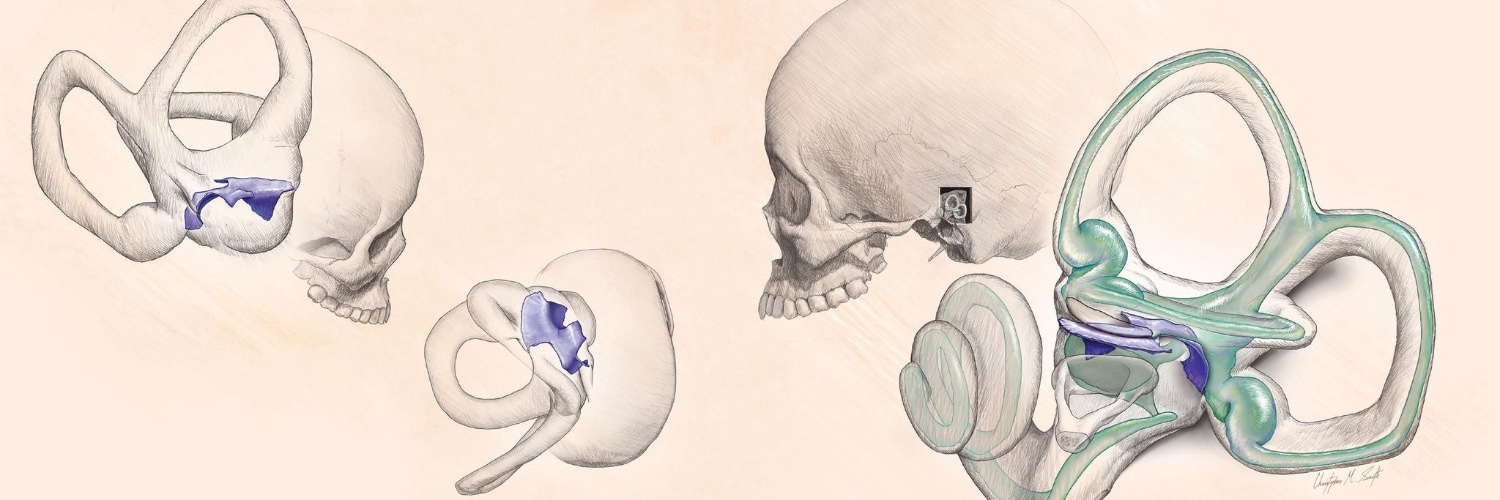
Out today in @PNASNexus! We present evidence for a new way to characterize the vestibular organs, challenging traditional assumptions about how the human inner ear is organized. https://t.co/TfXDQrINCX
New paper out in @PNASNews led by @CazenaveMarine1 shows different locomotor repertoires in Swartkrans Paranthropus and Sterkfontein Australopithecus! https://t.co/iNChxBWzFi
When the asteroid hit, why did birds survive when all other dinosaurs died?
It's a question I ponder in my upcoming book The Story of Birds. But first, I explore it here for @sciam !
https://t.co/LPWXEINS3G
If you're attending Anatomy Connected 2026, check out our session on navigating the publication landscape in anatomical sciences with presentations by the Editors-in-Chief of all 3 @AnatomyOrg journals!
Friday 4/17 4:00-5:30pm in Ruidoso/San Miguel 220/215
World’s most dangerous bird has bizarre, glowing headgear | Science | AAAS https://t.co/q01n0xQscV
Thank you to Perri Thaler for her article in @ScienceMagazine @aaasabout about our new #cassowary publication in @SciReports!!
Finally our latest paper in the Journal of Mammalian Evolution is out!!!
Have a look at what an additional Oreopithecus partial cranium can tell us about the phylogenetic position of this enigmatic Late Miocene Italian ape.
https://t.co/QIm59Of4h1
#paleoanthropology#APES
By redefining how we understand the evolution and organization of the vestibular system, this work establishes an expanded framework to investigate its roles in movement, perception, and sensory adaptation!
Out today in @PNASNexus! We present evidence for a new way to characterize the vestibular organs, challenging traditional assumptions about how the human inner ear is organized. https://t.co/TfXDQrINCX
Why does this matter?
Because the “peripheral vestibular system” isn’t one unified module.
The semicircular canals and otolithic organs are distinct systems with different evolutionary trajectories.
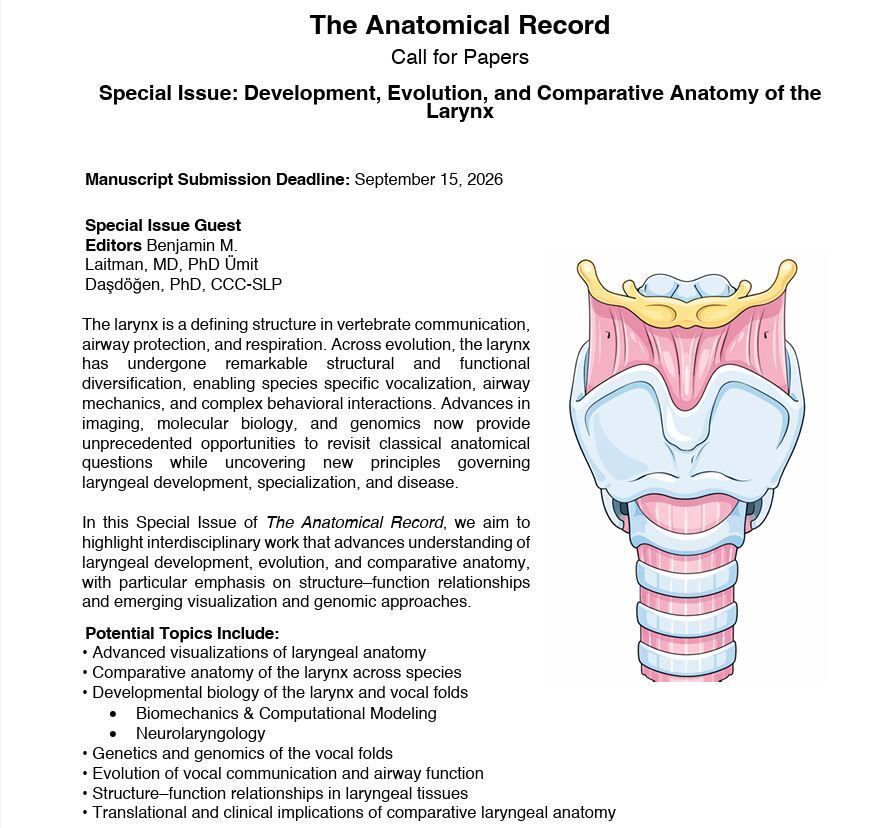
📢 Call for Papers! We invite submissions for special issue “Development, Evolution & Comparative Anatomy of the Larynx.” This issue aims to highlight interdisciplinary work exploring the development, evolution & structure–function relationships across species
📅 Deadline: Sep 15
New issue! From evolution of eyes & ears to cutting-edge imaging of sensory anatomy, new research explores how vertebrate senses guide adaptive responses in a complex world. Shared theme: sensing cues in an expansive environment shaped vertebrate radiation
https://t.co/3A1hTGy6Vx
New paper out: Nanotyrannus is a different species, not a juvenile T. rex. Growth record of the throat bone in the original skull of Nanotyrannus shows this is a grown-up individual, rather than a growing teenager, that lived alongside the tyrant lizard. https://t.co/PA3HUJag0a
🧵New paper of our lab is out on The Anatomical Record dedicated to inner ear studies. If you are curious about how closely early Central European Neandertals resemble classic, Late Pleistocene Neandertals, check it out! https://t.co/IWbHGjxM7i more in the🧵1/3