Liftoff of Starship V3, from the dunes right outside the pad.
This is the most insane shockwave action I have ever seen on video. Absolutely mad.
📽️ Me for @WeAreSpaceScout
one thing I love about AI is I sit thinking, with pen and paper, way more than before.
Rapid sketching 20 ideas, then handing off the best with some notes "to be made" might be the wet dream of all design minded people?
Also interesting merger of
- oldest tech: marks on surface, arguably the fastest way to visualize concept and think
- with super intelligence that executes.
Is this the way?
An extreme commitment to the truth makes relationships acutely dysfunctional but systems chronically functional (think Elon Musk).
An extreme commitment to kindness makes relationships acutely functional but systems chronically dysfunctional (think Sweden, UK)
when you realize that touching a single grocery store receipt puts more BPA into your body than drinking from a plastic water bottle for an entire year
and the Bali coworks were inspired by you and your random get togethers in the autism room, and now years later I get to go to the ones you organise - beautifulllllll ❤️
more people should organise these, they are good for the soul.
Start 100 events, meet 1000 people, make a few friends for life.
all that said tho church is starting to seem more and more appealing, church n cowork wen
age of the architect types tho maybe.
maybe it moves away from pure
utilitarian to something else.
maybe music is a good example:
we had huge orchestras and composers- big teams,
then bands, producers - maybe like indie like teams dev shops,
then remixes, djs - I wonder how that will look like in software
I can't go back to the regular YouTube UI after this 😅
Obsidian Reader now makes the transcript interactive so you can scrub, highlight, auto-scroll. It feels so nice.
As I build my own 2nd brain 🧠 on Obsidian using @karpathy ‘s wiki idea, it suddenly dawned on me - one day when we r gone, our kids could inherit an interactive map to your mind, passion, obsessions, work, fascinations…
It’s kind of beautiful way to think abt your 2nd 🧠.
This is only the second chimpanzee civil war ever documented. The first was Gombe, 1974. Fifty years apart. Genetic data suggests chimp communities split roughly once every 500 years.
Gombe was 9 males breaking off from a group of about 60. The splinter faction was hunted down over four years. Every male killed. Goodall had nightmares about it for decades.
Ngogo is operating at a completely different scale. 200 chimps. The largest studied community on Earth. They functioned as one unit for 20 years, shared territory, ran border patrols together, fought neighboring groups side by side. Then in 2015 something snapped. Five key males died, possibly from disease. Those males were the social bridges between two clusters. Once the connective tissue disappeared, the cliques hardened.
By 2017 they occupied separate territories and patrolled borders against each other. By 2018 the killing started. 28 dead so far, 19 of them infants. The Western faction, despite being smaller, initiated every attack. They ripped infants from mothers. The lead researcher calls himself a war correspondent.
The part that rewrites the textbook: no ethnic divisions, no religion, no ideology, no resource scarcity. Just a social network that lost its bridge nodes. The researchers think the same mechanic explains human civil wars better than cultural theories do. Polarization isn't about beliefs. It's about who stopped talking to whom.
the Elon Musk and Jim Simons approach to meditation and relaxation is something everyone should give a try. by far one of the most efficient ways to refresh yourself. 30mins is all you need to feel a massive difference in your mood, energy, and thoughts
let me explain what Karpathy just shared
he’s spending way less time using AI to write code and more time using it to build personal knowledge bases
the full breakdown:
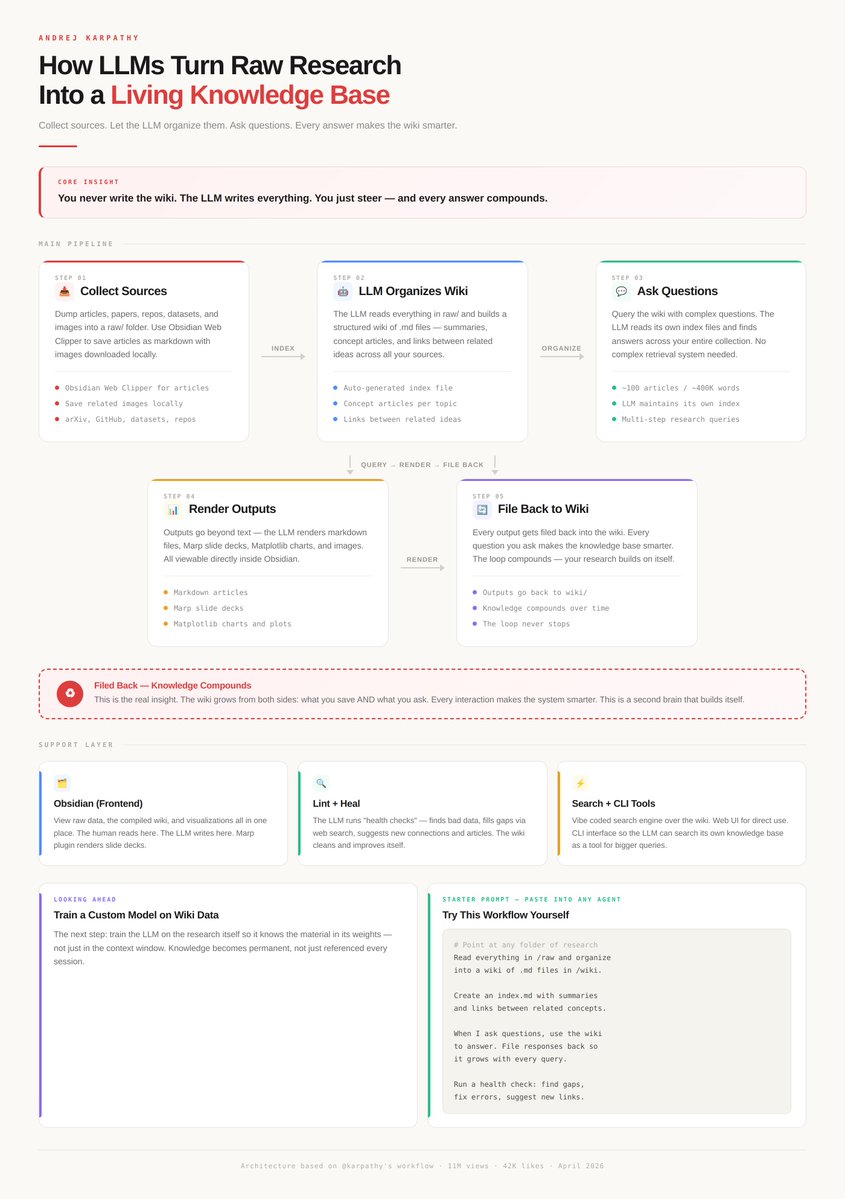
→ he dumps raw sources (articles, papers, repos, datasets, images) into a folder. then has an LLM organize them into a wiki… a collection of markdown files with summaries, links between related ideas, and concept articles that connect everything together
→ he uses Obsidian as his frontend. he views raw data, the organized wiki, and visualizations all in one place. the LLM writes and maintains the entire wiki. he rarely touches it directly
→ once the wiki gets big enough (~100 articles, ~400K words on one recent research topic)… he just asks the LLM questions against it. no RAG (complex retrieval system) needed. the LLM maintains its own index files and reads what it needs
→ outputs aren’t just text. he has the LLM render markdown files, slide decks, charts, and images… then files the outputs back into the wiki so every question he asks makes the knowledge base smarter
→ he runs “health checks” where the LLM finds inconsistent data, fills gaps using web search, and suggests new connections and articles. the wiki cleans and improves itself over time
→ he even vibe coded a search engine over his wiki that he uses directly in a browser or hands off to an LLM as a tool for bigger questions
→ his next step: training a custom model on his own research so it knows the material in its weights… not just in the context window
most people use AI to get answers.
Karpathy is using AI to build his own ‘Jarvis’ via compounding knowledge systems that get smarter the more he uses them
the difference between asking ChatGPT or Claude a question and having a personal research engine that grows with every session is the gap most people haven’t crossed yet
and this is where it gets really powerful
not replacing your thinking but organizing everything you’ve ever learned into something you can query or create with forever
if you’ve been using CLAUDE .md and context files in Claude Code… this is that same idea at a much bigger scale
if you’re doing any kind of AI work or deep learning on a new topic right now…
this workflow is worth studying closely
you’ll want to adopt it yourself
this is one of AI’s brightest minds after all. we’re all better off listening to him.