Own code vs agent frameworks?
3 years running agents in production taught us this:
We started with LangChain. Its loop didn't fit, so we built our own.
Even the LLM integration layer needed custom code.
A dependency can save code and still cost you control. 🧵
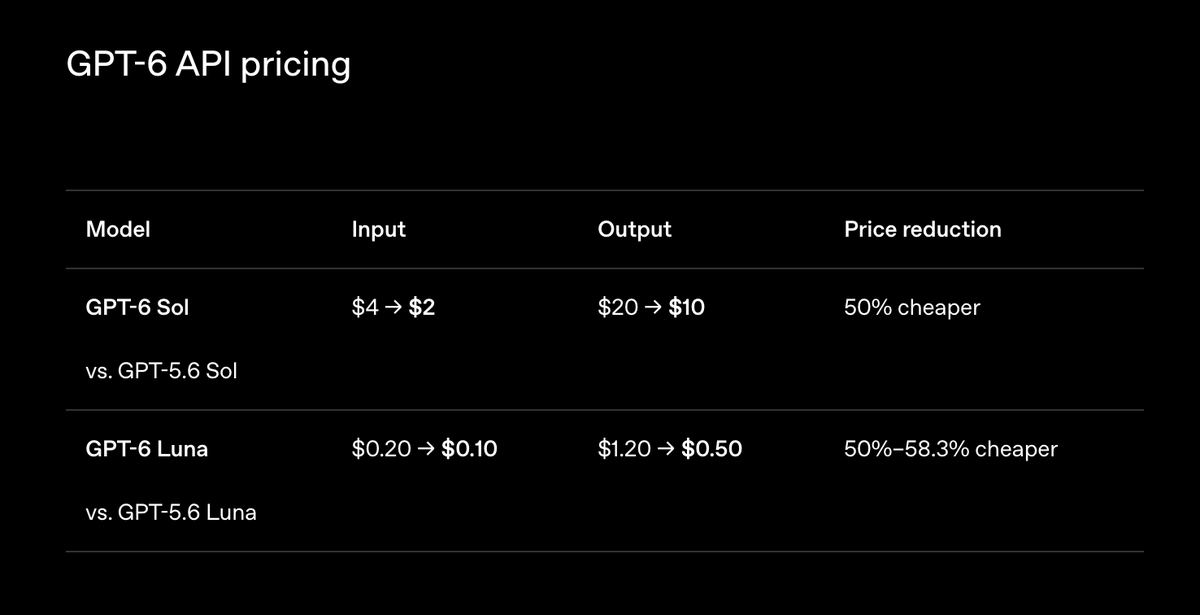
Improvements in caching and inference let us deliver GPT-6 Sol and GPT-6 Luna at lower cost.
We’re passing those savings on through lower API prices. Sol and Luna deliver more intelligence at half of the previous generation’s API prices, making more complex work practical to automate at scale.
GPT-6 Sol and Luna just landed in Astra’s orbit.
Both launch today with API prices 50% lower than GPT-5.6.
Build with Sol. Scale with Luna. To production and beyond.
Introducing Claude Opus 5.5, the first model in our new Claude 5.5 family.
It performs at the level of Claude Fable 5.1 for most tasks, and costs 40% less to run than Opus 5.
Most companies are experimenting with AI. Few can show measurable ROI.
One of the main issues is the lack of operating evidence: a clear view of how operations actually run and where AI can create value.
𝐋𝐚𝐦𝐩𝐢’𝐬 𝐀𝐈 𝐓𝐫𝐚𝐧𝐬𝐟𝐨𝐫𝐦𝐚𝐭𝐢𝐨𝐧-𝐚𝐬-𝐚-𝐒𝐞𝐫𝐯𝐢𝐜𝐞 𝐜𝐥𝐨𝐬𝐞𝐬 𝐭𝐡𝐚𝐭 𝐠𝐚𝐩.
Within days, @lampi_ai analyzes authorized context across relevant company data to map how the business operates.
It builds digital twins and turns signals into actionable intelligence:
→ An operating digital twin showing how operations run
→ A customer twin identifying revenue opportunities
→ ROI prioritization showing the highest-impact AI opportunities
Each opportunity is assessed by return, feasibility, data readiness, and time to value.
The strongest opportunities are converted into governed AI agents and deployed inside existing workflows.
Every agent operates within defined permissions, approval paths, and ownership rules, with human oversight, traceability, and value measurement built in.
Find the value. Deploy the agents.
For more: https://t.co/UVlbMm3QLP
@buildwtim Plug in an analytics tool like Umami and replay the user journey on your landing page.
Track where they come from, time spent, what they click, user agent, bots, drop-off points, etc.
@IamMysticc Weeklies are enough? Doing twice a week and constant chatting on slack but even though it's harder than being on the same office I feel like.
Anyone here building remotely with other cofounders ?
How do you stay aligned/focused when everyone works on their own stuff , without constantly chasing each other for updates ?
@itsalicesoul Na I don't let my agents post at all on X they suck at human interactions 😅
Other than that I use agents for anything else code , monitoring, debug, log review and so on.
@roudyhermez Ahah I'm the opposite. Over the years I built so many things without ever thinking they were worth productizing , until someone launched the same thing as a SaaS and made money 😅
@prasenx Agreed, but most vibecoders are just integrating HTML sites with external APIs, so the risk and the bar are pretty low.
We rarely see genuinely complex products being built by vibecoders.