@CDavidFloyd You are wrong though, objectively. Assuming ~1GW gets completed over the next 12-15mo as planned, number go up. Its quite simple. There's no voodoo in this sector
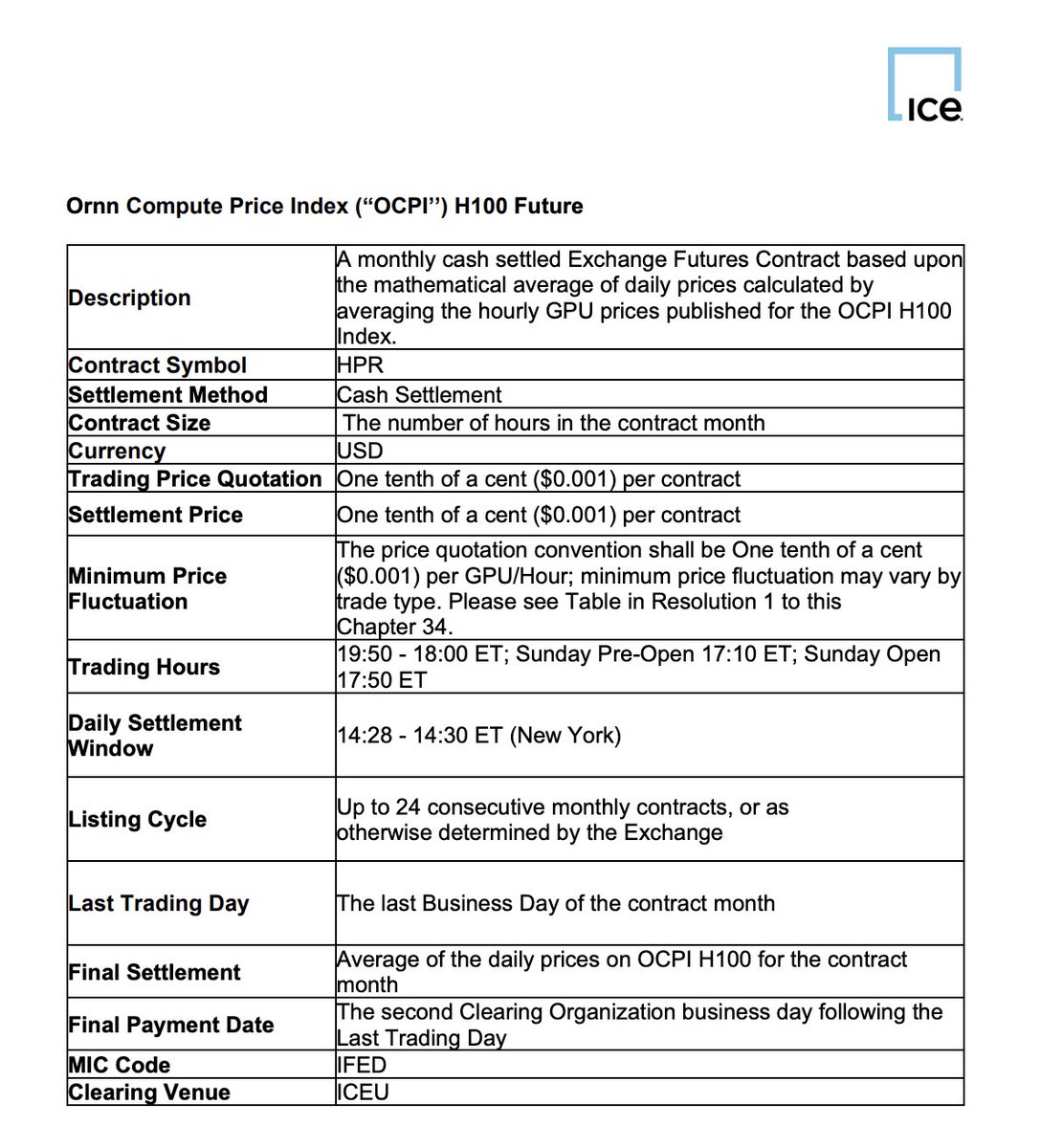
We are happy to announce that the contract specifications for our @ICE_Markets compute futures are now available.
Find more information here: https://t.co/B1v6sUj8fh
@GlobalCollapse You're conceptually correct but this should be paired w the acknowledgement there is alpha in that disconnect, across the board..buy early is the only valid approach but is also a questionable + complicated risk assessment..hence such focus on mgmt teams
@GlobalCollapse Well-said. In a perfect world multiple would expand some as portfolio scales. There is a non-zero element of optionality to be prepared for in a few of the names though, imo
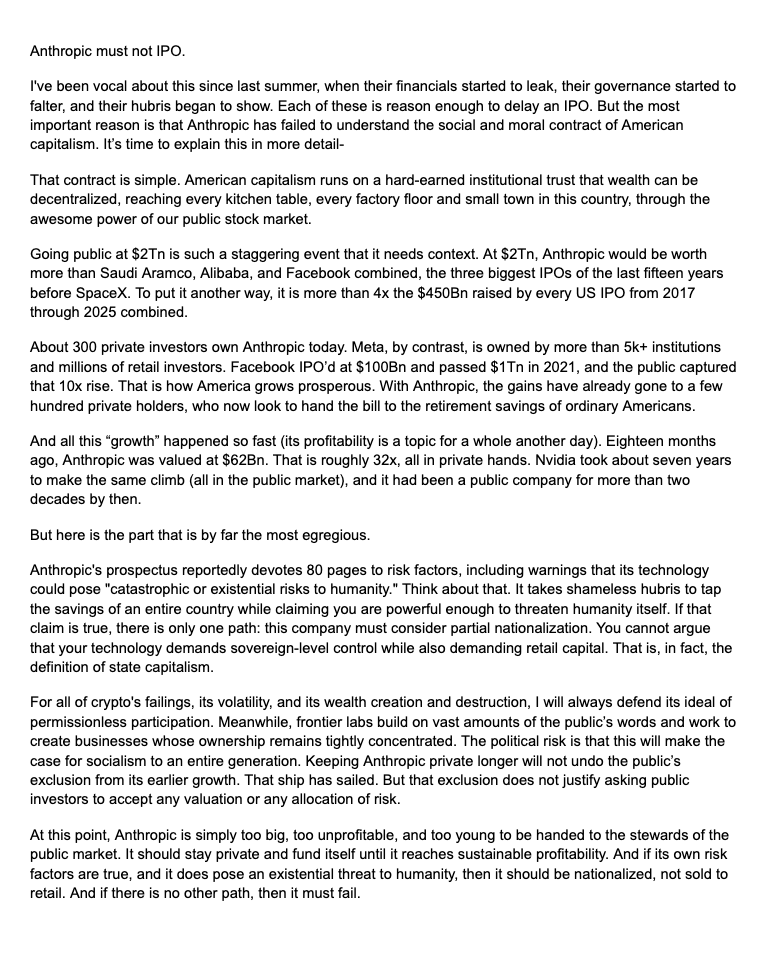
I’ve argued before Anthropic must not IPO on its current metrics. The bottom line is simple-
The might of American capitalism rests on a sacred social contract: if humanity must bear its risk, the public must also share in the prosperity, not just pay for it.
My thoughts below:
HOLY SMOKES!
SpaceX may have just landed one of the largest AI infrastructure agreements ever reported.
Anthropic has reportedly agreed to pay SpaceX up to $84.5 billion for access to Nvidia based computing capacity through 2029 and that is nearly double the roughly $45 billion maximum value SpaceX previously disclosed.
SpaceX is building an AI cloud business that could eventually compete with CoreWeave, Nebius, Microsoft, Amazon, Google, and Oracle.
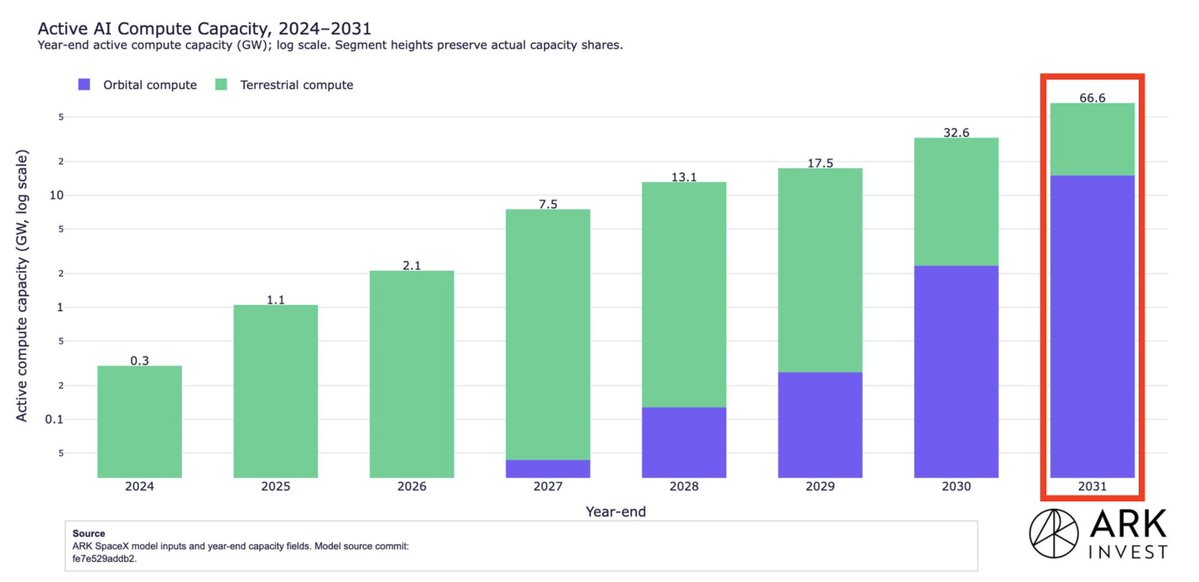
ARK models SpaceX’s active AI compute capacity increasing from 0.3 gigawatts in 2024 to 66.6 gigawatts by 2031.
Terrestrial data centers drive the early growth, but ARK expects orbital compute to become a major source of capacity after 2029 and potentially represent more than half of the total by 2031.
The strategy would begin with SpaceX building data centers on Earth for customers such as Anthropic like @elonmusk has already done and then SpaceX could then use Starship to launch computing systems, solar arrays, networking equipment, and radiators into orbit.
Starlink would provide the communications network connecting those orbital systems with customers and ground infrastructure and this creates a level of vertical integration that no traditional cloud company can easily match.
SpaceX could control the launch vehicle, satellite network, communications layer, terrestrial data centers, orbital computing systems, and customer contracts inside one company.
Orbital computing will also avoid some of the grid connection delays, land shortages, and permitting problems slowing data center construction on Earth.
I’m already a proud SpaceX investor, and if you want to see the other AI infrastructure and space names I’m positioned in around this buildout, check out my portfolio below.
https://t.co/Hkywss4Ugh
HOLY SMOKES!
SpaceX may have just landed one of the largest AI infrastructure agreements ever reported.
Anthropic has reportedly agreed to pay SpaceX up to $84.5 billion for access to Nvidia based computing capacity through 2029 and that is nearly double the roughly $45 billion maximum value SpaceX previously disclosed.
SpaceX is building an AI cloud business that could eventually compete with CoreWeave, Nebius, Microsoft, Amazon, Google, and Oracle.
ARK models SpaceX’s active AI compute capacity increasing from 0.3 gigawatts in 2024 to 66.6 gigawatts by 2031.
Terrestrial data centers drive the early growth, but ARK expects orbital compute to become a major source of capacity after 2029 and potentially represent more than half of the total by 2031.
The strategy would begin with SpaceX building data centers on Earth for customers such as Anthropic like @elonmusk has already done and then SpaceX could then use Starship to launch computing systems, solar arrays, networking equipment, and radiators into orbit.
Starlink would provide the communications network connecting those orbital systems with customers and ground infrastructure and this creates a level of vertical integration that no traditional cloud company can easily match.
SpaceX could control the launch vehicle, satellite network, communications layer, terrestrial data centers, orbital computing systems, and customer contracts inside one company.
Orbital computing will also avoid some of the grid connection delays, land shortages, and permitting problems slowing data center construction on Earth.
I’m already a proud SpaceX investor, and if you want to see the other AI infrastructure and space names I’m positioned in around this buildout, check out my portfolio below.
https://t.co/Hkywss4Ugh