Excited to share our new preprint "Genetic code expansion enables plant-directed control of bacterial activity", a fantastic collaboration with @kunjapur lab!
https://t.co/JDQZfRkpzY
So proud to share our latest publication @CellCellPress! Yue Rui reveals that the same enzyme that makes the wall, cellulose synthase complex (CESA), also tethers the plasma membrane to the wall during water-deficit stress, providing resilience. https://t.co/53DUFaVxjt
Applying the grammar to the WNK1 kinase crowding-sensing system, we identify regions within the long CTD predicted as hypersensitive, a feature conserved across distant homologues, highlighting the potential use of the grammar to uncover new disordered environmental sensors
Happy to share our new preprint in collaboration with @boothbylab describing the identification of a molecular grammar that captures key sequence features underlying variation in environmental ensemble sensitivity in IDRs https://t.co/Fdbvm6SPpU
Further, we show that homogeneous charge mixing is necessary and functionally sufficient to encode high ensemble sensitivity, a feature that enable de novo design of synthetic IDR sequences sensitive to the environment
My friend David Sabatini continues to be relentlessly targeted by gossip-driven tabloids pretending to be trusted scientific institutions. Science magazine’s latest piece is yet another one-sided hit job — downplaying or ignoring that the legal outcome was mixed, with some claims proceeding to trial and others moving to appellate review.
I’ve spoken to dozens of his former lab members, all of whom describe him as a generous and dedicated mentor. I’ve also talked to many women who worked closely with him and never had concerns about anything resembling a sexualized work environment. Yet most remain silent.
David was railroaded in a metoo-era mob campaign amplified by click-hungry reporters and social media trolls. All he’s ever wanted is to return to doing science — the work that defined his life.
As long as Science and outlets like it continue pretending to be arbiters of truth while operating as gossip mills, reputations will keep being destroyed - and truth will remain secondary to spectacle.
https://t.co/2OeqiIDMui
Functional diversity of Arabidopsis late embryogenesis abundant proteins in response to changes in the physicochemical environment https://t.co/SmNEsnXMjO #biorxiv_biophys
Our SUF4 condensation paper is finally out! https://t.co/aBzV1wu2tl Thank you to everyone who has scientifically, mentally, and emotionally supported my co-authors and me over the years. Below is a summary of the work-- we hope you enjoy our findings!
I genetically engineered the amazing Arabidopsis to mimic the striking patterns of my Tradescantia zebrina🧬🌱
From concept to creation, here's the story behind transforming this plant into a living work of art! (1/7) 🧵"
TSL will miss @NeftalyCM very much. We thank him for his many, varied and valuable contributions. We wish him well for the next exciting step of his career
🏆 Estamos orgullosos de anunciar que Daiana Capdevila, jefa de nuestro @capdevilalab, es una de las ganadoras del Fondo de Innovación de @Pewtrusts
👏🏻 ¡Felicitaciones!
🔗Leé la nota completa: https://t.co/KFGKuwmXVB
📢New paper alert!! With @boothbylab@alexholehouse@fried_lab we take a look at how an entire proteome survives desiccation. TLDR: Desiccation tolerance is encoded in specific residues on the protein surface, and occurs primarily in biosynthetic enzymes. https://t.co/v8OVBs1aFP
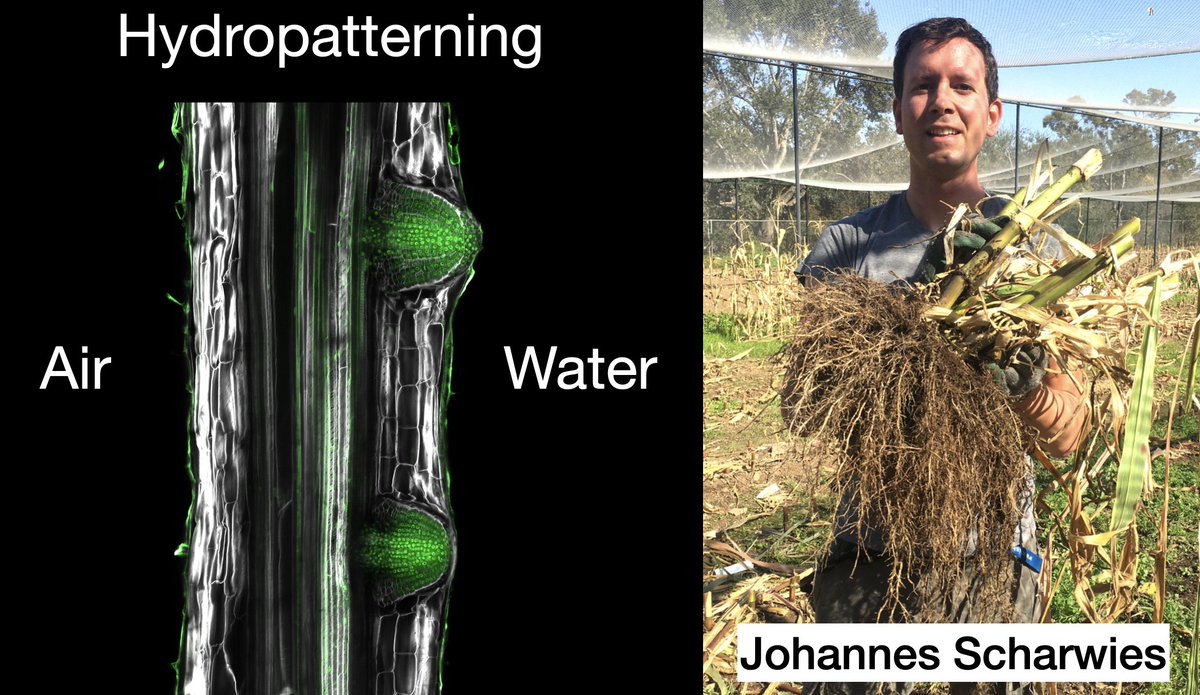
Ok, this is a big one! Proud to present our latest story on hydropatterning-a process that allows plants to sense moisture gradients in soil and activate branching. Johannes Scharwies defines the genetic basis for this response in maize and Arabidopsis!
https://t.co/78tRPra1yz
Excited to announce our latest publication from the amazing Ying Xie in @MolecularCell
We find that stress granules and P-bodies fluidize the cytoplasm in response to diverse stresses. Tweetorial soon!
https://t.co/p8c1uOZkqj