Imagine losing an entire book of the Bible. That’s essentially what happened in 2 Kings 22, which we read today in Bible in One Year.
The high priest found a scroll of the Torah in the temple, likely Deuteronomy. When it was read to Josiah, the young king realized how far the nation had strayed from the path of Yahweh. The result was reformation, a revitalization of faithful worship in Judah, all sparked by the rediscovery of God’s Word.
That raises a question for us. What will revitalize the church today? Clever marketing? Entertainment-driven worship? A more culturally comfortable version of church? No.
Reformations may seem to arise because people grow sick of the church’s theological trash stinking to high heaven and decide to wheel it to the curb. They abhor the cancers of corruption worming their way through the soul of the ecclesial hierarchy. They are dismayed over closeted creeds mildewing, muscular singing atrophying into the blubber of emotionalism, and want to vomit every time they catch a whiff from a pulpit exhaling the bad breath of moralism, legalism, or self-helpism.
But in the end, reformation does not happen because people react. It happens because God acts.
He sees his starving people and ends the famine of the Word. He sends the rain of the Gospel so that we feast on Christ and his gifts.
Moral reform fades as quickly as a sandcastle before the tide. Political reform is like tidying the house while the roof burns. But Gospel reform endures, because it is nothing less than the life of God in Christ given to the dead.
Only the Gospel gives life because it alone gives us Jesus. Not Jesus plus our agendas, not Jesus plus self-improvement, but Jesus alone.
When that Word is preached, taught, read, and studied, the Spirit is at work. The church is drawn again into the life of Christ. Worship is enlivened. Preachers proclaim Christ crucified and risen. Hungry people are fed with something real.
That is how reformation comes. The church is nailed again to the crucified and risen Lord, sharing in his death and life. And so, once more, she becomes a living witness in the world, a place where mercy flows, and life is given through the Word.
“I would much rather give children hymns that they can grow into, rather than songs they will grow out of.”
—Rev. Pres. Mark Chepulis, LCMS North Dakota District, in the ND District News insert in The Lutheran Witness, May 2026
The 1580 Book of Concord concludes:
“In the sight of God and of all Christendom, we want to testify to those now living and those who will come after us. This declaration presented here about all the controverted articles mentioned and explained above—and no other—is our faith, doctrine, and confession. By God’s grace, with intrepid hearts, we are willing to appear before the judgment seat of Christ with this Confession and give an account of it. We will not speak or write anything contrary to this Confession, either publicly or privately. By the strength of God’s grace we intend to abide by it.”
Why Was Moses Not Allowed to Enter the Promised Land?
There are three reasons that are usually considered. Each of them reflects the biblical language in Psalm 106 and Numbers 20.
First, the action of Moses is highlighted. God told him to speak to the rock, but instead, Moses struck it twice.
Second, some highlight the character of Moses since he was irate with the people that day.
Third, the words of Moses are sometimes given as the reason, because he called the people “rebels” and said, “Shall we [himself and Aaron] bring water for you out of this rock….” (Num. 20:10). Some argue that Moses implied that he and his brother were the source of this miracle rather than God.
The Lord explained it to Moses and Aaron this way: “Because you did not believe in me, to uphold me as holy in the eyes of the people of Israel, therefore you shall not bring this assembly into the land that I have given them” (20:12).
Psalm 106 says that the Israelites “angered [God] at the waters of Meribah, and it went ill with Moses on their account, for they made his life bitter, and he spoke rashly with his lips” (vv. 32-33).
Pulling this all together, Moses did not trust God that day, did not treat him as holy, was embittered, and spoke rash words. As a result, it would not be Moses but Joshua who led the people into the promised land.
Many centuries later, Moses stood beside the new and greater Joshua, Jesus the Messiah, atop the Mount of Transfiguration (Matt. 17:13). So, Moses did in fact make it to the land of promise, but only in Jesus.
As it was for Moses, so it is for us. Only in Christ are we, sinners like Moses, entering into the kingdom of God. Jesus and Jesus alone gets us there. And he gets us there solely by grace, for “the law was given through Moses; grace and truth came through Jesus Christ” (John 1:17).
_________
We read Numbers 20 today in Bible in One Year. For more information and to sign up, visit https://t.co/XxNvEtNH7e
Q: Does Numbers 5 teach or permit abortion in the Old Testament?
A: No, Numbers 5 does not teach, describe, or permit abortion—this is a misunderstanding based on inaccurate translations and assumptions.
Q: What is happening in Numbers 5?
A: Numbers 5:11–31 outlines a specific ritual called the Sotah (“goes astray” or “commits adultery”). When a husband suspects his wife of adultery, but has no evidence, the woman is brought before the priest, a ritual is performed, and she drinks a mixture called “bitter water.” If she is guilty, she will suffer physical affliction; if innocent, she will remain unaffected and able to bear children.
Q: Does the text say the woman is pregnant?
A: The woman is never said to be pregnant. This crucial fact is overlooked or ignored by those who misuse this text to argue for abortion. The issue at hand is suspected infidelity. The ritual is meant to determine her guilt or innocence—not to cause an abortion.
Q: What does the phrase “her thigh will sag [or ‘fall’] and her belly swell” mean?
A: In Hebrew, her thigh will נפל (“fall”). The meaning is uncertain, though “thigh” may be used here as a euphemism for the reproductive organs. The root צבה means “swell” or “distend.” In verses 21, 22, and 27, it refers to a bodily reaction related to reproductive organs. However, nowhere does it mention miscarriage or abortion.
Q: Why does the NIV translation say “her womb will miscarry”?
A: This is a grossly misleading paraphrase. The Hebrew does not contain any word that means “miscarry.” If Moses had meant “miscarry,” he could have used one of the Hebrew words that clearly mean that—like שָׁכֹל (shākal)or יָצָא (yātza)—but neither is found in this passage.
Q: What’s the bottom line?
A: Numbers 5 is a ritual of divine judgment for suspected adultery, not a procedure for abortion. The text does not mention pregnancy, does not use Hebrew terms for miscarriage, and should not be used to argue that the Bible permits or supports abortion.
_________
We read Numbers 5 today in Bible in One Year. For more information and to sign up, visit https://t.co/XxNvEtNH7e
Not a single word from Abel is recorded in Scripture. Cain murders him, and Cain has something to say. But the victim of violence? the recipient of hate? the righteous one? Not a syllable.
Cain has words, Abel none.
But Abel does speak in a different language. He utters crimson eloquence, red rhetoric so profound his speech pierces heaven's veil to lodge in the ears of God.
How so? The Lord says, "The voice of your brother's blood is crying to me from the ground" (Gen. 4:10).
You see what's happening?
1. Blood has a voice.
2. Blood cries out to God.
3. Blood is heard by heaven.
Far, far later, the author of Hebrews wrote about another crimson eloquence, about more red rhetoric. He says that the blood of Jesus "speaks better than the blood of Abel" (12:24).
Whatever Abel's blood said to God, Christ's blood said it better.
The voice of Jesus's blood, crying out from the ground beneath the cross, piercing the heavens, lodging in the ears of God, speaks one and only one message: "Father, forgive them."
That eloquent blood pronounces the absolution of the world, you included.
Believe it. It is for you.
_____
We read Hebrews 12 today in Bible in One Year. Join us at https://t.co/XxNvEtNH7e
Welcome home Reid, Victor, Christina, and Jeremy! 🫶
The Artemis II astronauts have splashed down at 8:07pm ET (0007 UTC April 11), bringing their historic 10-day mission around the Moon to an end.
NEW — Hallmark has unveiled their annual slate of #StarTrek holiday ornaments, including the USS Cerritos, the classic Galileo shuttle, and more!
https://t.co/58KevOWt4e
Project Hail Mary writer Andy Weir on social commentary in books:
"I dislike social commentary. Like… I really hate it. When I’m reading a book, I just want to be entertained, not preached at by the author. Plus, it ruins the wonder of the story if I know the author has a political or social axe to grind. I no longer speculate about all possible outcomes of the story because I know for a fact that the universe of that book will conspire to ensure that the author’s political agenda is validated. I hate that."
"I put no politics or social commentary into my stories at all. Anyone who thinks they see something like that is reading it in on their own. I have no point to make, and I’m not trying to affect the reader’s opinion on anything. My sole job is to entertain, and I stick to that."
"To that end, I also don’t talk about my personal political opinions publicly. I don’t want readers to even know, honestly. I don’t want that in the back of their minds as they read my stuff."
Is this why he has the #1 sci-fi movie in decades?
“The Birth of Christ is the eucatastrophe of Man’s history. The Resurrection is the eucatastrophe of the story of the Incarnation. This story begins and ends in joy.”
— J.R.R. Tolkien
#HappyEaster
A new milestone for humankind: The crew of Artemis II are now the farthest any human has ever travelled, reaching a maximum distance of 252,752 miles from Earth.
This surpasses the previous record set by Apollo 13 in 1970 by about 4,102 miles.
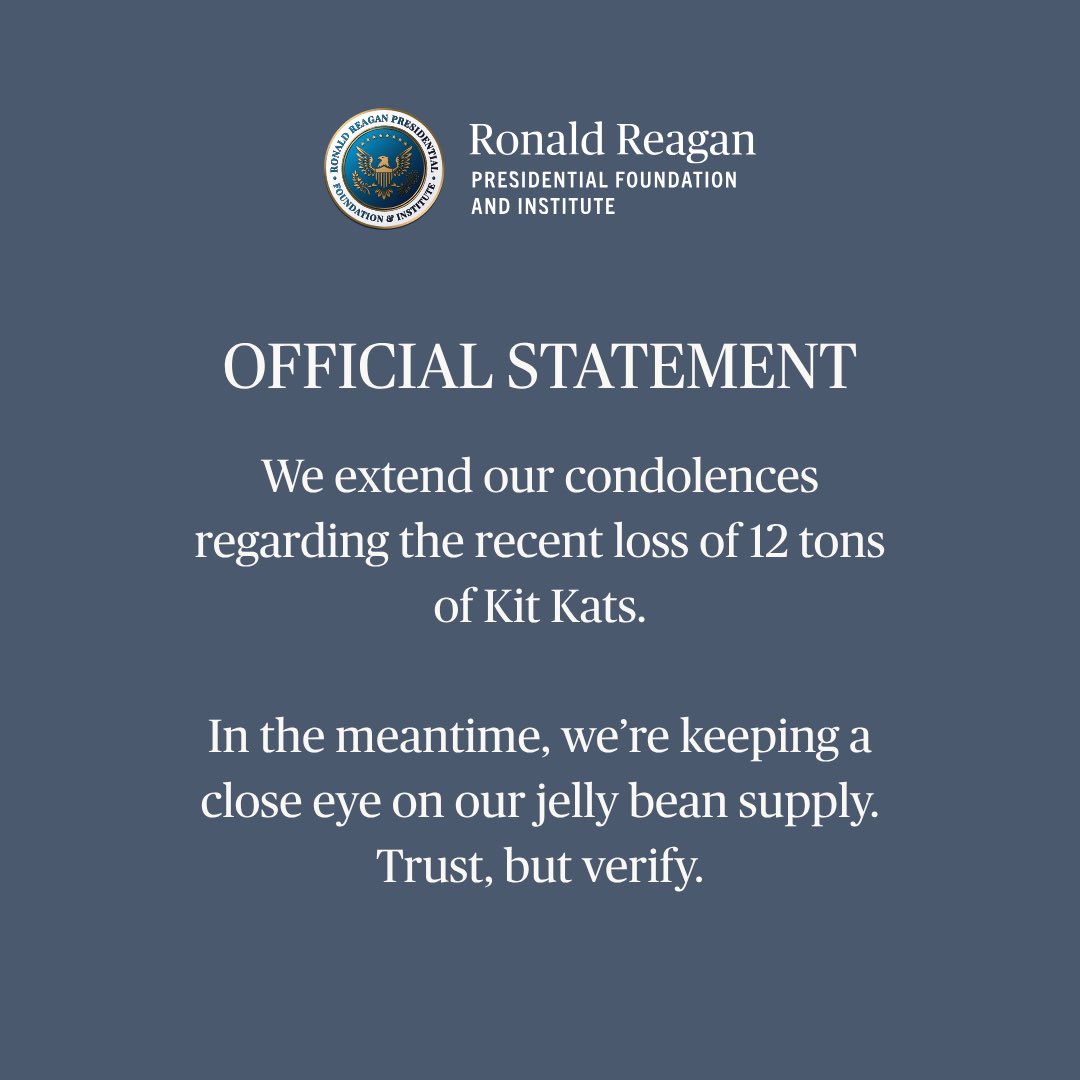
SUGAR HEIST: KitKat is raising the bar in the search for their missing chocolate.
The company has launched an official 'Stolen KitKat Tracker' encouraging candy-lovers to help them locate the stolen sweets.
A devotion on wives and wells: Genesis 24:32–52, 61–67
When Abraham’s servant goes to find a wife for Isaac, he meets that woman, Rebekah, at a well. When Jacob first encounters the bride he cherishes, Rachel, he also meets her at a well. And when Moses meets his future wife Zipporah, he also meets her at a well. In all three cases, a son of the covenant meets a woman who is outside of the faith at the place where water is drawn and he draws her into the family of God. Three times we see this in the Books of Moses. And in a way, we see this a fourth time when Jesus meets the Samaritan woman at the well.
Jesus, of course, has no earthly bride. But in a sense, the Samaritan woman represents the bride of Christ. Here is an unfaithful, adulterous woman covered in sin and corruption. She is outside the family of faith through her rejection of God’s word. But in His mercy, Christ appears at the well and draws her into the true family of faith, invites her to become the bride at the wedding feast of salvation, the bride whose sins are covered by the blood of the Groom, the bride who is born again into the family of God through the living waters that Christ gives, the waters of regeneration and renewal of the Holy Spirit, the waters of baptism.
And so, in that woman, just as we see Rebekah and Rachel and Zipporah, we see ourselves. Once we were parched in the wilderness, unable to satisfy our thirst, lost and condemned. But then the Bridegroom who laid down His life for His bride found us, and through the waters of Holy Baptism, washed us clean, satisfied our thirst, brought us out of the land of idols and death, and took us to His side forever.








![birdchadlouis's tweet photo. Why Was Moses Not Allowed to Enter the Promised Land?
There are three reasons that are usually considered. Each of them reflects the biblical language in Psalm 106 and Numbers 20.
First, the action of Moses is highlighted. God told him to speak to the rock, but instead, Moses struck it twice.
Second, some highlight the character of Moses since he was irate with the people that day.
Third, the words of Moses are sometimes given as the reason, because he called the people “rebels” and said, “Shall we [himself and Aaron] bring water for you out of this rock….” (Num. 20:10). Some argue that Moses implied that he and his brother were the source of this miracle rather than God.
The Lord explained it to Moses and Aaron this way: “Because you did not believe in me, to uphold me as holy in the eyes of the people of Israel, therefore you shall not bring this assembly into the land that I have given them” (20:12).
Psalm 106 says that the Israelites “angered [God] at the waters of Meribah, and it went ill with Moses on their account, for they made his life bitter, and he spoke rashly with his lips” (vv. 32-33).
Pulling this all together, Moses did not trust God that day, did not treat him as holy, was embittered, and spoke rash words. As a result, it would not be Moses but Joshua who led the people into the promised land.
Many centuries later, Moses stood beside the new and greater Joshua, Jesus the Messiah, atop the Mount of Transfiguration (Matt. 17:13). So, Moses did in fact make it to the land of promise, but only in Jesus.
As it was for Moses, so it is for us. Only in Christ are we, sinners like Moses, entering into the kingdom of God. Jesus and Jesus alone gets us there. And he gets us there solely by grace, for “the law was given through Moses; grace and truth came through Jesus Christ” (John 1:17).
_________
We read Numbers 20 today in Bible in One Year. For more information and to sign up, visit https://t.co/XxNvEtNH7e](https://pbs.twimg.com/media/HHi59oeWQAQIGtN.jpg)


![birdchadlouis's tweet photo. Q: Does Numbers 5 teach or permit abortion in the Old Testament?
A: No, Numbers 5 does not teach, describe, or permit abortion—this is a misunderstanding based on inaccurate translations and assumptions.
Q: What is happening in Numbers 5?
A: Numbers 5:11–31 outlines a specific ritual called the Sotah (“goes astray” or “commits adultery”). When a husband suspects his wife of adultery, but has no evidence, the woman is brought before the priest, a ritual is performed, and she drinks a mixture called “bitter water.” If she is guilty, she will suffer physical affliction; if innocent, she will remain unaffected and able to bear children.
Q: Does the text say the woman is pregnant?
A: The woman is never said to be pregnant. This crucial fact is overlooked or ignored by those who misuse this text to argue for abortion. The issue at hand is suspected infidelity. The ritual is meant to determine her guilt or innocence—not to cause an abortion.
Q: What does the phrase “her thigh will sag [or ‘fall’] and her belly swell” mean?
A: In Hebrew, her thigh will נפל (“fall”). The meaning is uncertain, though “thigh” may be used here as a euphemism for the reproductive organs. The root צבה means “swell” or “distend.” In verses 21, 22, and 27, it refers to a bodily reaction related to reproductive organs. However, nowhere does it mention miscarriage or abortion.
Q: Why does the NIV translation say “her womb will miscarry”?
A: This is a grossly misleading paraphrase. The Hebrew does not contain any word that means “miscarry.” If Moses had meant “miscarry,” he could have used one of the Hebrew words that clearly mean that—like שָׁכֹל (shākal)or יָצָא (yātza)—but neither is found in this passage.
Q: What’s the bottom line?
A: Numbers 5 is a ritual of divine judgment for suspected adultery, not a procedure for abortion. The text does not mention pregnancy, does not use Hebrew terms for miscarriage, and should not be used to argue that the Bible permits or supports abortion.
_________
We read Numbers 5 today in Bible in One Year. For more information and to sign up, visit https://t.co/XxNvEtNH7e](https://pbs.twimg.com/media/HHEcY4MacAARHQh.jpg)