@ZLOK Why do they keep talking about "voting" like it's a democracy?
If bitcoin worked they way they allege, it would completely lack sybil resistance.
@cwilbzz@GrassFedBitcoin@_DannyKnowles False trichotomy.
I'm with the people who think spam is highly undesirable and that the people adding it to the chain suck. We'd love to be able to stop it, but accept the technical reality that it isn't possible to do so without causing even more harm.
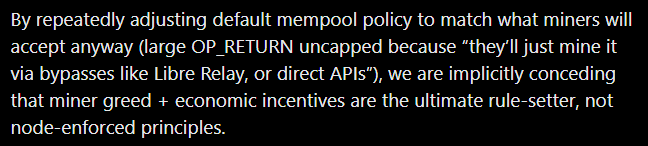
@hodlonaut But miner greed + economic incentives ARE the ultimate rule-setter. If it were otherwise, anyone could push through any soft fork they liked just by spinning up enough sybil nodes.
@ausbtcclub There is no "community".
You also can't complain about an implementation changing a default relay setting in spite of a small minority objecting, given BIP-110 thinks 55% in favour is sufficient to change actual consensus rules.
@Bit_Faced@Bob_Croft@grok@Scavacini777 You keep asking how a new node knows the consensus rules if it doesn't ask a miner. It knows them because the rules are built into the node software as downloaded.
Making initial connections to honest nodes is a non-trivial issue: https://t.co/fvw0FlkvoT
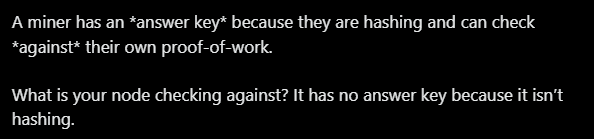
@Bit_Faced@Bob_Croft@grok@Scavacini777 What is this "answer key"?
Proof of work involves hashing different versions of the block header until a hash value is found that satisfies the current difficulty target.
Non-mining nodes validate by hashing the same block, using the same SHA256 algorithm as the miner.
@Bit_Faced@grok@Scavacini777 Mining nodes create new coins. That isn't in dispute.
We're talking about the entirely different subject of how nodes join the network.
@Bit_Faced@grok@Scavacini777 Nodes don't need to query miners.
A successful miner broadcasts a new block to the nodes to which it's connected. Those nodes relay the blocks to the nodes to which they're connected, and so on until all nodes in the network have the block.
@Bit_Faced@grok@Scavacini777 If it works how you say it works, how will the node software know it's connecting to a miner? It's the same question.
You need to read up on how node software initially learns about nodes it can connect to to start downloading the blockchain.
@Bit_Faced@grok@Scavacini777 That doesn't say miner, it says node.
You categorically don't need to connect to, or communicate (directly) with, a miner, for consensus rules or anything else. Most nodes never will.
@Bit_Faced@Bob_Croft@grok@Scavacini777 You seem very confused about how all this works.
All any node needs to do to validate a new block is hash it and check that the hash value is below a value defined by the current difficulty.
This is part of the consensus rules, which are in the node software at download.
> No coins are confiscated.
Not true. BIP-110 freezes coins and in certain scenarios enables coin theft. I know personally of people who would have their coins stolen and there is nothing they can do now to stop that
> No addresses are censored
Definitely not true! All sending to P2PK outputs/addresses is banned
Also, certain addresses that have coins will be unspendable.
> The primary effect is that large arbitrary data used by Ordinals, Runes
Not true. Runes is largely uneffected
And BIP-110 is clearly an attack on Bitcoin. It's an attempt to change the Bitcoin protocol rules without consensus, that's an attack. There is a hostile nature to it also, an attempt to change Bitcoin's rules to get back at Core for example. That is a ridiculous reason to change the Bitcoin protocol and BIP-110 is clearly an attack on Bitcoin
@Bit_Faced@grok@Scavacini777 Why would a non-mining node need to query a miner?
Most miners run custom versions of the same Core/Knots/whatever node software that non-mining nodes use. Bitcoin's consensus rules are common across all versions of such node software.