Just a few minutes ago, President Trump signed an Executive Order to establish a Strategic Bitcoin Reserve.
The Reserve will be capitalized with Bitcoin owned by the federal government that was forfeited as part of criminal or civil asset forfeiture proceedings. This means it will not cost taxpayers a dime.
It is estimated that the U.S. government owns about 200,000 bitcoin; however, there has never been a complete audit. The E.O. directs a full accounting of the federal government’s digital asset holdings.
The U.S. will not sell any bitcoin deposited into the Reserve. It will be kept as a store of value. The Reserve is like a digital Fort Knox for the cryptocurrency often called “digital gold.”
Premature sales of bitcoin have already cost U.S. taxpayers over $17 billion in lost value. Now the federal government will have a strategy to maximize the value of its holdings.
The Secretaries of Treasury and Commerce are authorized to develop budget-neutral strategies for acquiring additional bitcoin, provided that those strategies have no incremental costs on American taxpayers.
IN ADDITION, the Executive Order establishes a U.S. Digital Asset Stockpile, consisting of digital assets other than bitcoin forfeited in criminal or civil proceedings.
The government will not acquire additional assets for the Stockpile beyond those obtained through forfeiture proceedings.
The purpose of the Stockpile is responsible stewardship of the government’s digital assets under the Treasury Department.
PROMISES MADE, PROMISES KEPT
President Trump promised to create a Strategic Bitcoin Reserve and Digital Asset Stockpile. Those promises have been kept.
This Executive Order underscores President Trump’s commitment to making the U.S. the “crypto capital of the world.”
I want to thank the President for his leadership and vision in supporting this cutting-edge technology and for his rapid execution in supporting the digital asset industry. His administration is truly moving at “tech speed.”
I also want to thank the President’s Working Group on Digital Asset Markets — especially Treasury Secretary Scott Bessent and Commerce Secretary Howard Lutnick — for their help and support in getting this done. Finally Bo Hines played a critical role as Executive Director of our Working Group.
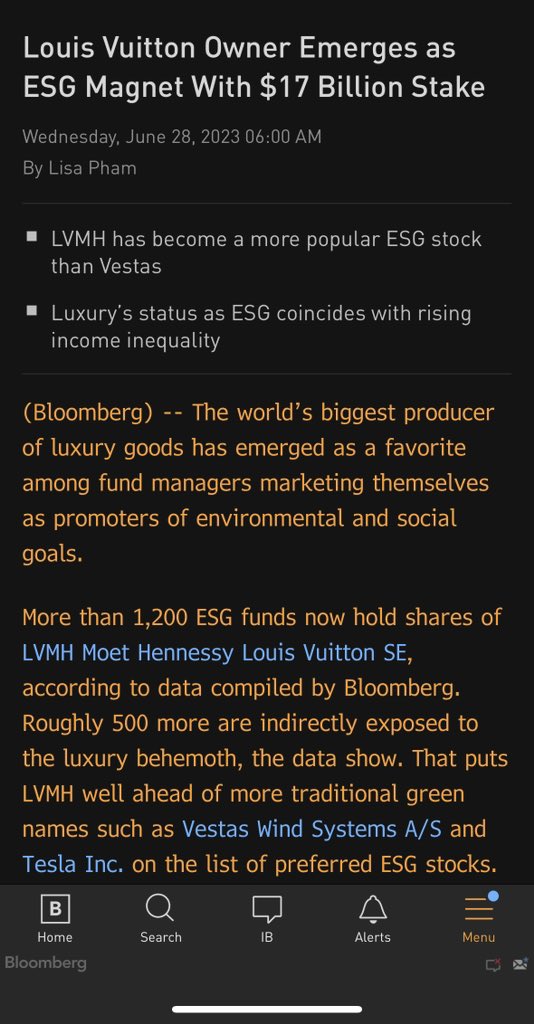
Quick, if I put a gun to your head and said pick the most climate friendly, socially impactful company with only one class of stock and separated powers between CEO and Chairman: Tesla or Louis Vuitton? How would you answer?
Well most of us would pick Tesla and apparently we’d be wrong.
Do you think of Louis Vuitton as an ESG stock? Actually, it would seem that a great luxury goods company like LVMH maximizes enterprise value by being anti ESG:
- sell goods at prices that are between slightly and completely inaccessible
- use expensive, hi-touch, unscalable techniques from artisans all around the wold
- thrive when the rich get richer
- be tightly controlled so no outside forces can ever distract or question the strategic decisions of the founder
Seems literally the opposite of E, S and G! And, frankly, operating this way is what has made LVMH such a good company for so long.
But as you can see below, LVMH, through no fault of their own have found themselves wrapped in this odd movement.
I’ve maintained for a while (and still do) that, individually, each part of ESG makes a lot of sense. But taken together, it’s become a perverted marketing program for fund managers to accumulate AUM.
In turn, they then create these false checkboxes that make no sense - LVMH is in, Tesla less so.
Initially, these ESG funds are buyers that can help lift a stock price (like they did for LVMH recently). The problem comes, however, when these ESG owners accumulate enough stock and then become activists to amp up the ESG that they said was there in the first place. I suspect many boards and CEOs will find themselves fighting off these folks with their consultant-led presentations…see Berkshire as a prime example.
In summary, I have ZERO issues with LVMH. I think it’s fabulously run, has awesome margins and is led by a master entrepreneur. And to the extent I would own the stock, this is why I would do so. In fact, I find LVMH very non-ESG. Which is why it’s so perverted and comical at the same time that the ESG funds are one of its biggest and growing shareholders.
“AI could negotiate and find you a better home and sell your home for the optimal price.” - @jason
How will AI disrupt the #RealEstate industry?
Jason and @DavidSacks debate 👇