lot of companies building "chat w/ your data" or "chat w/ your evals", or insert important business noun of your choice. But really what people want is "chat with a smart coworker who spends all their time thinking about your data and omnipotently already knows everything about it". subtle but crucial difference
@homsiT@anuraggoel@readwise 😢
definitely intrigued though! *love* your personal site; what a way to show off what i couldn't even imagine having the patience to fight with goodreads/kindle to do.
@homsiT@anuraggoel@readwise nah you'll have to pry my oasis out of my cold dead hands, and i do a lot of docs sent to kindle
looking more closely at your docs, pulling MyClippings.txt off the device still seems to be the best batch access method 😔 alas
@anuraggoel@homsiT@readwise hmmmm, ok, fair, my highlights have languished forever and it'd be nice to access my many years' worth of kindle metadata.
would be fun to play around and see if i can get my claude to pull in relevant highlights from over the years based on my focus each week 🤔
@anuraggoel@readwise love the idea, so dubious about execution. the value of kindle is total frictionlessness—eg i'd love more detailed analytics but readwise's options are 1) use kindle cloud reader on a browser or 2) take photos with the app of a physical book? 🙈
@perperp_er There's no excuse not to instrument the code; that's just a loop. use the @honeycombio skill pack to instrument the code and merge the outcomes right in.
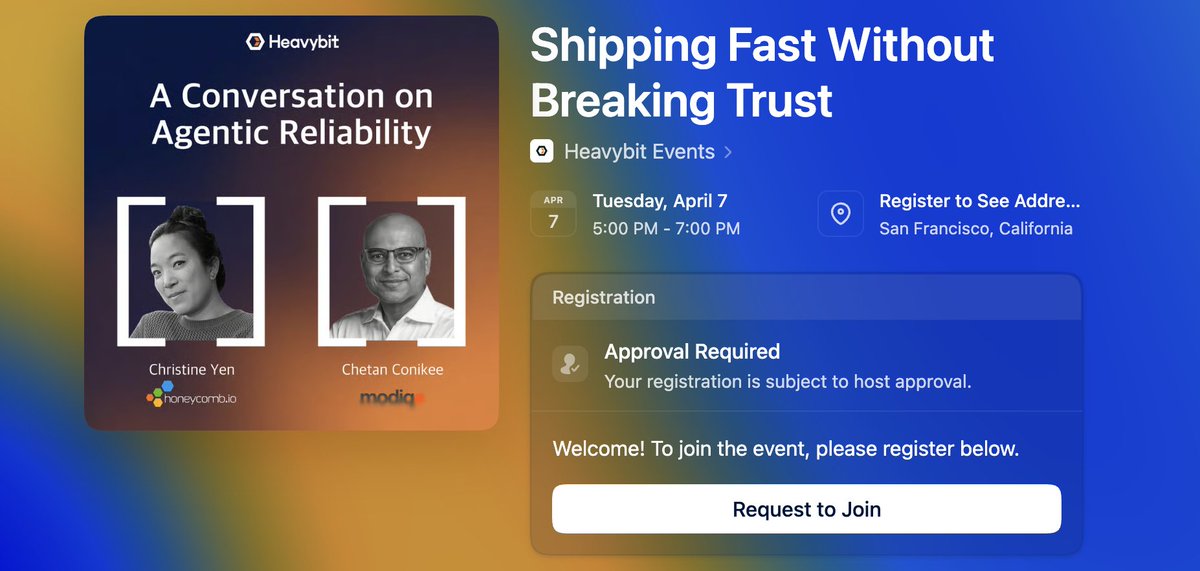
Attending @HumanXCo? We're hosting an intimate fireside chat with @honeycombio's @cyen before she takes the HumanX stage. Moderated by @conikeec, they're going to be discussing how teams can design observability for an AI-driven world. Space is limited! https://t.co/ywQeo9Ibog
We've been building an internal Claude Code plugin system at Intercom with 13 plugins, 100+ skills, and hooks that turn Claude into a full-stack engineering platform. Lots done, more to do. Here's a thread of some highlights.
If you're a team of 5+ and you don't have formal, tracked SLOs around:
* Request queue time (web server)
* Background job queue time (per queue)
... you should, because you already have an informal one (your customers complaining).
There have been some good posts on what "wide events" instrumentation is but not as many on how to go about it, what attributes you should add, or how to work with OpenTelemetry
I put everything I've learned in the last few years into one guide https://t.co/SPZ9GdtyRj
Service level objectives aren’t one-size-fits-all. @cyen, CEO of @honeycombio, recommends teams define their own SLOs to meet their unique needs! 🎯
Tune in for Christine’s take on shifting from tool-centric discussions to a customer-focused approach: https://t.co/BtXlAfrhpT
These three offerings respectively solve the three biggest Observability challenges:
1. Everything’s logs already; I don’t want to instrument it all again.
2. Scale is hard.
3. My engineers are morons.
How would you migrate your code from metrics to wide structured logs? 💥LIKE THIS💥 (courtesy @JeremyMorrell)
Also see this terrific how-to blog from @jessitron, "How to Get Infinite Custom Metrics for Free": https://t.co/y0LXNq7UHu
It's been five years and Datadog still can't get close to @honeycombio in terms of experience of slicing and dicing tracing data.
Just added a new field to my traces. I want to group by that field to compare old vs. new. Datadog is not capable of that. At least not automatically