Here we go...
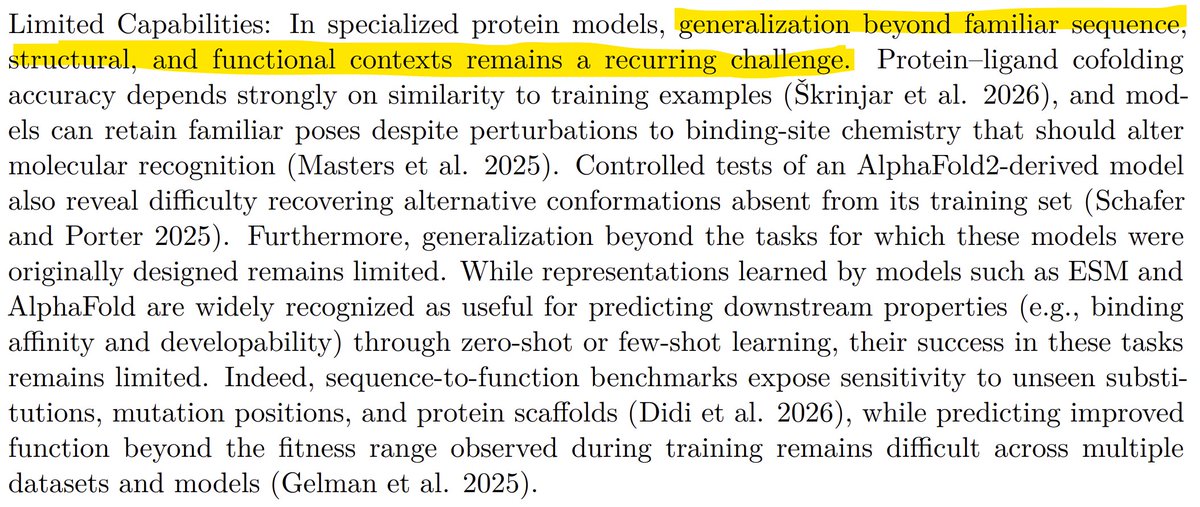
The paper opens by saying generalization abilities of specialized proteins models are a recurring challenge. They are! That is why good evaluations in biological machine learning take care to assess generalization and relationships between training and test data.
Is it just me that feels the looped architecture is closely related to diffusion/flow matching, which also feeds the output of an NN to itself iteratively? They do it differently (e.g. denoiser also conditions on the noise level) but there seems to be commonality.
For almost any task humans can perform, LLMs seem to outperform them. But structure prediction appears to be a different story. Yet our in-house results show their (top-tier LLMs + top-tier structure predictors) potential to improve protein design pipelines.
Performance improved across model generations.
In computer tests, an internal research model matched or outperformed specialized models on many protein tasks, including designing shapes and predicting how molecules fit together.
The models’ written reasoning and code suggest they draw on math, physics, chemistry and biological knowledge to work through these problems.
Some personal updates:
I'll join Princeton University as an Associate Professor in the Department of Computer Science in Fall 2027. I'm moving my Robot Perception and Learning Lab to @PrincetonCS, along with my students. And yes, I'm recruiting new PhD students and postdocs this cycle!
I'm deeply grateful to my students, colleagues, and collaborators at UT Austin, who have made it a memorable chapter of my life. UT is a great place to build a research career, with tremendous resources, excellent students, and a warmhearted community. I also feel fortunate to have called Austin home for the past six years, as I have witnessed its growth into one of America's most vibrant tech hubs.
Alongside this transition, I'll continue to co-lead the NVIDIA GEAR team, where we push the frontier of general-purpose robot autonomy. I also look forward to connecting with the growing robotics industry on the East Coast and finding new collaboration opportunities.
Needless to say, this move comes at a challenging time for academia.
Rapid AI advances are fundamentally reshaping how knowledge is created, disseminated, and applied. Universities must rethink their roles in a world where frontier AI systems can perform tasks once requiring years of specialized training. Yet, I believe these challenges present universities with a greater mission: to prepare younger generations for the post-AGI era and cultivate human character, values, taste, judgment, and a sense of purpose. The pursuit of truth, driven by intellectual curiosity and academic freedom, remains at the heart of universities.
On the research side, I've seen firsthand how frontier AI development is becoming increasingly resource-intensive and concentrated in well-funded industrial labs (including GEAR itself). At the same time, academia has an enduring responsibility to seek fundamental understanding, ask hard questions whose answers have no immediate commercial payoffs, and advance knowledge for the benefit of humanity and the betterment of society.
I chose Princeton because of its deep commitment to fundamental research and education. I see it as an extraordinary place to tackle these challenges and explore new opportunities. Together with the Princeton community, I hope to help shape the future of higher education.
I'm excited for this next chapter and everything ahead!
📢 I'm recruiting PhD students & postdocs to join my group at @CS_UVA!
Focus: neurosymbolic AI, generative models, constrained generation, explainability, trustworthy AI, reliable LLM reasoning, etc
Check out our lab page https://t.co/rdw3OuIfmF for more info
RT appreciated 😄
Everything is bigger in Texas. Including the future of science. 🤘
America’s most powerful academic supercomputer is now online at @UTAustin.
• 4,000 NVIDIA Blackwell GPUs
• 80 exaflops of AI performance at FP4
• 400 petabytes of all-flash storage
• Designed for 10x faster scientific simulations than its predecessor
From discovering new medicines to understanding the origins of the universe, Horizon will accelerate human progress and discovery.
42 years after starting @Dell in a UT dorm room, I’m especially proud of what Dell Technologies, @nvidia , @TACC and National Science Foundation (@NSF) have built together.
The next great scientific breakthrough will begin right here in Texas. 🤠🚀
In case anyone is curious:
We’ve had a ~pixel-perfect world model since last year, which is critical for synthetic data generation.
The (much) smaller version of that in the car is a conditional mean-flow model, based on the recent sequence of Tesla Universal Vision Encoder features, which are the same ones that are plugged into the 3B encoder model that produces the driving actions.
We fork off from these UVE features, then run a separate ~1B diffusion model. This takes in the previous reality-view generation with added noise and then denoises it to the current visualization.
It then produces a small video chunk (8 images at 36 fps, at the resolution of the UI screen). This work is done by 1/2 of a TRIP engine every UVE frame at 18 hz and is spread over 4 cycles.
Currently, the latency is a bit high due to compute constraints, but we have ways to interleave newer UVE features along the diffusion transformer layers to cut roughly 35% of the latency.
We fully support OpenAI's transparency initiative. Thanks to @merettm@markchen90@gdb@sama for leading the way.
We all got into this field to build safe AGI that is genuinely good for humanity. One of the hardest parts of AI safety is coordination, and this is a step in the right direction. Many more steps like this will be needed to deliver safe, contained, and aligned AGI in the next few years.
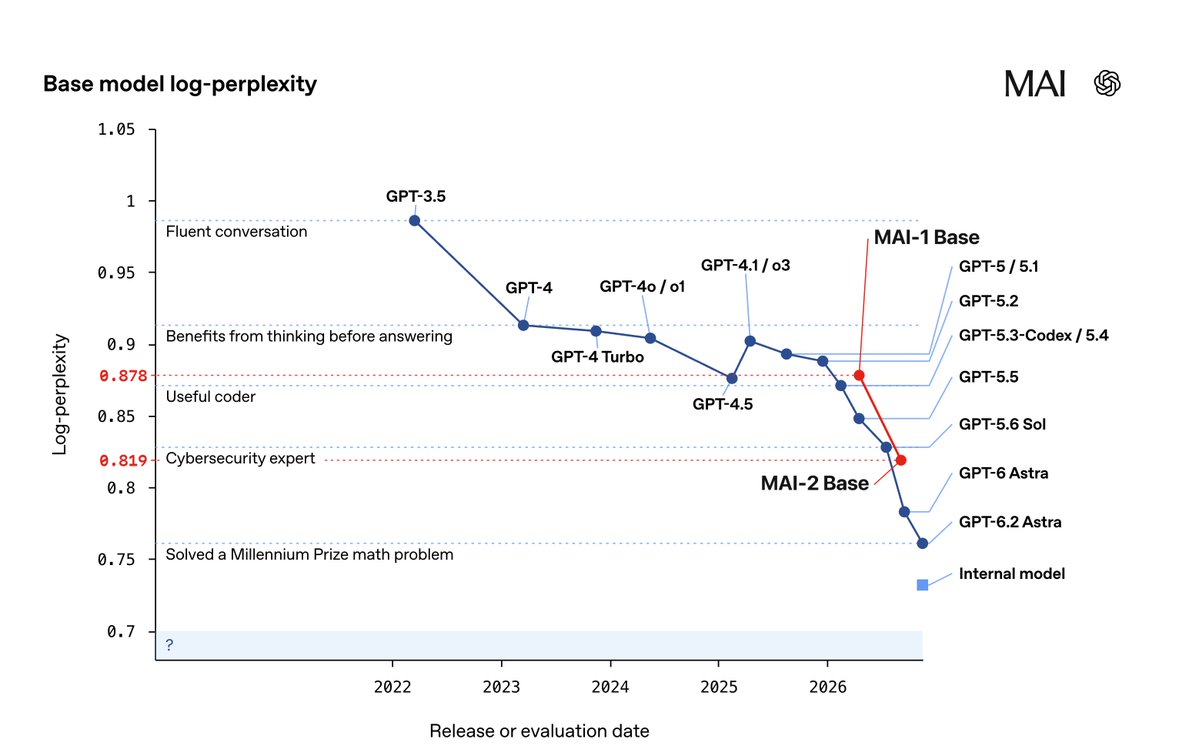
We're committed to sharing our pre-training progress on a common held-out evaluation set. With OpenAI's permission, we report MAI-2 Base on their evaluation set. Its log-perplexity is 0.819, putting it in the same ballpark as the GPT-5.6 Sol base model. Our model uses the same tokenizer as OpenAI, so the numbers are directly comparable.
In the future, to be able to compare across labs we might need to report bits-per-byte (BPB) rather than perplexity since different labs use different tokenizers. We will also need different evaluation datasets - the fact we have access to OpenAI's evaluation dataset is a special case.
Safety and alignment is now the mission. It's the absolute number one most important focus for our industry. And it begins with small, practical steps like these towards better coordination on pacing.
As AI systems get more powerful, we believe we will see a speedup in the rate of scientific progress. How we prepare for this, build the infra to support it, and deal with the associated safety issues will define 2027 and beyond. https://t.co/sqEzhYivFY
Today we’re releasing Inkling 2 Mini, a looped transformer, with open weights.
A big reason we're doing this is to let the AI safety community study looping, especially how loops affect chain-of-thought monitorability and how to interpret the computation inside loops. 🧵
Besides Inkling 2 Mini (aka Loopling), we also share a variable-looped model, TML-d24-varloop-research, because Inkling 2 Mini only supports a fixed number of looping passes.
https://t.co/GS80nza2os
Studying the variable-loop model, we saw that performances on long-context benchmarks improve with more passes, such as GraphWalks BFS and MRCR v2; but knowledge-intensive benchmarks doesn’t improve with more passes, such as AA-Omniscience, SimpleQA Verified, SimpleVQA, and WorldVQA.
We shipped Inkling 1.0 on July 15, 2026. Now Inkling 2 Mini outperforms it in almost every way at just 2.7% of the size. That’s how we iterate at Thinky :bufo-ship:
Enjoy Inkling in your pocket!
1/5 EBMs are usually taught as one model family among many. In our new tutorial with @du_yilun, we use them as a single lens on machine learning.
"An Energy-Based Perspective on Machine Learning" https://t.co/ZpPD2qTIPi
Biases and Limits of AlphaFold Predictions for Non-Globular Proteins
1. The paper compiles 27 experimentally validated “failure modes” where AlphaFold predictions diverge from biologically relevant states for non-globular proteins (NGPs), arguing that many issues come from missing biological context rather than incorrect local geometry.
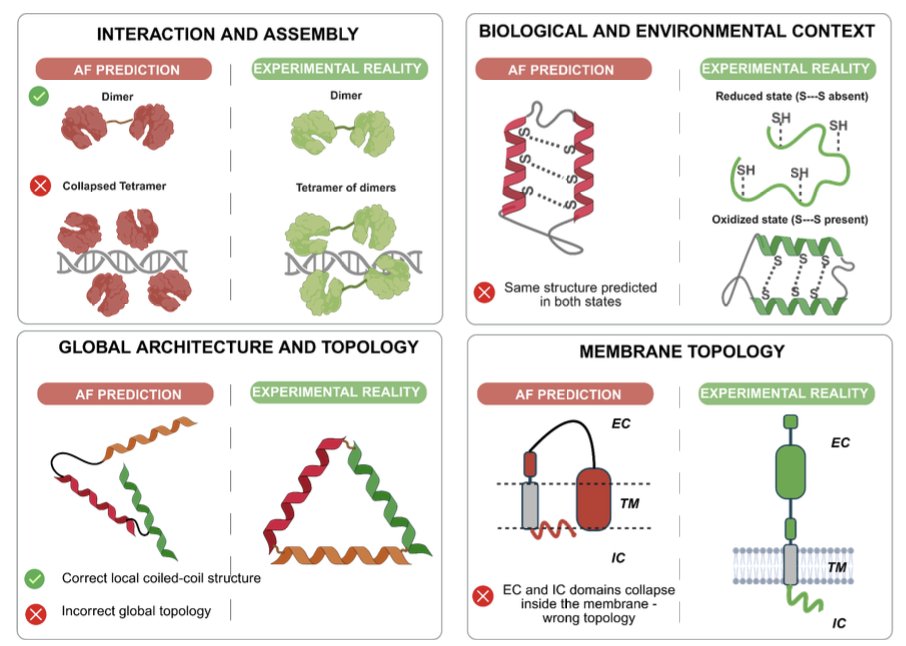
2. It proposes a practical framework with four recurring discrepancy categories: (i) interaction and assembly, (ii) biological/environmental context, (iii) global architecture and topology, and (iv) membrane topology—intended to help users decide when a single AF model is likely to be misleading.
3. A key message is that NGPs often do not have one dominant structure: intrinsically disordered proteins/regions, repeat proteins, and low-complexity regions may exist as ensembles and undergo disorder–order transitions, so a single static prediction can be an incomplete or wrong “answer.”
4. Interaction and assembly: the p53 case illustrates that AlphaFold can model a correct dimeric arrangement yet misplace dimer–dimer organization in the functional tetramer, highlighting limitations in predicting higher-order quaternary architecture even when subunits look correct.
5. Biological and environmental context: the TRIAP1 example shows redox-dependent conformational switching (oxidized α-helical vs reduced molten-globule-like). AlphaFold predictions remain essentially unchanged even when cysteines are replaced by serines to mimic reduction, underscoring difficulty in capturing state changes not specified by sequence alone.
6. Global architecture and topology: for de novo Coiled-Coil Protein Origami (CCPO), AlphaFold reproduces several local coiled-coil features but fails to recover the intended global topology/connectivity, emphasizing that local correctness does not guarantee correct whole-chain architecture—especially relevant for protein design.
7. Membrane topology: for Type Ve autotransporters, AF2/AF3 can produce locally plausible domains arranged in ways incompatible with the membrane plane (e.g., extracellular regions crossing the membrane, incorrect periplasmic domain organization), reflecting the lack of an explicit membrane environment in the modeling.
8. The authors note that AF-derived metrics (e.g., pLDDT, RSA) can correlate with disorder signals but do not capture experimentally observed conformational heterogeneity; they caution that non-expert users may overinterpret confident-looking snapshots.
9. Comparing AF2 vs AF3, the paper acknowledges AF3’s advances (diffusion-based modeling; complexes with proteins/nucleic acids/small molecules/ions; selected PTM inputs) but concludes many core challenges persist for NGPs, especially context-driven conformational transitions and ensemble behavior.
10. The recommended practice is to interpret AlphaFold models as hypotheses and integrate complementary experiments (e.g., NMR, SAXS, cryo-EM, cross-linking, circular dichroism) to identify the biologically relevant state; longer term, the field needs ways to predict, represent, and store conformational variability and environmental dependence (pH, ionic strength, redox, membranes, partners).
📜Paper: https://t.co/eqr3NanoXi
#AlphaFold #ProteinStructure #IntrinsicallyDisorderedProteins #StructuralBiology #ComputationalBiology #ProteinDesign #MembraneProteins #Bioinformatics #MachineLearning
중국의 한국에 대한 이번 최혜국 대우 합의는 한중관계의 전면적 실질적 복원을 넘어, 한중관계의 새로운 미래를 만들어나가는 토대가 될 것입니다.
대중협상에서 큰 역할을 해 준 우리 정부 공직자 여러분 수고 많으셨습니다. 감사드립니다.
국민여러분께서도 맡은 일 잘 해낸 외교부 문화체육부 산업부, 청와대 안보실 정책실 등 공직자들을 많이 격려해 주십시오.
I agree with this point, and it's one of the key motivations behind releasing Mol-1-Constraint (https://t.co/PltVzfS2T4): enabling LLMs to provide more flexible input constraints to the existing best folding model. LLMs can then understand more and accomplish even more.
Takeaways:
• LLMs recall fold-level topology of known families; register, loops and interfaces are not there
• Test on post-cutoff structures, not textbook proteins
• Always report the true-contact ceiling
• Use LLM contacts as restraints for a real folding or docking method, not as the folder