Find out what’s happening at the intersection of NLP and Healthcare and how Geisinger is putting patient first. Extracting Patient Narrative from Clinical Notes: Implement Apache Ctake... https://t.co/eYffxYXq8I via @YouTube
@honeycombio Her team also skipped the mandates & built a set of AI values instead:
"Every AI output has to have a human owner. If you don't want your name on it, it's probably not good work."
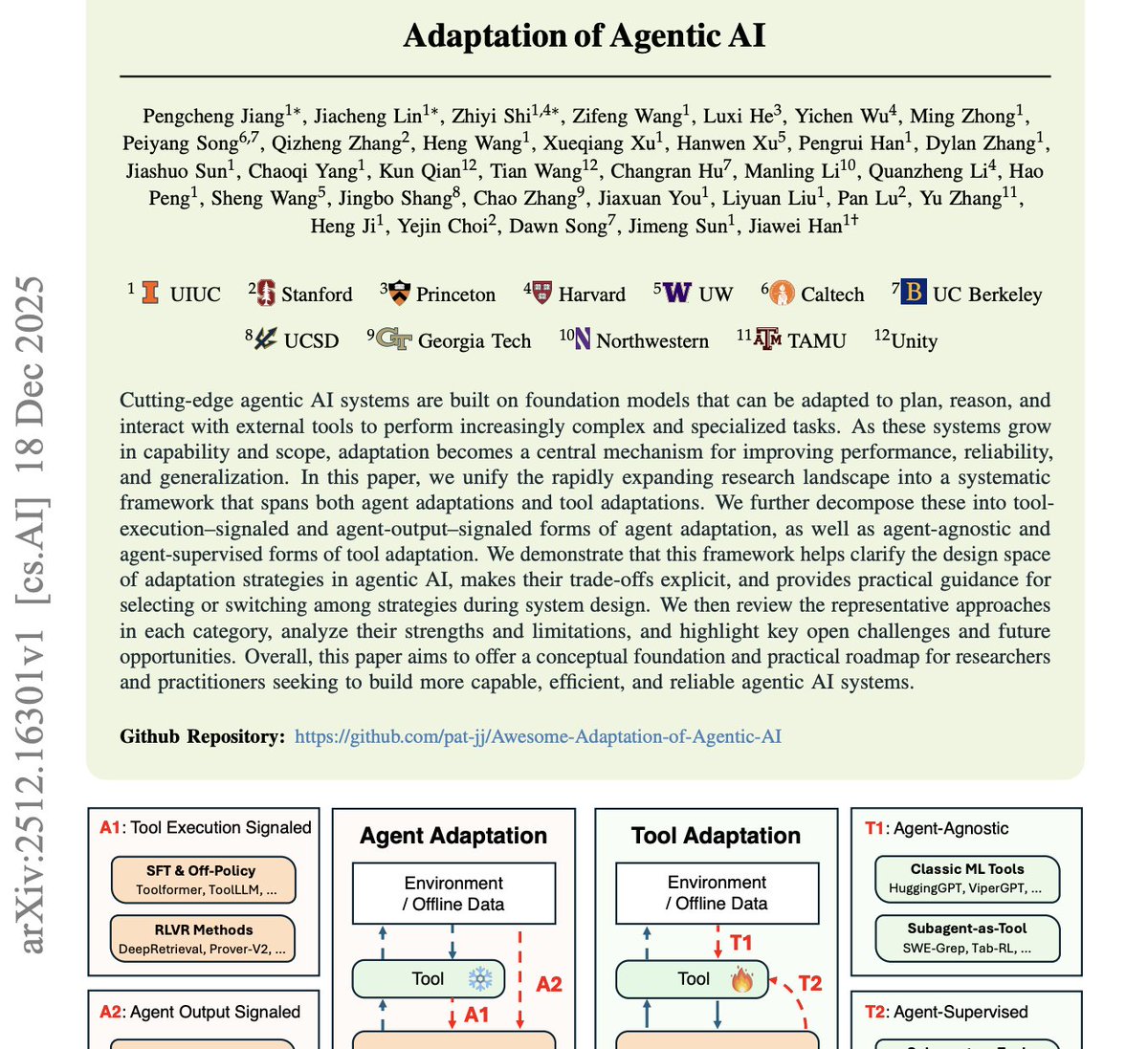
This paper from Stanford and Harvard explains why most “agentic AI” systems feel impressive in demos and then completely fall apart in real use.
The core argument is simple and uncomfortable: agents don’t fail because they lack intelligence. They fail because they don’t adapt.
The research shows that most agents are built to execute plans, not revise them. They assume the world stays stable. Tools work as expected. Goals remain valid. Once any of that changes, the agent keeps going anyway, confidently making the wrong move over and over.
The authors draw a clear line between execution and adaptation.
Execution is following a plan.
Adaptation is noticing the plan is wrong and changing behavior mid-flight.
Most agents today only do the first.
A few key insights stood out.
Adaptation is not fine-tuning. These agents are not retrained. They adapt by monitoring outcomes, recognizing failure patterns, and updating strategies while the task is still running.
Rigid tool use is a hidden failure mode. Agents that treat tools as fixed options get stuck. Agents that can re-rank, abandon, or switch tools based on feedback perform far better.
Memory beats raw reasoning. Agents that store short, structured lessons from past successes and failures outperform agents that rely on longer chains of reasoning. Remembering what worked matters more than thinking harder.
The takeaway is blunt.
Scaling agentic AI is not about larger models or more complex prompts. It’s about systems that can detect when reality diverges from their assumptions and respond intelligently instead of pushing forward blindly.
Most “autonomous agents” today don’t adapt.
They execute.
And execution without adaptation is just automation with better marketing.
Most early-stage founders think that they're doing "enterprise sales" when they speak to any company with more than 250 employees.
True enterprise sales looks something like:
Day 1: first meeting (over Teams or WebEx) with 3 people with "analyst" or "associate" or "assistant" in their titles.
Day 25: second meeting. 14 people are in the call and you spend 25 minutes of the 45 minute meeting on intros. There are 11 associate district managers there for some reason? 9 of the 14 people have to "drop early" for another meeting.
Day 66: after 28 emails to get this meeting scheduled, it gets pushed out 2 months because Bill from legal is swamped and Terry is out of town.
Day 127: the SVP you need to meet with joins the call with 21 other people. She has zero context and you need to start from the top. Meeting goes well and follow ups are set.
Day 131: you see that the SVP you met just posted on LinkedIn that she's leaving the company, and you go back to the drawing board and restart the cycle.
Did you know that until 2022 any installed app on Android could see all other apps on your phone without permission? Now, devs need to declare which apps they need visibility to in AndroidManifest.xml
I was curious to see which Indian apps were spying on my installed apps 👇
Want to take a moment to really appreciate the brilliant minds at Google. So much of our modern technology was born out of that company a decade or two ago:
At a certain scale, Snowflake or Databricks is going to hurt your org’s wallet. In my previous team, we had a home grown Lakehouse with S3 and Hive Metastore. Later moved to Iceberg. Spark ran on EMR on EKS. Trino self deployed.
What prevents teams from leaving cloud d/ws?
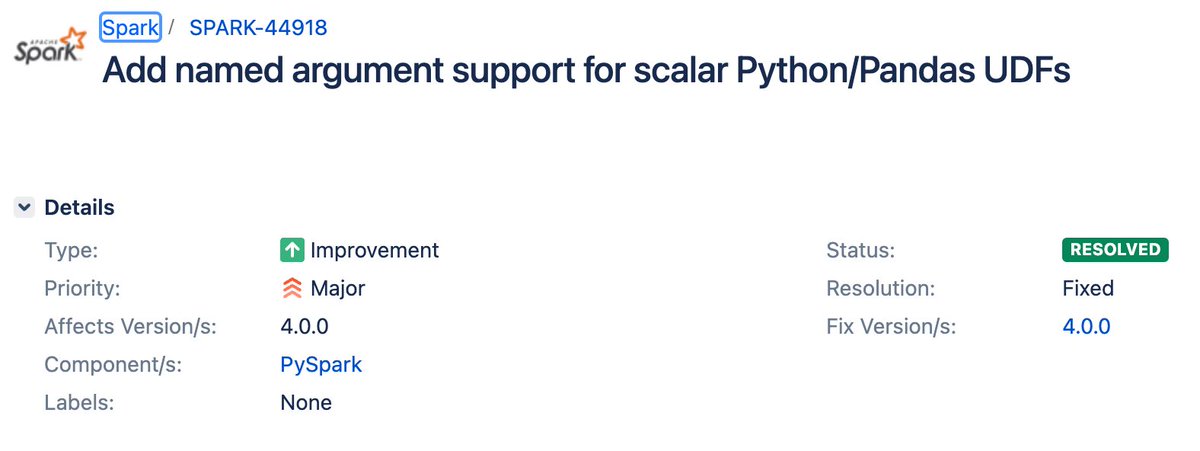
And we know what's coming in #ApacheSpark 4.0.0. This version surely makes us all long-time Spark users soooo OLD! 😆
And I'd not be surprised if some tricks of mine may've happened to be outdated already 😉
Named parameters in SQL statements are already available since 3.5.
The "generative" part of the brain is what turns ideas and plans into actions, including spoken and written words.
But the hard part of intelligence is to come up with those ideas and plans.
In the brain, ideas are formed in the prefrontal cortex.
Turning them into actions is done by the motor cortex and the cerebellum.
Reducing intelligence to generation is like reducing software to print() statements.
Every single one of these videos is AI-generated, and if this doesn't concern you at least a little bit, nothing will
The newest model: https://t.co/zkDWU8Be9S
(Remember Will Smith eating spaghetti? I have so many questions)
here is sora, our video generation model:
https://t.co/CDr4DdCrh1
today we are starting red-teaming and offering access to a limited number of creators.
@_tim_brooks@billpeeb@model_mechanic are really incredible; amazing work by them and the team.
remarkable moment.
Vacations are difficult. You meet your family after months and that too for a few days. You come across so many difficulties. Both parents and you create a house of cards of lies. While they lie how great they are and living their best without your support or company but you
My students are know-nothings. They are exceedingly nice, pleasant, trustworthy, mostly honest, well-intentioned, and utterly decent. But their brains are largely empty, devoid of any substantial knowledge that might be the fruits of an education in an inheritance and a gift of a previous generation. They are the culmination of western civilization, a civilization that has forgotten nearly everything about itself, and as a result, has achieved near-perfect indifference to its own culture.
It’s difficult to gain admissions to the schools where I’ve taught – Princeton, Georgetown, and now Notre Dame. Students at these institutions have done what has been demanded of them: they are superb test-takers, they know exactly what is needed to get an A in every class (meaning that they rarely allow themselves to become passionate and invested in any one subject); they build superb resumes. They are respectful and cordial to their elders, though easy-going if crude with their peers. They respect diversity (without having the slightest clue what diversity is) and they are experts in the arts of non-judgmentalism (at least publically). They are the cream of their generation, the masters of the universe, a generation-in-waiting to run America and the world.
Related: The Chaos of College Curricula
But ask them some basic questions about the civilization they will be inheriting, and be prepared for averted eyes and somewhat panicked looks. Who fought in the Peloponnesian War? Who taught Plato, and whom did Plato teach? How did Socrates die? Raise your hand if you have read both the Iliad and the Odyssey. The Canterbury Tales? Paradise Lost? The Inferno?
Who was Saul of Tarsus? What were the 95 theses, who wrote them, and what was their effect? Why does the Magna Carta matter? How and where did Thomas Becket die? Who was Guy Fawkes, and why is there a day named after him? What did Lincoln say in his Second Inaugural? His first Inaugural? How about his third Inaugural? What are the Federalist Papers?
Some students, due most often to serendipitous class choices or a quirky old-fashioned teacher, might know a few of these answers. But most students have not been educated to know them. At best, they possess accidental knowledge, but otherwise are masters of systematic ignorance. It is not their “fault” for pervasive ignorance of western and American history, civilization, politics, art and literature. They have learned exactly what we have asked of them – to be like mayflies, alive by happenstance in a fleeting present.
Related: Courses without Content
Our students’ ignorance is not a failing of the educational system – it is its crowning achievement. Efforts by several generations of philosophers and reformers and public policy experts — whom our students (and most of us) know nothing about — have combined to produce a generation of know-nothings. The pervasive ignorance of our students is not a mere accident or unfortunate but correctible outcome, if only we hire better teachers or tweak the reading lists in high school. It is the consequence of a civilizational commitment to civilizational suicide. The end of history for our students signals the End of History for the West.
During my lifetime, lamentation over student ignorance has been sounded by the likes of E.D. Hirsch, Allan Bloom, Mark Bauerlein and Jay Leno, among many others. But these lamentations have been leavened with the hope that appeal to our and their better angels might reverse the trend (that’s an allusion to Lincoln’s first inaugural address, by the way). E.D. Hirsch even worked up a self-help curriculum, a do-it yourself guide on how to become culturally literate, imbued with the can-do American spirit that cultural defenestration could be reversed by a good reading list in the appendix. Broadly missing is sufficient appreciation that this ignorance is the intended consequence of our educational system, a sign of its robust health and success.