Someone just pointed out that—almost unbelievably—this is real footage from a fight in which the Canada goose ultimately prevailed over the eagle: https://t.co/wLQ6O7ccqf
If this isn't a metaphor for US trade policy, I don't know what is.
@joshuakeating Ah what a damn shame. I literally got a Vox subscription two months ago because I kept on wanting to read your paywalled articles. Let us know what you end up doing next!
I think here’s an interesting tension between many academics’ insistence that “AI can’t think” and the discovery that AI has demolished traditional methods for evaluating learning and thinking.
It’s very funny that ten years ago beltway chickenhawks adopted an unachievable phony demand to justify opposing the JCPOA, Trump didn’t realize it was fake and fought a war to get it, discovered it was unachievable, and is now giving the chickenhawks the worst day of their lives
The Fidesz regime is deeply entrenched across the Hungarian government: courts, bureaucracy, regulators, tax agencies, even cultural organizations were all part of it.
If Magyar does not use his power to enact sweeping constitution changes, much of that system could survive.
>90% of sulphur imported into Africa is from the Middle East… and therefore passes through the Strait of Hormuz
Let that sink in.
I have heard that traders are already struggling to source any. Sulphuric acid prices will therefore significantly increase across Africa… and if the disruption lasts longer than ~3 weeks, copper oxide operations will have to close as they’ve run out of acid.
Oxide copper is the dominant ore source of copper produced in DRC… and the DRC is the world’s 2nd largest copper producer.
Last time I flew on a Danish Hercules, it was ferrying American troops from Kabul to Helmand. Now it’s flying military deployments triggered by American threats to invade a Danish territory. How times have changed.
From photographer Christopher Anderson, who took the portraits of Trump’s inner circle for Vanity Fair. The great @shaneisland caught him at the airport in Paris: https://t.co/zt7rCYC6NQ
Does not just apply to Europe of course. The collective silence from world leaders on the atrocities happening in Sudan show just how far we've come from the R2P era of int'l relations (which to be sure had its own flaws, but this silence is a far greater failing)
✍️ If Europe wants credibility when invoking international law in Ukraine, Gaza or elsewhere, it cannot ignore the atrocities happening in Sudan. Though the options are limited, there are ways to hold the responsible accountable @Cinzia_Bianco @_Will_Brown https://t.co/LR5i9Zx1Ut
Der Papst zitiert Hannah Arendt: "Der ideale Untertan totalitärer Herrschaft ist nicht der überzeugte Nazi oder engagierte Kommunist, sondern Menschen, für die der Unterschied zwischen Fakten und Fiktion, zwischen wahr und falsch, nicht länger existiert.“
https://t.co/RagtJjFrIS
Checking sources is a superpower--you would not believe the stuff people sneak into things.
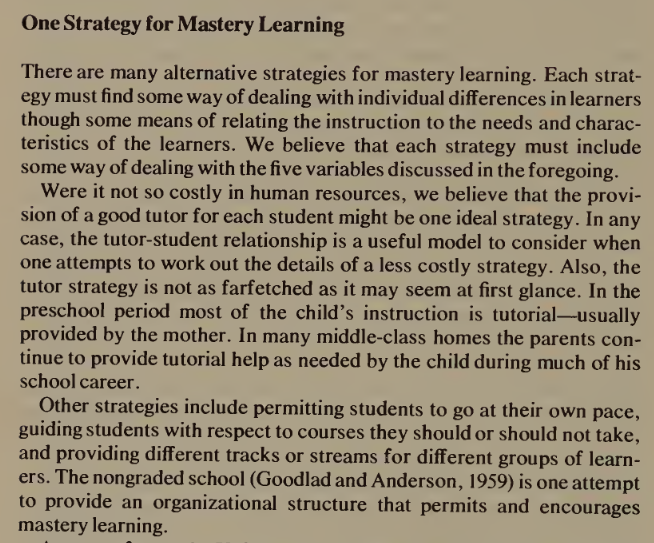
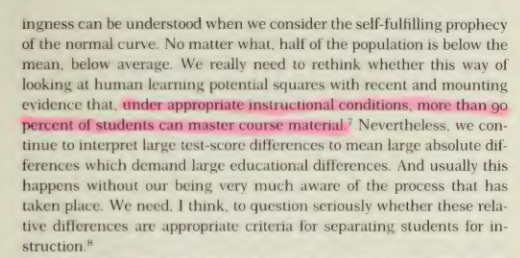
As one example: the book "Keeping Track" is by far the most influential anti–ability grouping book. Key to its argument is a claimed finding that 90% of students can master course material under the right circumstances to argue that all students should be placed into the same courses.
Where does that footnote - footnote 7 - lead? Benjamin Bloom's "All Our Children Learning." Not to a specific page. Not to a specific note within it. The entire book.
So let's dig in! What does Bloom say?
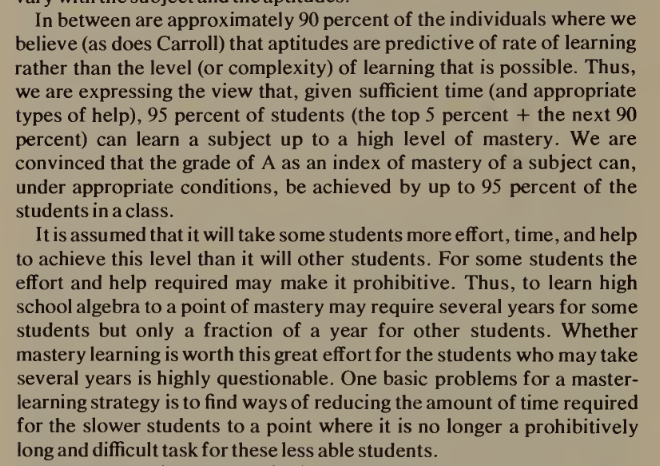
He notes his belief that around 90% of people differ in rate of learning rather than the level of learning theoretically possible, but that it will take some students more time, effort, and help to reach that level than others (sometimes prohibitively so). Some, he'll note, might take several years on high school algebra, while others can do it in a fraction of a year.
Then he provides suggestions. How do you structure a school so that students can learn at appropriate paces to meet his "90%" goal? He has a few ideas:
1. Give each student an individual tutor.
2. Let students go at their own pace.
3. Guide students towards or away from specific courses.
4. Provide different tracks for different groups of learners.
Did you catch that?
Bloom says: obviously kids learn at different paces, so if you want them to master the material, either let them rush ahead individually or group them by ability. If we do that, everyone's level will improve.
Oakes takes that, strip-mines the entire book down to a claim she paraphrases as "under appropriate learning conditions, more than 90 percent of students can master course material," and then uses it to argue that we should not let kids rush ahead individually or group them by ability.
This book has been cited more than 10000 times. It is by far the most influential single thing ever written on ability grouping. And it cites sources it knows nobody will examine to argue for the polar opposite of what those sources advocate.
Check sources.
randy clarke had a good line about this:
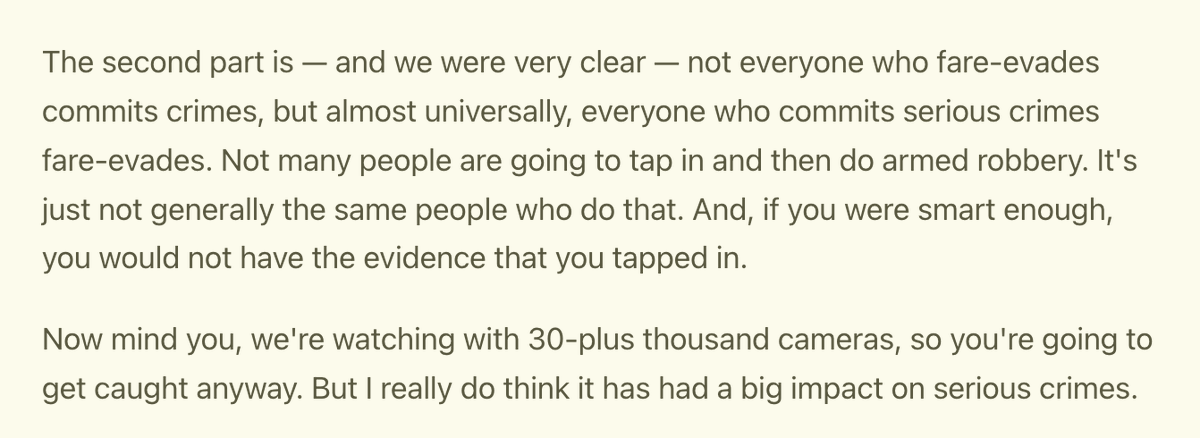
"not everyone who fare-evades commits crimes, but almost universally, everyone who commits serious crimes fare-evades. Not many people are going to tap in and then do armed robbery.
Proportionally, the estimated 100-200k Pride marchers in Budapest today would correspond to something approaching 1m in London or New York. And this in a country that has now spent 15 years under illiberal, authoritarian rule.
What a symbol of hope.
Not sure how many people realize that battery storage already supplies 30% of California’s electricity demand at peak.
Batteries aren’t the future — they’re here now.