@440Megatonnes Have to be careful how you interpret nitrogen use efficiency… here it is calculated as N harvested divided by N fertilizer added. This ignores other sources of nitrogen like nitrogen fixation and soil N mineralization. The value can be greater than 100% as in a soybean crop.
New research on P.E.I. has convinced some Island potato farmers to switch over to what are known as enhanced efficiency fertilizers, that slowly release nitrogen when plants need it over the course of the season.
https://t.co/n97GTSCZYj
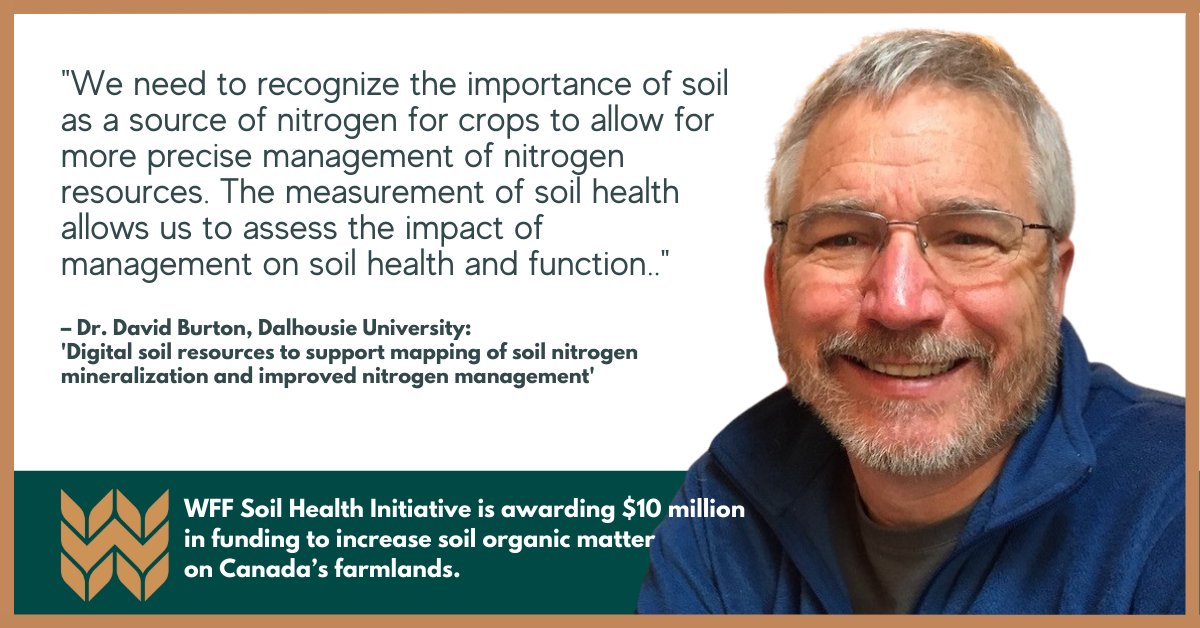
Dalhousie's @d_burton leads a project to develop machine learning digital soil mapping tools for farmers to estimate and inform 'Right Rate' nitrogen fertilizer application. https://t.co/rcbncUclxh #SoilHealth#Funding#Biodiversity
@RobSoil@hpoffenb Sorry I should have been more precise… maximum economic return of nitrogen (MERN)…. usually occurs at an N rate less than maximum yield, but is more profitable for the producer.
REMINDER ‼️ Soil Health and Nitrogen Management with Dr. David Burton is THIS Wednesday, March 1st at 1pm via Zoom!
Register here: https://t.co/DlOmXUYaN6
This is a Knowledge Sharing Event for OFCAF and there are CEUs available! #OntAg#AgTwitter#SoilHealth
@kevinki16180099@TerryDaynard@AJStein_de Great to see these on farm trials… no apparent bump as a result of using the N fixing treatment, but also no effect of reducing N fertilizer by 30%. Not sure these crops were N limited. You would only expect to see an effect of the N fixing biological if N was limiting yield.
Today, we’re announcing the eight projects that will receive funding as part of the $10 million Weston Family Soil Health Initiative to support the adoption of #soil health improving practices on Canada’s farmlands. https://t.co/rcbncUcTmP. #soilhealth#biodiversity
SCRCA will be hosting a webinar with Dr. David Burton, Director and Research Prof at @dalagriculture
March 1st @ 1pm EST - join us via zoom to hear more on soil health, nitrogen management, & recent research updates.
Register here: https://t.co/DlOmXUYaN6
@d_dburton#ontag
CSSS’ 23rd annual meeting will be held at Dalhousie University, Truro, NS. The theme is "Soils Go Digital." Online submission of conference abstracts is open from January 15th, 2023 thru March 1st, 2023. More info: https://t.co/q3QjX73AII #soil#conference
Sustainable soil management—from understanding the fundamental properties and characteristics of soil systems to understanding how soil management impacts food and energy production, water quality, waste management, climate change and biodiversity. https://t.co/DHZ5VraCpk
Online, self-paced certificate
This certificate will provide training to nutrient management planners and those implementing nutrient management plans in Atlantic Canada. https://t.co/dz66LZrGQ1
A meta-analysis of 27 meta-analyses finds strong reductions in nitrous oxide emissions from controlled-release fertilizers and inhibitors. Synthesizing the evidence of nitrous oxide mitigation practices in agroecosystems https://t.co/GONsezLNI3
@4RSolution@4Rnutrients
@Agronomydoc@TerryDaynard@cdnagro@rgstone1 If I understand correctly, you apply all treatments at 80% of recommended rate, but apply both non-treated and treated N sources at the same rate. Correct?
@Agronomydoc@TerryDaynard@cdnagro@rgstone1 Were the EEFs applied at the same N rate as the urea? For the increased efficiency of these sources to become apparent they should be applied at a 10 - 20% lower rate… helps offset the cost as well.
@TerryDaynard@stuartsmyth66 Unfortunately most journals see this as a cash cow… hopefully the journals supported by scientific societies will eliminate the open-access fees. This should be a service for them, not a business.