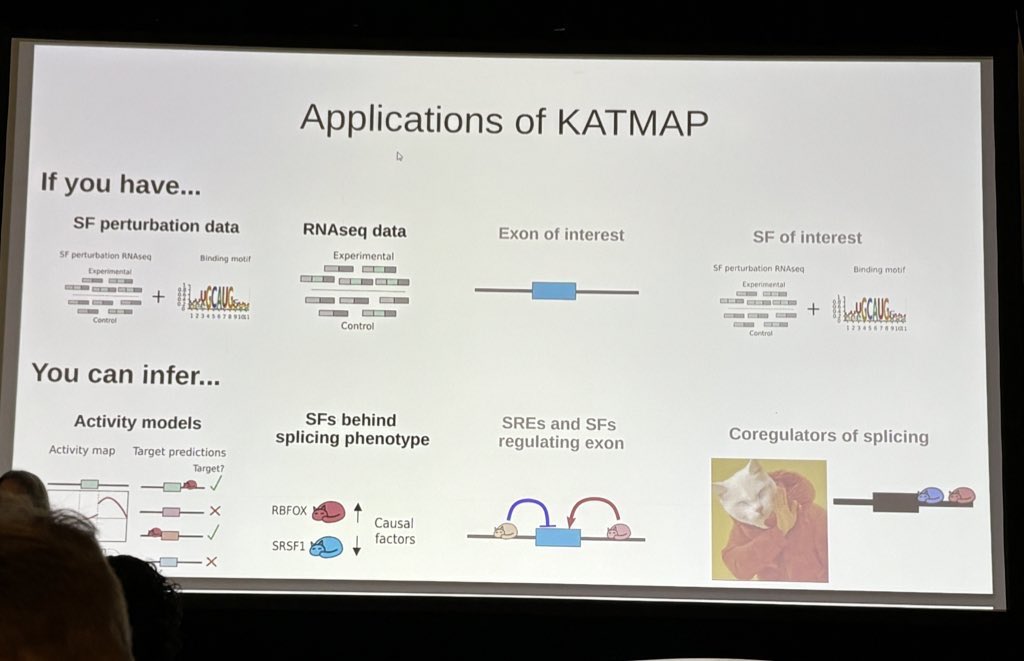
Excited to share our model for interpreting RNAseq data in terms of splicing factor regulation.
"In the spirit of accuracy, all splicing factors are depicted as cats" - @LaptopBiologist
https://t.co/ReCVbelzR5
My PhD project from @daSpliceIsRight Lab/@MITBiology is out now in @NAR_Open! Thanks for great feedback & pleasant review process. Absolutely thrilled to be sharing this work w the world 🥰🤪 now onto the next chapter... 🐈🐈⬛😸😻https://t.co/IcluUJGemD
My PhD project from @daSpliceIsRight Lab/@MITBiology is out now in @NAR_Open! Thanks for great feedback & pleasant review process. Absolutely thrilled to be sharing this work w the world 🥰🤪 now onto the next chapter... 🐈🐈⬛😸😻https://t.co/IcluUJGemD
Emma is also currently searching for a Boston-based scientist role where she can contribute her skills to a meaningful mission on a dynamic team. Reach out if you're looking for a molecular/computational biologist w/ deep expertise in RNA, splicing, gene expression, & NGS assays!
We present newly-minted PhD, Dr. Kowal (@ejkk0)'s exciting work on how different intron sequences enhance gene expression! Read to discover what motifs create the strongest introns as well as other intriguing insights from her large-scale screen:
https://t.co/i2Kvurnic7
Elegant study by @ejkk0 & @daSpliceIsRight identifying 5'UTR intron sequences that enhance mRNA expression. Cool to see the integ. reporter + higher Dox leading to greater intron-med. enhancement. Suggests a feedback loop between transcription & splicing to boost gene expression!
Congratulations to Biograd Hannah Jacobs! She was recently selected as an MIT Prize for Open Data Winner for her project on detecting naturally variable human exons in publicly available RNA sequencing data to aid in understanding health and disease @daSpliceIsRight
Congratulations to Kira, PhD student in our lab, and Keegan, former technician for both winning poster awards at the recent GRC on Post-transcriptional Gene Regulation!
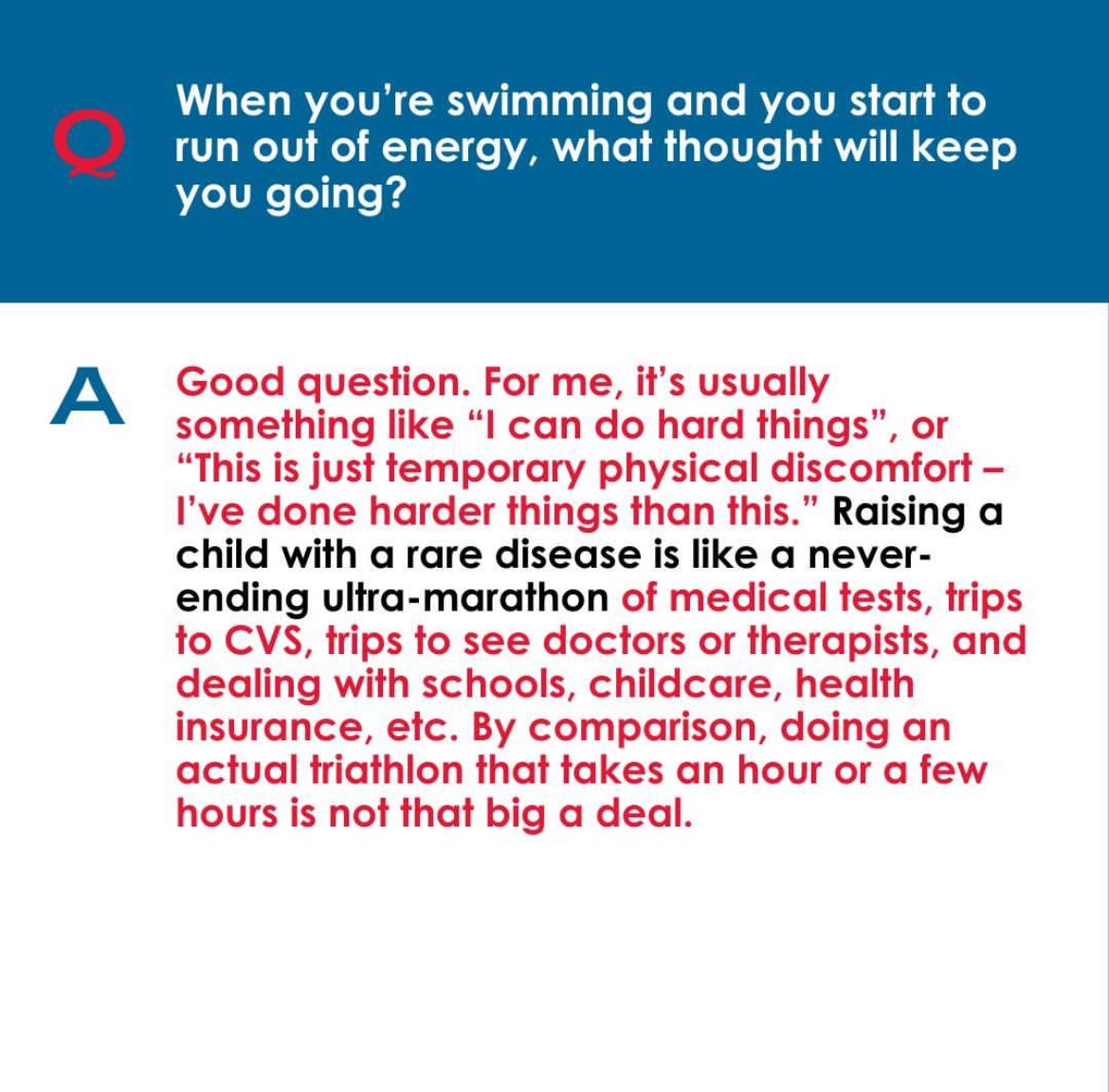
CB lab head, Chris, is participating in a team Iron Man in 2 weeks with two other dads of daughters with epilepsy.
He will be doing the swimming leg and they are raising funds for @CureEpilepsy to support more research.
Support them here: https://t.co/DPu18MvwTZ
Check out this feature on @MadeleineOudin- for her deeply inspiring efforts on epilepsy in her lab + alternative splicing expertise from our lab, to understand SCN8A mechanisms, and help Margot - and other kiddos like her - get the treatment they need!
https://t.co/PeCorJwIMO
Want to understand how splicing decisions are actually made in the cell based on pre-mRNA sequence? PhD student Kayla McCue has been hard at work modelling just that, & we're very excited to announce that now you can read about it in her new preprint! https://t.co/mU2rbjWhjo
See also: our thread breaking down some of the highlights of the methods and results of this work when it was released as a preprint - https://t.co/7Q7bu3ffwC
New Burge Lab preprint!
How do we interpret the impact of genetic variants in non-coding regions of the human genome?
Led by Postdoc Scott Findlay, this work describes our efforts to validate classification of regulatory variants in 3ʹ UTRs: https://t.co/XV25cvI11F
Short 🧵👇
Check out our recent work on evolutionary constraint and #GeneticVariants in human 3' UTRs, now published with @SpringerNature in @NatureComms and available here! https://t.co/uof0qs4i8U
Alternative splicing matters for genetic diagnoses. Honored to be a part of this exciting work on the impact of splicing in SCN8A. Sodium channels undergo mutually exclusive alternative splicing, with higher 5N during development, shifting to exon 5A during early childhood.
It's the season of decorative gourds 🎃💜 Bid on one of these stunning purple glass pumpkins, hand-made by grad student Connor Kenny, and you will also be supporting crucial, life-saving epilepsy research through the @SCN8AAlliance! https://t.co/gZmrqyZymT
DHX15 is one of the helicases in the spliceosome. We found that it mediates splicing quality control by repressing the splicing of weak introns - but it can't do it alone! Teamwork makes the dream work, in the lab & in this paper, out now in Cell Reports! https://t.co/rIpYKpg0o7
Neural Networks are often used as black box predictive tools, but do they have to be?
https://t.co/zSEcfYCu1w
Here we strive to create an interpretable model of RNA splicing based closely on the known binding & activity of RBPs, & improve RBP binding prediction along the way.
Excited to welcome my PhD co-advisor Chris @daSpliceIsRight to visit us @ColumbiaSysBio on Oct 18. He will talk about 'Interpretable Models of RNA Splicing and Splicing Factor Activity.'