Me and the agents worked on something cool
Check it out @ https://t.co/kvmLWX5YAJ
It’s what I wake up to daily and you will see some of your fav folks on there as well
@StockSavvyShay@Venu_7_@Mr_Derivatives etc
Enjoy it’s free!
$BTDR: The power pivot: who gains when bitcoin miners start hosting AI
TL;DR
• Miners moving into AI compete on multi-year contracts and execution, not just power.
• Riot leads our score, MARA is second, Keel third; Riot's Data Center segment did $23M in Q2 2026.
• Riot expects an NOI margin of 80% to 90%, which is its pricing-power claim.
• Risk: these are early earnings-call claims, and the moat holds only if execution does.
🧵
For information only. Not investment advice.
How big a bet does a fund make on an $863B chipmaker? Dragoneer Investment opened a brand-new $AMD position at 19.3% of its book in Q2.
Advanced Micro Devices sells EPYC server CPUs and Instinct AI GPUs, which makes it a core AI GPU supplier. It sits in our Agentic compute: CPU, memory and connectivity thesis, at Early signs.
Dragoneer wasn't alone. 17 tracked funds held AMD at the end of Q2, up from 11 a quarter earlier.
12 funds added and 5 cut, while 4 opened conviction-sized positions.
That's why the TradeStory AI Fund Focus Score reads 100 of 100. It measures how hard tracked funds are building a position, and 65+ counts as strong accumulation.
These are quarter-end holdings filed within 45 days, not today's trades. Does the cluster hold up in the Q3 filings?
For information only. Not investment advice.
Surgical robots have a supply problem: where capacity, not demand, sets the pace
TL;DR
• Supply, not demand, is the limit: Stereotaxis says it is supply constrained on catheters.
• Globus Medical leads our score, Zimmer Biomet is second, Stryker third; all cite supply on calls.
• The number: Stereotaxis expects about a $1 million catheter revenue step up a quarter.
• The risk: Stereotaxis relies on one contract manufacturer, Osypka, for that output.
🧵
For information only. Not investment advice.
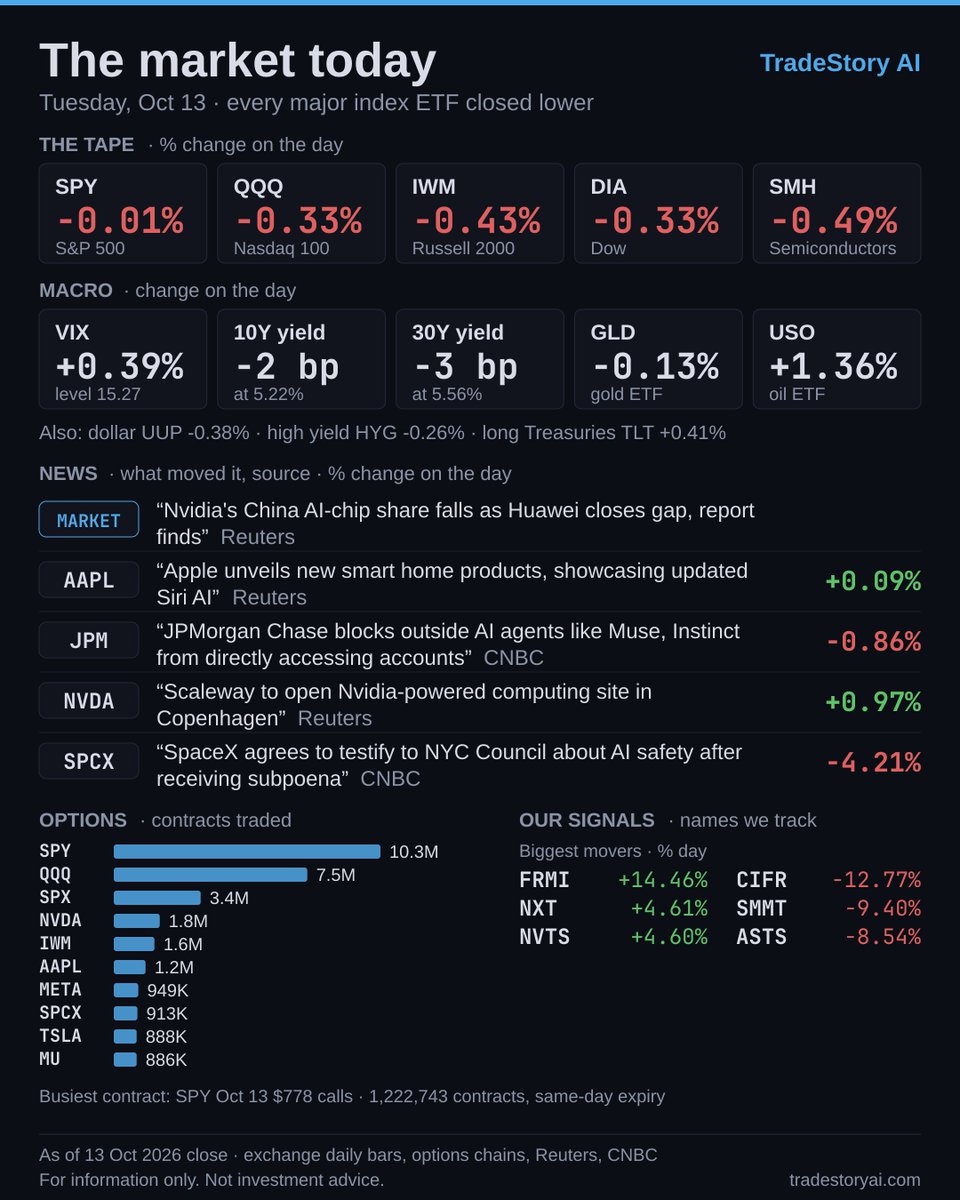
Every major index ETF closed lower Tuesday. The day's story (Reuters): "Nvidia's China AI-chip share falls as Huawei closes gap, report finds".
Company news, options, macro and our signals are in the image 📊
For information only. Not investment advice.
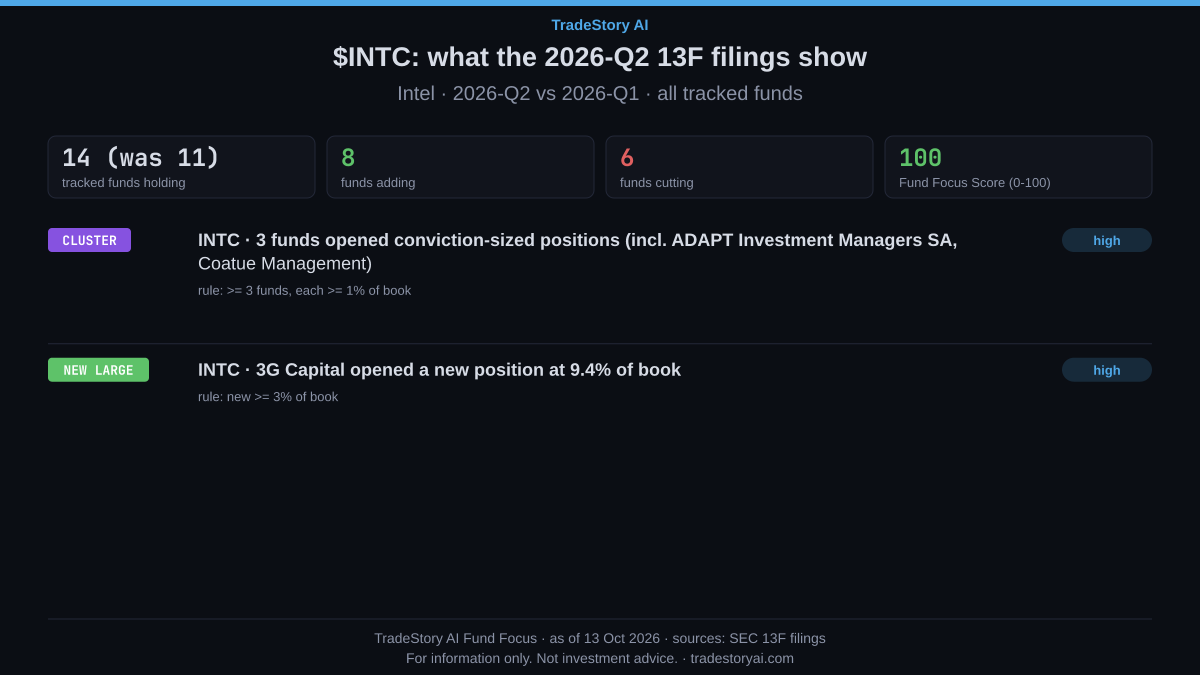
Why did 3G Capital put 9.4% of its book into $INTC?
It was a new position at the end of Q2. Coatue Management and ADAPT Investment Managers SA also opened stakes of 1%+ of book, a CLUSTER signal.
14 tracked funds held INTC at quarter-end, up from 11 in Q1.
8 added, 6 cut, 2 exited.
The TradeStory AI Fund Focus Score is 100 of 100. It measures how hard tracked funds are building a position; 65+ is strong accumulation.
Intel is a $511.2B mega-cap CPU maker and a foundry rival to TSMC and Samsung. It sits in our Agentic compute thesis, at Early signs.
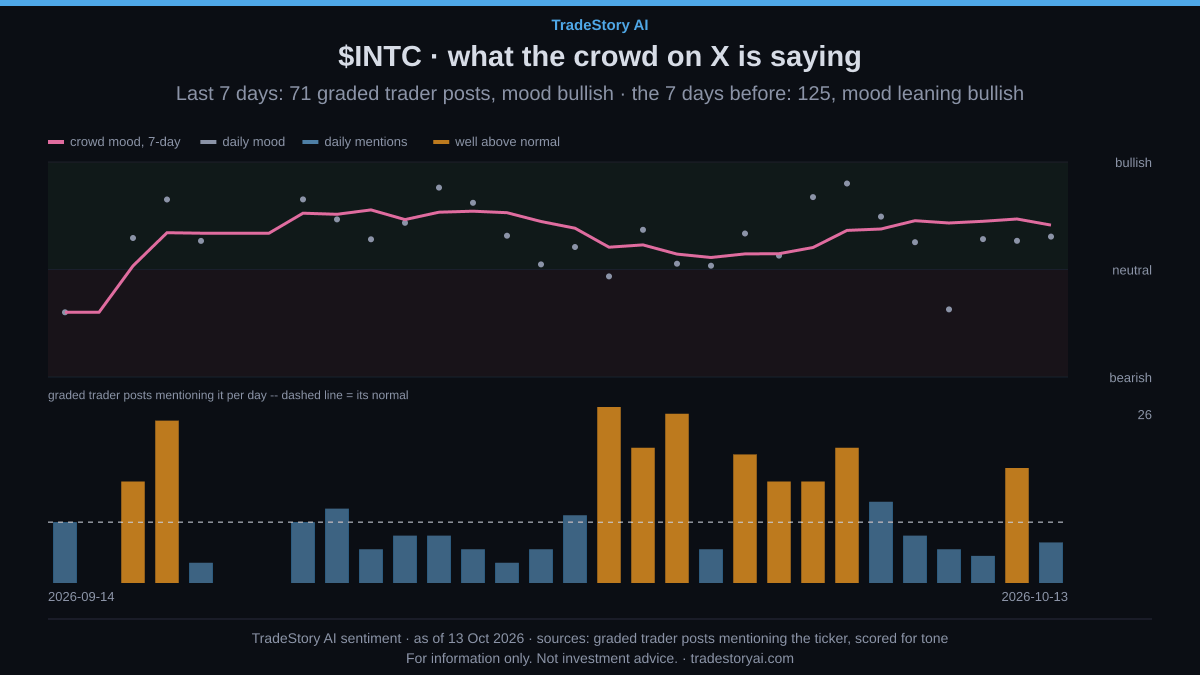
TradeStory AI's Fundamentals read is neutral at 46/100, while crowd mood on X is bullish and turning more so.
📌 Quarter-end holdings, not today's trades. Do the funds or the fundamentals lead from here?
For information only. Not investment advice.
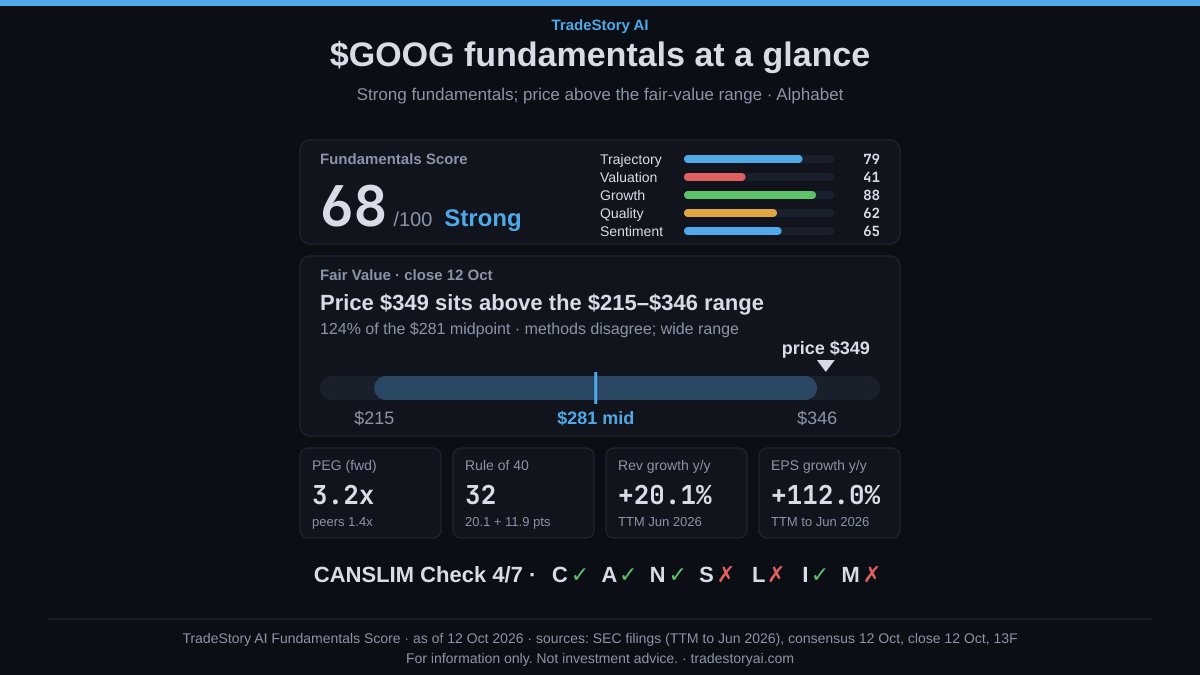
Strong fundamentals for $GOOG.
Price $349 (close 12 Oct) sits above the $215–$346 fair-value range (124% of midpoint).
TradeStory AI Fundamentals Score: 68/100.
Growth 88 leads, valuation 41 trails.
1/2
For information only. Not investment advice.
@Venu_7_ I’m a bit baffled coming of the 3 month break out , I did expect strength
The major think I feel now is positioning
There is no tail wind. Most are positioned neutral - neither short that could squeeze or long that could pus higher
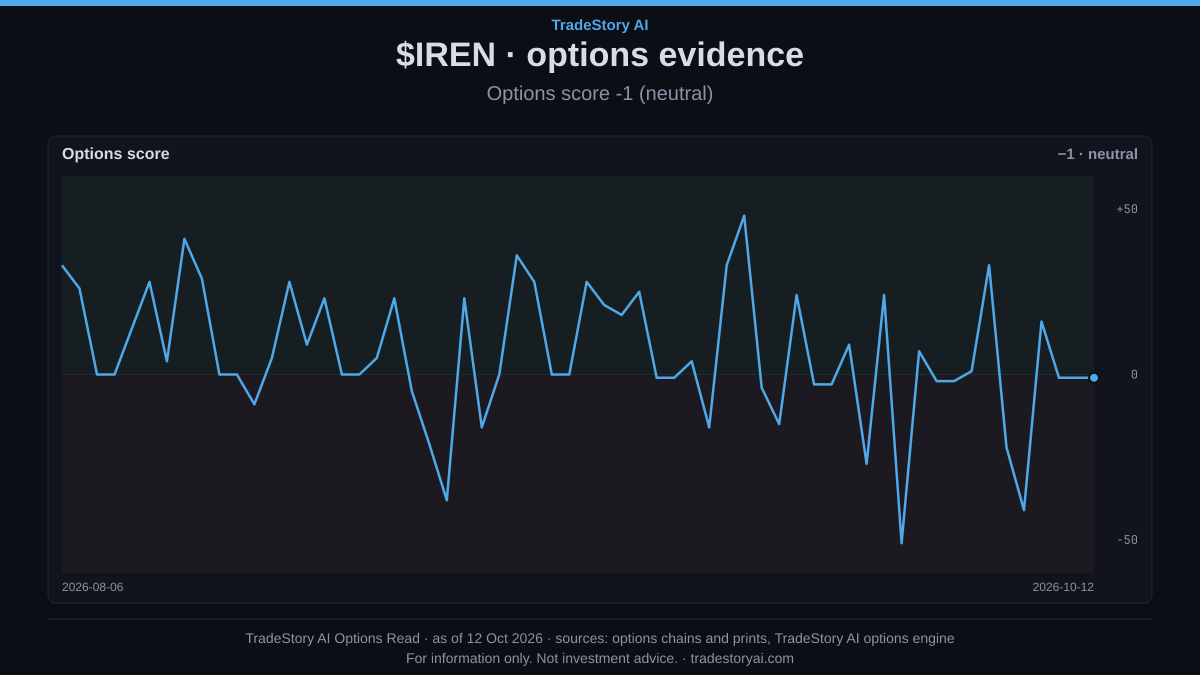
$IREN leads the power ladder with 5,000 MW signed, but its chart is bearish.
IREN sells AI cloud capacity and says it has secured $4 billion of ARR for its 2026 capacity.
In the TradeStory AI Power Ledger it has 5,000 MW signed, ahead of NBIS at 3,500 MW.
WULF has 839 MW and APLD 400 MW contracted. Pipeline plans, like IREN's 300 MW, aren't ranked.
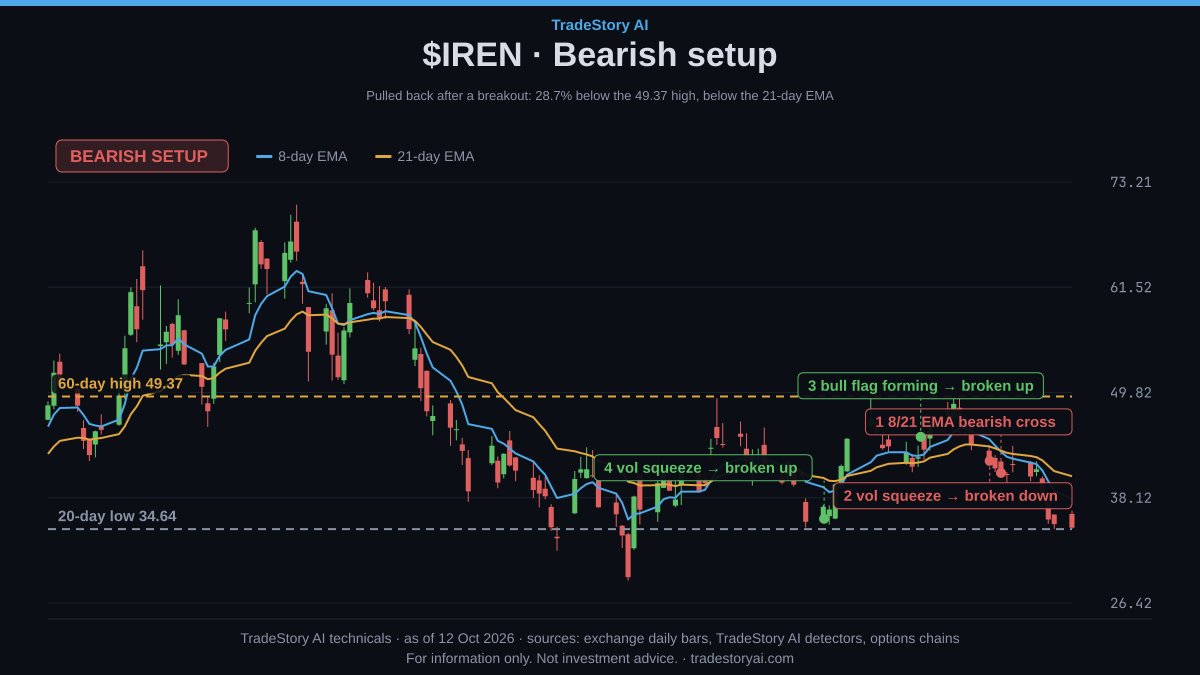
📉 The chart disagrees: bearish, 28.7% below the 49.37 high and under the 21-day EMA of 41.08.
It's not a breakout yet.
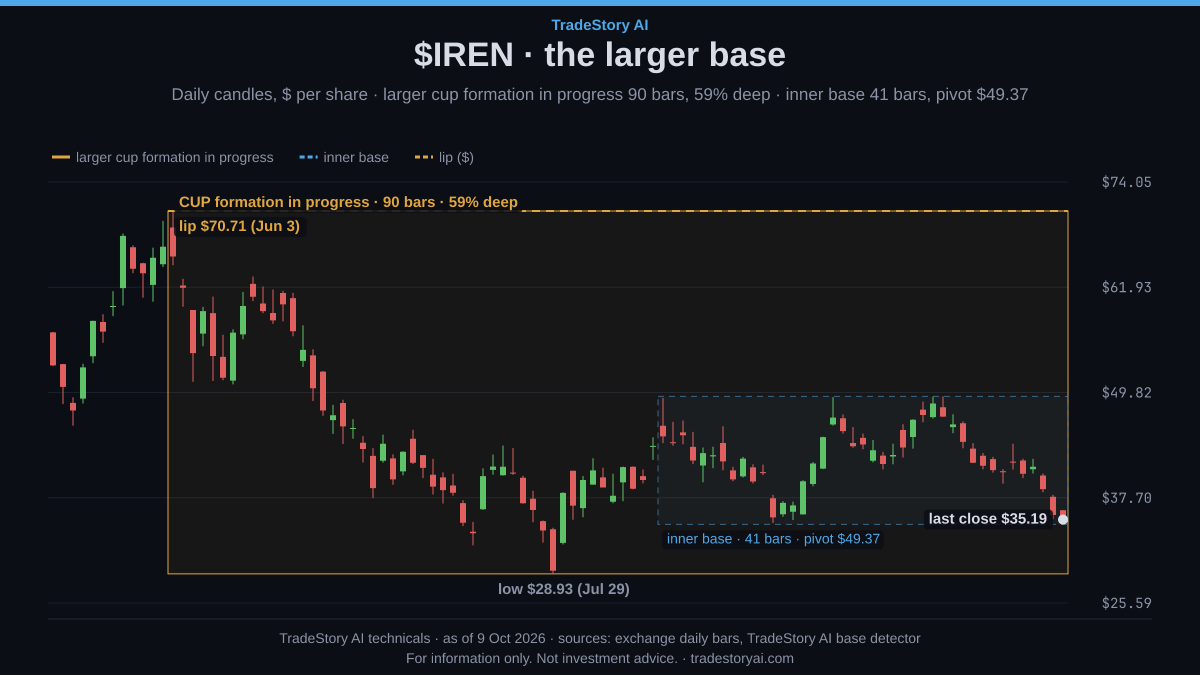
It also sits inside a larger 90-bar cup formation in progress, with a Jun 3 lip at $70.71 and 59% depth.
Support is 34.64 and the options score is -1, neutral. Which matters more here, signed megawatts or the chart?
For information only. Not investment advice.
The major index ETFs closed mixed Monday. The S&P 500 ETF $SPY fell 0.06% to 778.10, semis (SMH) led the drop at -2.05%, and the 10-year yield was unchanged at 5.24%.
Company news, options, macro and our signals are in the image 📊
For information only. Not investment advice.
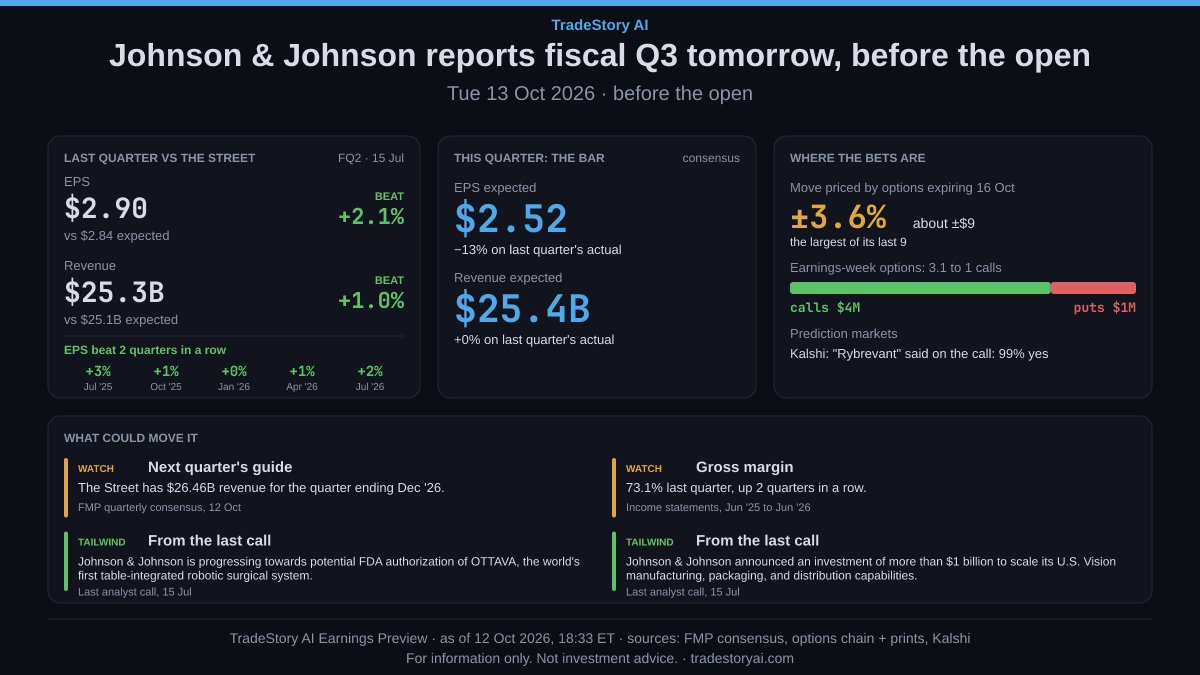
$JNJ reports fiscal Q3 tomorrow before the open.
The Street expects $2.52 EPS on $25.38B revenue, EPS −13% and revenue 0% on last quarter.
Options price a ±3.6% move by Friday, the largest of its last nine reports.
1/3
For information only. Not investment advice.
everyone is working towards being apple of the data center.
own the silicon, fund the data centers, run anyone's model, own the agent harness and take premium on every layer.
You should expect the silicon chip companies to move up the stack as the application companies move down the stack.
In AI, it is increasingly true that everyone competes with everyone. Everyone will soon offer their own LPS, silicon, cloud and applications.
The question is what will the constraint be that you can build a long term market and margins around…
Is it distribution? Is it a data moat? Is it a physical constraint like power?
🐋 11,431 Oct 30 $751 puts on $QQQ were bought at the ask, a $15.0M premium.
The print came at 11:07 ET on 2026-10-12, with QQQ near 746.36 and 18 days to expiry.
The strike sits 0.6% above the stock.
To pay off, QQQ has to finish below the 737.87 break-even, 1.1% under the stock, by 2026-10-30.
At $13.13 a contract, that's the price of the bet.
Open interest before the trade was 891 contracts. With 11,431 traded, most of it can't be closing an old position, so it's a new one.
Buying puts at the ask is usually read as bearish. It can also be a hedge.
QQQ is Invesco QQQ Trust, a mega-cap in asset management with a market cap of $535.3B. Which is it here: a bet or a hedge?
For information only. Not investment advice.
Memory is leading this drop, not the whole market.
Intraday at 10:33 ET (not the close), the S&P 500 is down 0.08% while semiconductors are down 2.28%.
The leading explanation is reports that China's CXMT has made progress on a denser DRAM chip design. Our move explainer hasn't confirmed that as the cause.
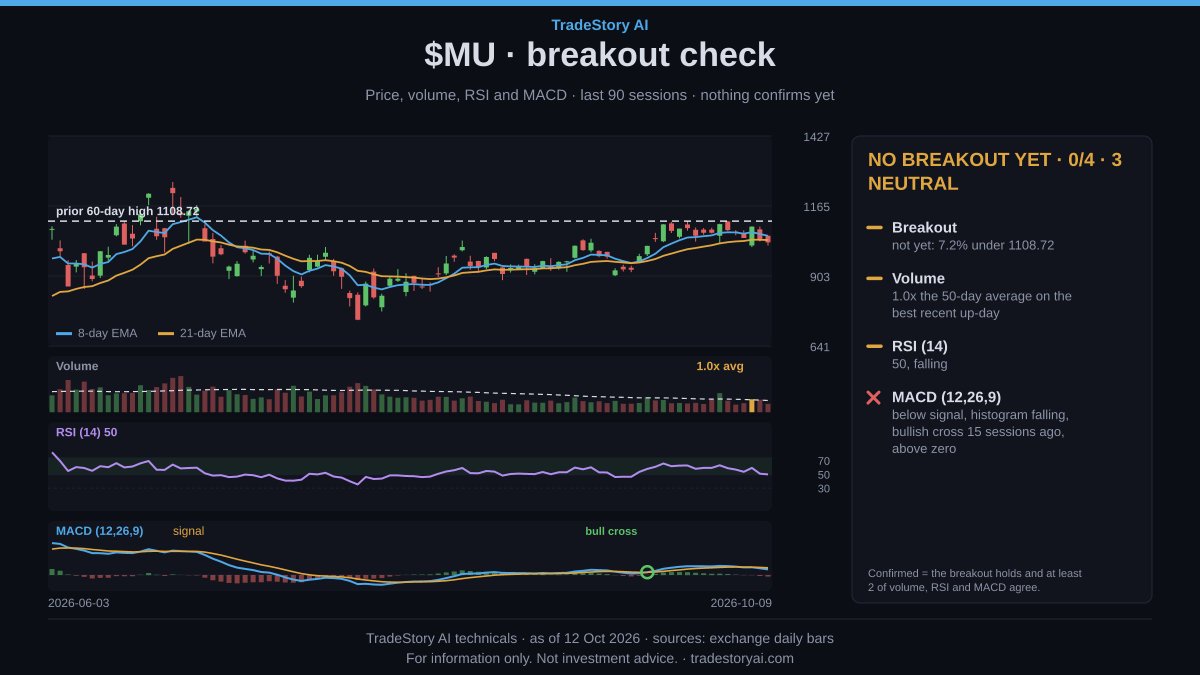
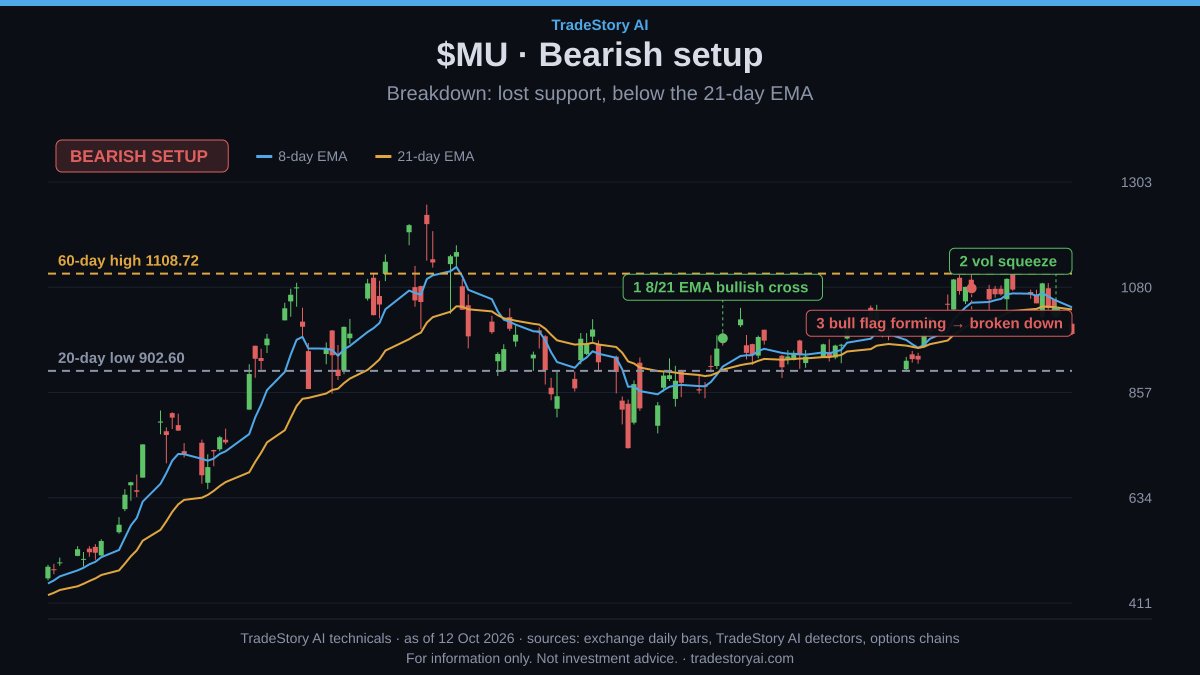
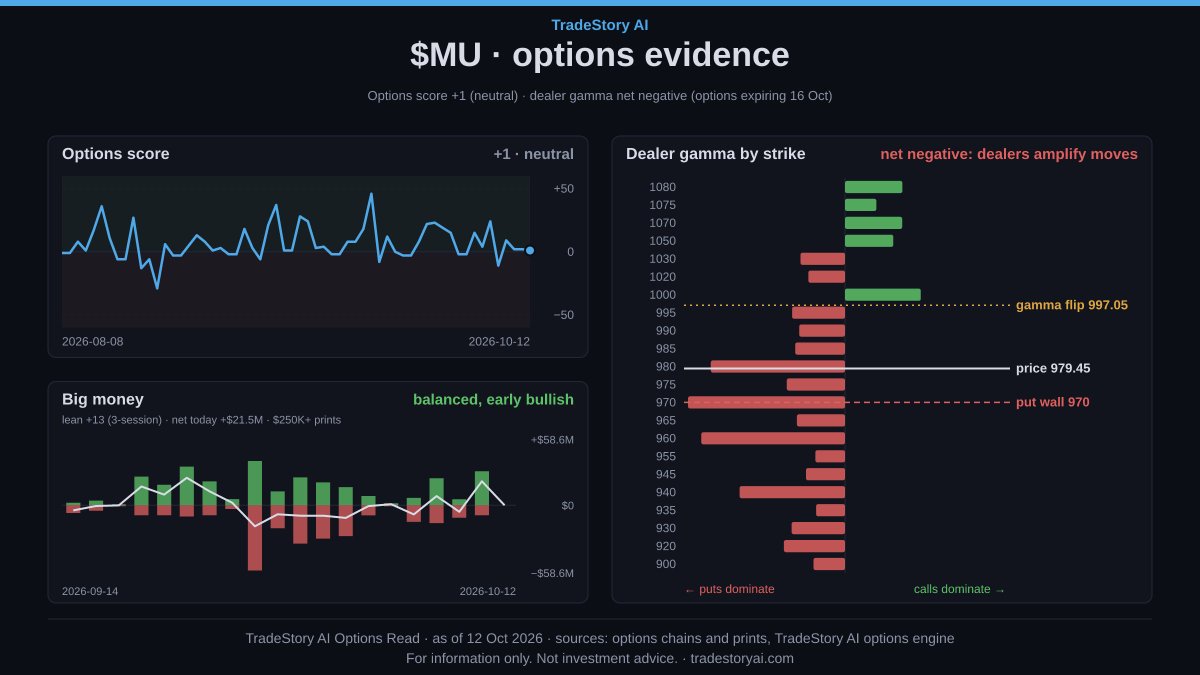
$MU (Micron Technology) makes DRAM, NAND and HBM memory for AI systems, and it's a $1.2T mega-cap.
📉 It's trading at 980.73 intraday, against a 1029 close on Oct 9.
The chart is bearish: support is lost and price is below the 21-day EMA.
Below, the 20-day low at 902.60 is the level that decides it. Above, 997.05 is the gamma flip, where dealer hedging stops adding to moves.
1/6
For information only. Not investment advice.
Tess (one of my agents) is starting to test a Paper book, its something ive been building along side me to be a better trader. its in test now and will give it actual $ when ready. But enjoy its picks! $FROG $AMZN $TEAM
Tess' Weekly Picks, week 42 (week of Oct 12): picked from 773 names screened. As of Fri Oct 9 close. Each pick has a pinned entry and stop; tracking starts at Mon's open and it is graded after Fri's close. Top of the list: $CVX, XOM and S. Each pick's chart and evidence follow in the replies, with updates through the week. #TessWeeklyPicks
For information only. Not investment advice.
The gigawatt race: what AI capacity plans tell you about the frontier labs
TL;DR
• Frontier AI capacity is now counted in gigawatts, and power gear may outrun GPUs.
• Meta leads our score, Microsoft is second, Amazon third; all three are chasing capacity.
• SpaceX expects over 2 GW of compute this year, possibly closer to 10 GW by end of next year.
• Risk: custom chips trade performance, e.g. Meta's MI450X at 900GB/s vs 1,800GB/s.
🧵
For information only. Not investment advice.