I reread this every year.
I cry like a baby every year.
Todd Beamer died a father, husband, and hero.
Todd: Hello… Operator… listen to me. I can’t speak very loud. This is an emergency. I’m a passenger on a United flight to San Francisco. Our plane has been hijacked.
Lisa: I understand. Can they see you?
Todd: No. There are three that we know of. They have knives — razor knives, like box cutters. Someone announced from the cockpit there was a bomb. It sounded fake.
Lisa: Your name?Todd: Todd Beamer. United Flight 93.Todd: They killed one passenger in first class. They forced most of us back. Fourteen of us here. Five flight attendants. The guy with the bomb ordered us to sit on the floor.
Lisa: Are you okay?
Todd: We’re going down… wait. No. We’re leveling off. We changed directions. We’re flying east again.
Todd: A guy named Jeremy called his wife. She told him two planes hit the World Trade Center. Lisa, is that true?
Lisa: I have to tell you the truth. It’s very bad. Both towers are gone. A third plane hit the Pentagon. Our country is under attack. I’m afraid your plane may be part of their plan.
Todd: Oh God. Lisa, will you do something for me? Call my wife and my kids. Promise me you’ll call.
Lisa: I promise.
Todd: Our home number is… You have the same name as my wife. Lisa. We’ve been married ten years. She’s pregnant with our third child. Tell her I love her. I’ll always love her. We have two boys — David, he’s 3, and Andrew, he’s 1. Tell them their daddy loves them and he is so proud of them. The baby is due January 12th. I saw an ultrasound. We still don’t know if it’s a girl or a boy.
Lisa: I’ll tell them. I promise, Todd.(Lisa patches in the FBI.)
Agent: Todd, your plane is on a course for Washington. Best guess is the White House or the Capitol.
Todd: I understand. I’ll be back.
Todd: Everyone knows this isn’t a normal hijacking. We have decided we will not be pawns in their plot.
Lisa: What are you going to do?
Todd: Four of us are going to rush the one with the bomb. Then the cockpit. A stewardess is getting boiling water. We’ll take them out.
Todd: Would you pray with me?They pray the Lord’s Prayer. Then: Yea, though I walk through the valley of the shadow of death, I will fear no evil, for thou art with me.
Todd: God help me. Jesus help me.Are you guys ready? Let’s Roll.
I attended a county fair and watched a child sell a pig.
The pig is worth, I am told, somewhere near four hundred dollars. I looked this up afterward because I did not believe what happened.
The girl is twelve. She walked the animal into a ring wearing a white shirt and a numbered card. She had raised it herself, from a piglet, for nine months, which I confirmed, and she had a binder of records because the program requires one.
The bidding began. Local men. A man from a bank. A man who sells tires. A woman who owns a restaurant I had eaten at the previous evening.
It did not stop at four hundred.
It stopped at three thousand two hundred.
I turned to the man beside me and asked whether the pig was of exceptional quality.
He said, "It's a fine pig."
I asked whether it was worth three thousand two hundred dollars.
He said, "No."
I asked why the price was three thousand two hundred dollars.
He said, "She's a good kid."
I stood up. I could not remain seated. I said, out loud, in a metal building that smelled of animals, that a market which knowingly and deliberately misprices a good in order to put a child through a university, and does so every year, in the open, with an auctioneer and a microphone, is not a market at all but a rite, and that I have never seen a province conduct one so cheerfully.
He said, "You want a lemonade?"
I said that I did.
Here is the part I had entirely misread. The men bidding against each other were not rivals. They were raising it together. The tire man bid, then the bank man bid, and the tire man nodded at him, and they were pushing the number upward on purpose, in public, in front of the girl. She knew. Everyone knew. The auctioneer knew. The rite requires that nobody says it.
Afterward the girl shook every buyer's hand. She writes them letters later. That is also part of it. She writes letters.
I asked the restaurant owner why she bids every year.
She said, "Somebody bought mine."
She is fifty-eight.
@PretzelLogic9@TheWrigleyWire I mean, there's 114 pitchers who have thrown 70+ innings this year. Just 16 are 34+. Of those, only 6 have an xFIP under 4.40. Pretty near EVERYONE is washed as a starting pitcher in baseball by 34. Stupid to expect anyone to continue to be effective at that age.
@PretzelLogic9@TheWrigleyWire He's 34, nearly 35 -- past his sell by date. Probably he's just done as a starter in MLB. Almost everyone is at 34. xFIP has been climbing for years. Cubs were lucky to get as much out of a guy this old as they did.
@JaMezTTG@mike_petriello@MLBStats Batting average is a percentage, and so a probability. Is it also not a statistic?
Sometimes it is better not to try to argue.
@11TimeChamps @TheConnorPils Not about being a Cubs fan but understanding what StatCast represents. Its data was impossible to get until the technology arrived -- but now we can literally toss out all other stats as obsolete and inaccurate. StatCast is telling us truth about things we used to only guess at.
@JaMezTTG@mike_petriello@MLBStats StatCast data is more real than any stat, truly -- just impossible to collect without technology that didn't exist until recently. Stats so useful you can almost throw out all other stats. Renders them obsolete.
What's going on? Are neocons having a come-to-Jesus moment?
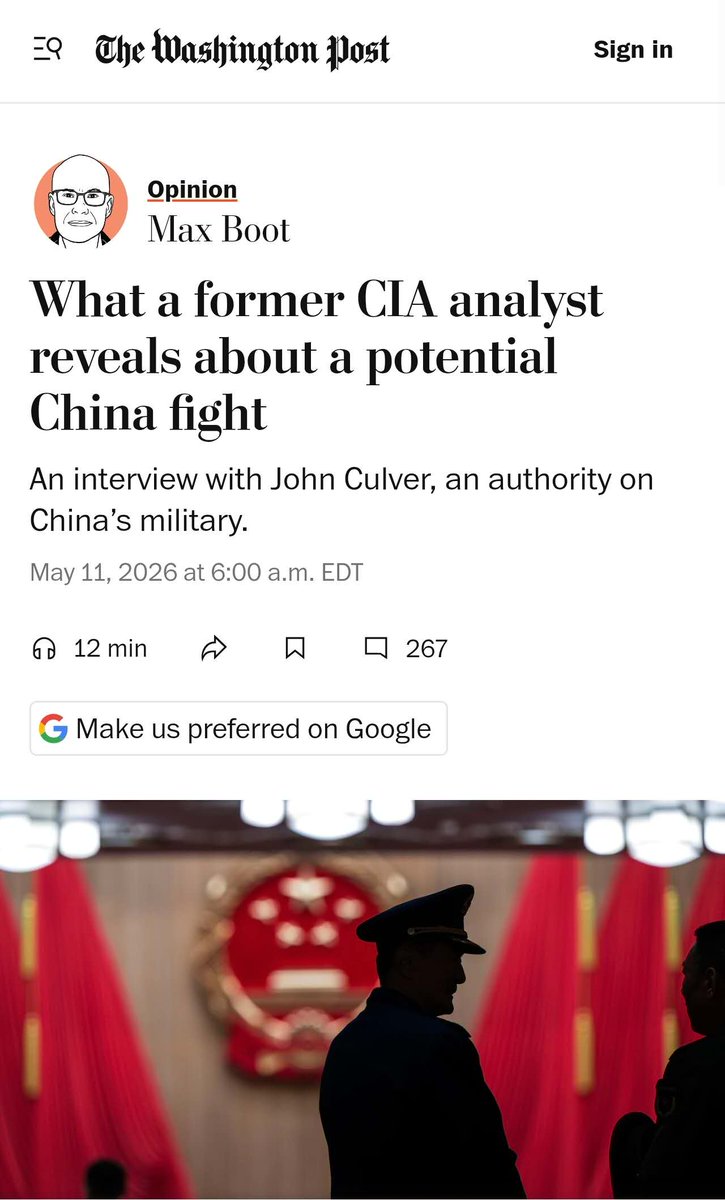
After Bob Kagan writing an article on how the U.S. is facing "total defeat" in Iran (see https://t.co/Io9xy1M8ks), you now have Max Boot - the very author of “The Case for American Empire” and one of the most vocal advocates for the Iraq war - publishing a Washington Post interview explaining that China has surpassed the U.S. in most military domains.
If anything, Boot’s interview is even more devastating than Kagan's piece, because it's not editorial opinion - he’s interviewing John Culver, a former top CIA analyst (he was national intelligence officer for East Asia) and one of the world’s foremost authorities on the Chinese military which he’s been studying since 1985.
This isn't a pundit opining - this is someone who spent decades inside the intelligence community staring at the actual data.
So what is Culver saying?
1) In case of war with Taiwan, the U.S. will flee the theater
This is undoubtedly the single most stunning revelation in the entire piece. Culver says that - as far as he is aware - the Pentagon’s plan in case of war with Taiwan is… flee!
This is the exact quote: "I think some of the thinking in the Pentagon, and it may have evolved since I retired, is that when we think there’s going to be a war, we need to get our high-value naval assets out of the theater, and then we would have to fight our way back in. From where, it’s not clear. Guam is no bastion either."
Why? Because, as he explains, any high-value U.S. assets would be sitting ducks in the entire area. China can strike U.S. forces deployed to Japan, Australia, or South Korea “in a way that Iran really can't” and, given that Iran has hit at least 228 targets across U.S. bases in the Middle East - forcing the U.S. to evacuate most of them - that's saying something. Also, U.S. aircraft carriers would need to operate within 1,000 miles of the fight to matter, which - given it’s well within range of Chinese missiles - they won’t.
As Culver bluntly puts it: “There's really no safe spaces.”
2) China leads in most military domains - and it's not even close
Culver says that “it’s hard to not be hyperbolic” about China’s military capabilities and that, at this stage, “it’s hard to point to an area other than submarines and undersea warfare and say the United States still has an advantage.”
In some critical areas, such as advanced munitions - which, when it comes to war, is pretty damn relevant - his assessment is that China leads by “magnitudes.” As a reminder, an order of magnitude means 10x so, by assuming he knows that and meant what he said, “magnitudes” means at least a hundred times more, meaning U.S. capabilities would be less than 1% those of China.
At the same time, Culver also says that “whichever side runs out of bullets first is going to lose.” So if China produces “magnitudes greater than our industrial base could produce” - as he puts it - then you don't need a PhD in military strategy to put two and two together…
The picture, if anything, is even more damning in shipbuilding capabilities. He reminds that a single shipyard in China - Jiangnan Shipyard, on Changxing Island near Shanghai - “has more capacity than all U.S. shipyards combined.”
Put all Chinese shipyards together and China’s broader naval shipbuilding capacity is 232 times larger than that of the United States (and this is from a leaked U.S. Navy briefing slide).
Culver helpfully adds that China “deploys enough ships every year to replicate the entire French navy” - which, as a Frenchman, hurts a little, but at least we'll always have the cheese (I hope).
3) Despite this, a war in Taiwan is highly unlikely
If your only window into China is Western media coverage, you'd naturally assume all of the above means war over Taiwan is about to break out. After all, if China is so powerful and the U.S. so outmatched, why wouldn't it just take Taiwan and be done with it?
Culver’s assessment - and mine, incidentally - is the exact opposite: China’s increasing relative strength vis-a-vis the U.S. makes war less likely, not more.
How so? As Culver explains Taiwan is “a crisis Xi Jinping wants to avoid, not an opportunity he wants to seize.” The stronger China gets, the less it needs to fight: why launch a war when you can simply wait for the military balance to become so lopsided that the U.S. quietly drops its security guarantee on its own? Culver himself foresees a future “when Americans might start to say, maybe Taiwan is a war we don’t want to get involved in.” That would almost automatically mean peaceful reunification, which has always been China’s primary objective.
This doesn't mean China views the U.S. as harmless. Quite the contrary - Culver says Beijing sees America “as a very militarily aggressive country” that is “declining in power and becoming more violent” as a result. Which he says is one further reason why “war over Taiwan is not something that Xi Jinping is looking for.”
China doesn't want to hand a pretext to a dangerously trigger-happy power - all the more when patience alone delivers what it wants.
4) The game is up
Last but not least, perhaps the most revealing aspect of the interview is that Culver doesn’t seem to see a way out: this is structural and irreversible.
Asked by Boot whether “the Trump administration’s $1.5 trillion defense budget, assuming it’s approved, [would] change the trend lines” (which, as a reminder, would constitute a 50% increase in defense spending), his reply is that “it would probably help to some extent, but I worry that we could be throwing good money after bad.” Not exactly brimming with optimism…
Similarly, when asked why the U.S. keeps investing billions in aircraft carriers and even “Trump-class battleships,” his answer is that it's because “the military services have a nostalgia for the things that meet their expectations for how you get promoted.” In other words, wasted money.
Same thing for the Pentagon's much-hyped “Hellscape” drone strategy to defend Taiwan. Culver asks the obvious question: “What drones are you talking about launching from where?” He points out that they’d “have to pre-deploy them if not on Taiwan itself then on Luzon or the Japanese southwest islands, all of which can be struck by the Chinese.” He adds that this is “the tyranny of time and distance when you look at war in the Pacific.”
The picture that emerges, both from Boot’s Culver interview and Kagan’s article, is remarkably consistent: the U.S. is “checkmate” in the Middle East, would need to entirely flee the Pacific theater before a war even starts, cannot produce enough weapons, cannot keep its supposed “allies” safe, and has no strategy to reverse any of it - nor can one even be produced given the structural nature of the gap. Even a 50% increase in defense spending, Culver says, would be “throwing good money after bad.” That's not my assessment - that's theirs.
Two of America's most prominent hawks, in two of its most establishment outlets, in the space of 48 hours, have essentially published the obituary of American military primacy.
Yesterday I concluded my post by saying that even the arsonists now smell the smoke. Today I'll say: the arsonists are now writing the fire report.
Dostoevsky was 28 when they stood him in front of a firing squad. Blindfolded. Hands tied. He could hear the rifles being loaded.
At the last second a messenger on horseback arrived. The Tsar had commuted the sentence. The entire execution was staged. Psychological torture designed to break him.
It worked. He had a seizure on the spot.
They sent him to a labour camp in Siberia. 4 years. Freezing. Starving. Sleeping on wooden planks next to murderers. His epilepsy got worse. He had no paper. No pen. Nothing.
When he got out he was broke. His first wife died. His brother died. He inherited his brothers debts. He was so desperate for money he signed a contract with a publisher that would have given away the rights to everything hed ever write if he missed the deadline.
He wrote The Gambler in 26 days to make it. Dictated it to a 20 year old stenographer named Anna. Married her three months later.
Then the real work started. Crime and Punishment. The Idiot. Demons. The Brothers Karamazov. The greatest novels in the history of the Russian language. Maybe any language.
The man who stood blindfolded before the firing squad, who convulsed on the ground while soldiers watched, who slept next to killers in Siberia for 4 years, who was buried in debt and grief.
That man wrote: "every minute can be an eternity of happiness."
He earned the right to say it.
its never over. never give up fren.
Look, I know none of this stuff matters anymore. But my G*d.
This will be the 4th time the S&P 500 $SPY has hit a record high while 5% of its members fall to 52-week lows.
1. July 1929
2. January 1973
3. December 1999
4. Today
Warren Buffett cautioned that he’s seeing signs of fragility emerging in the banking system as it has become more connected to non-bank players https://t.co/2Rn6B2kMTd
The problem historically is that the SP500 stocks’ A-D Line does not do a very good job of showing bearish divergences when you would want that message. The NYSE A-D does better in that regard. The reason for this difference is that SP500 stocks are the varsity stars. When illiquidity starts to become a problem, it affects the weak stocks first (canary principle). So looking at a list of stocks with no canaries does not get you that message as well.
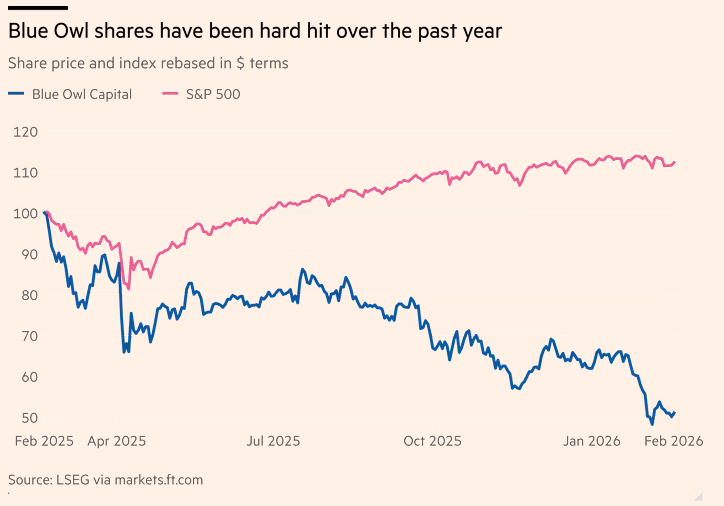
🚨Private credit is flashing a warning sign last seen before the Great Financial Crisis:
Blue Owl Capital permanently halted investor redemptions at its retail private credit fund, OBDC II, backtracking from an earlier plan to reopen withdrawals.
The fund has been closed to redemptions since November 2025 after a failed merger that would have forced investors to take a -20% hit.
Redemptions in Q3 2025 nearly DOUBLED to $60 million, or 6% of the net asset value, forcing the firm to sell -$1.4 billion in credit assets across 3 funds.
The $1.4 billion portfolio sold spans 128 companies across 27 industries, with 13% of the loans concentrated in internet and software businesses, sectors increasingly vulnerable to AI disruption.
This comes as scrutiny into private credit loan quality intensifies after a string of high-profile defaults.
In August 2007, BNP Paribas freezing 3 funds due to "complete evaporation of liquidity" became the first domino of the Global Financial Crisis.
Blue Owl is not BNP Paribas, and private credit is not subprime mortgages, but the pattern of locking investors out when redemptions surge is familiar.
When a fund stops letting investors leave, it is no longer a liquidity issue.
It is a solvency question.
@grok@posting_anon@RedditCFB@grok when was the last time an NCAA football team beat a ranked opponent while amassing less than 50 yards of passing offense?
@VinceBiegel@scott_stelpflug Especially as those are just 5 games.
I think the one to watch is Maryland at home next week. If that is not a convincing W, we're officially in the Maryland Northwestern UCLA tier.