How do pollsters ask people about who they are? It might be more complicated than you think! Read our new data essay on how @pewresearch asks about people's religion, race/ethnicity, gender, party, and income: https://t.co/qtbPqY909W
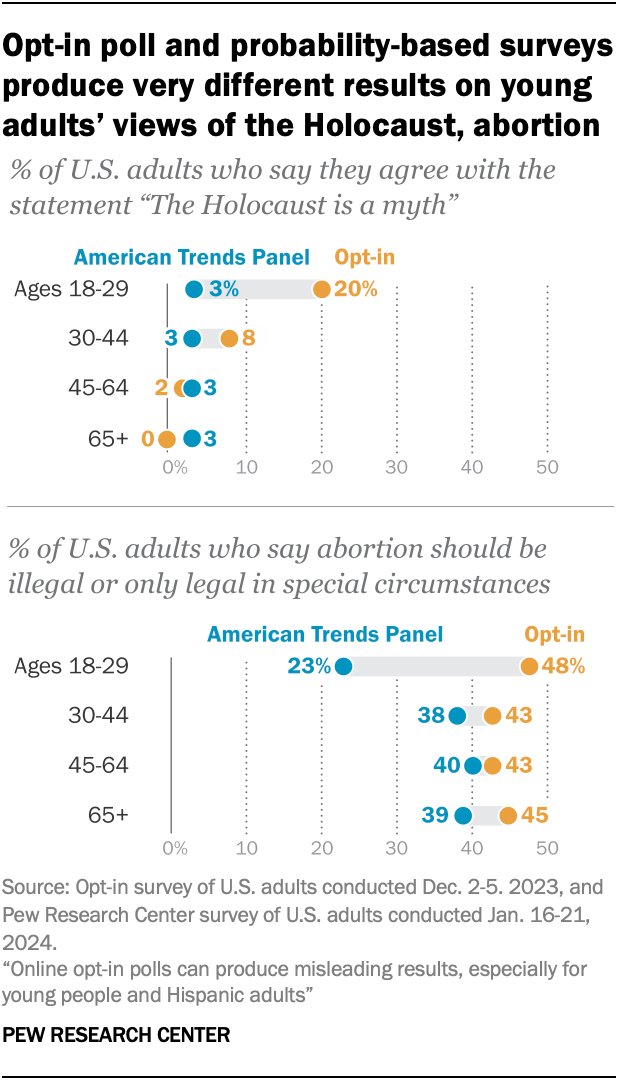
NEW @pewmethods analysis shows some of the pitfalls of online, opt-in polling, including the occasional eyebrow-raising finding about young adults – like a recent claim that 1 in 5 young Americans believe the Holocaust is a myth. Read the full analysis: https://t.co/8klLcpz5ev
We just release a new analysis the highlights the potential of opt-in surveys -- those that allow people to volunteer to participate -- to provide misleading results, especially for young adults and Hispanics https://t.co/bZFwPFmtlD
To help describe the richness of public opinion, pollsters sort people into groups based on their religion, race, gender, partisanship and more. We've written a new data essay that takes a look at how we measure those characteristics https://t.co/sR3I5M73xb
Pew Research Center has gathered data around some of this year’s defining news stories, from the rise of artificial intelligence to the debate over affirmative action in college admissions.
Here’s a look back at 2023 through some of our most striking research findings🧵⬇️
We recently updated the @pewresearch National Public Opinion Reference Survey (NPORS) fact sheet with new 2023 data, allowing us to produce benchmark estimates for several topics, such as Americans’ political and religious affiliations. https://t.co/EGrnt79voJ
Pew Research Center has just released estimates and data from its annual National Public Opinion Reference Survey (NPORS), which interviewed 5,733 U.S. adults identified via address-based sampling. The study had a 31% response rate. https://t.co/Vs8zYsJgSD
The nuances of question wording: Democrats are more likely than Republicans to see "gun violence" as a very big national problem, while Republicans are more likely than Democrats to see "violent crime" as a very big national problem. https://t.co/Dg6teprElr
A short post that reflects a *LONG* internal discussion. This is @pewresearch in self-reflective mode, wanting to 'do generations better'. For generation lovers and haters alike: 5 things to keep in mind when you hear about Gen Z, etc. https://t.co/nE7dj7LRKq
I'm excited to share our new @PewResearch report on Asian American Identities, based on the largest nationally representative survey of its kind to date, focused on Asian Americans. See more from @PewIdentity#BeingAsianInAmerica#AAPIHeritageMonth https://t.co/PdEEVGfixG
The public polling landscape has drastically changed since 2000. Many pollsters are using different methods, and a growing share are using multiple methods - sometimes three or more! Read more here: https://t.co/Tc1ISRM4y9
A question we hear a lot: Are pollsters changing their methods in response to falling response rates, new tech, and errors in preelection polls? Yes! Our new study finds that most national pollsters have changed or added methods since 2016 https://t.co/7mH27EMpzo
Pew Research Center's Summer 2023 internships are up! It's a great opportunity to work with many different teams, including mine, @pewmethods!! Apply here: https://t.co/vf6O0trthP
Looking to brush up on your knowledge of public opinion polling? Our polling mini course, which is made up of five short, easy-to-read lessons, is perfect for you. https://t.co/Gdh9cw6INr
Come work with me and @dcoxpolls!! This is a great opportunity for anyone interested in public opinion and survey research - we've got lots of exciting things in store! https://t.co/mK3l5BS74I
A new Knight-supported @amersurveyctr report found that young adults today have had very different religious and social experiences than previous generations did. More ⬇️ https://t.co/A6t2JXopB4
Are you a Gen Zer who grew up religious but has since left religion? My colleagues and I would love to ask you a few questions about your experience! Please DM if you're interested