Awesome reasoning here.
"AI will change everything" and "Change takes time" can both be true at the same time.
Skeptical about strong claims on either side of this debate.
If you read this and don’t understand why it’s happening it’s an opportunity to reset your understanding of how the real world works.
The real world will need a ton of help actually getting agents going in the enterprise. Companies have legacy tech stacks they need to modernize, data in tons of fragmented tools, knowledge that isn’t captured or digitized, and change management needed to actually utilize agents effectively. And they have to do all this while still running their business day-to-day, unlike startups.
This is why there is so much opportunity for companies (software or services) to actually deploy agents in specific domains and workflows. This remains a big opportunity for both existing services providers but also tons of new startups as well. Every new technology wave produces a new era of consulting firms that can deliver on that technology.
It’s also why the FDE model is going to be alive and well for a long time because companies will want to have their vendor actually help drive the change management and implementation for their new workflows.
The people aren’t going away. Far from it.
I studied how @trq212@bcherny and a handful of others build with Claude Code. Took the best parts of each approach and combined them into one system.
Then I wrote the instructions that 10x'ed my output.
Copy the full contents of the markdown file below and paste it into the instructions field of a Claude Project.
Then say "build me a skill for X" and it runs the full process:
- Interviews you on what the skill should do
- Classifies the skill type
- Drafts the full SKILL.md
- Self-reviews against quality criteria
- Generates test cases
- Iterates on failures
- Optimizes the trigger description
- Delivers a production-ready skill file
I found that for me, the biggest unlock was a reusable system that I can use to build more skills. And this has made me 10x better at Claude.
I guess you can call it a skill that builds skills?
The .md file is below.
Interesting data point, 3/5 of my biggest clients asked me if I knew how to handle UI guidelines skills.
Design/dev work is def. changing and there's no way around learning how to early adopt all that
i can't believe nobody caught this.
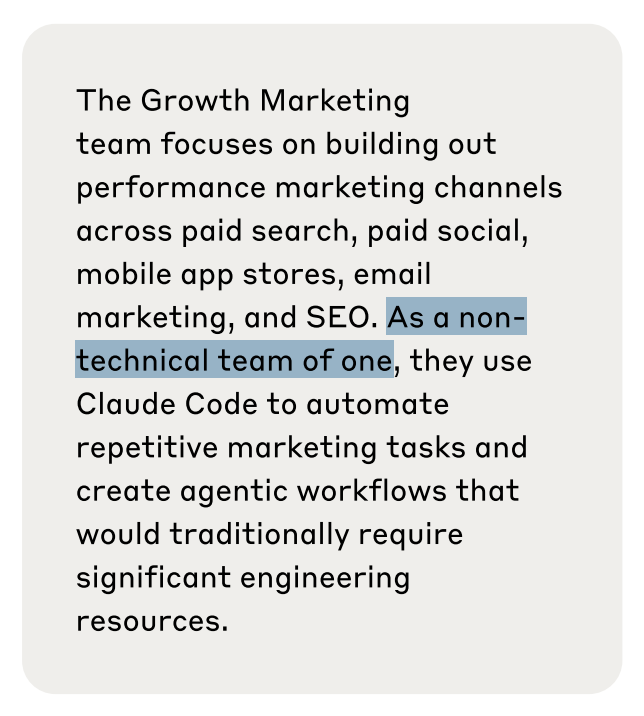
Anthropic's entire growth marketing team was just ONE PERSON
(for 10 months, confirmed)
a single non-technical person ran paid search, paid social, app stores, email marketing, and SEO for the $380B company behind claude
here's exactly how one human is doing the job of a full marketing team:
it starts with a CSV.
1. he exports all his existing ads from his ad platforms along with their performance metrics (click-through rates, conversions, spend, etc)
2. feeds the whole file into claude code
3. and tells it to find what's underperforming.
claude analyzes the data, flags the weak ads, and generates new copy variations on the spot
this is where he gets clever:
he then splits the work into 2 specialized sub-agents:
1. one that only writes headlines (capped at 30 characters)
2. and one that only writes descriptions (capped at 90 characters).
each agent is tuned to its specific constraint so the quality is way higher than cramming both into a single prompt
so now he's got hundreds of fresh headlines and descriptions.
but that's just the text.
he still needs the actual visual ad creative, the images and banners that go on facebook, google, etc.
so he built a figma plugin that:
1. takes all those new headlines and descriptions
2. finds the ad templates in his figma files
3. and automatically swaps the copy into each one.
up to 100 ready-to-publish ad variations generated at half a second per batch.
what used to take hours of duplicating frames and copy-pasting text by hand
so now the ads are live.
the next question is which ones are actually working.
for that he built an MCP server (basically a custom integration that lets claude talk directly to external tools) connected to the meta ads API.
so he can ask claude things like:
• "which ads had the best conversion rate this week"
• or "where am i wasting spend"
and get real answers from live campaign data without ever opening the meta ads dashboard
and the part that ties it all together and closes the loop:
he set up a memory system that logs every hypothesis and experiment result across ad iterations.
so when he goes back to step one and generates the next batch of variations...
claude automatically pulls in what worked and what didn't from all previous rounds.
the system literally gets smarter every cycle.
that kind of systematic experimentation across hundreds of ads would normally need a dedicated analytics person just to track
the numbers from the doc:
ad creation went from 2 hours to 15 minutes. 10x more creative output.
and he's now testing more variations across more channels than most full marketing teams
a $380 billion company.
and their entire growth marketing operation (not GTM) = just one person and claude code lol
truly unbelievable
Hyper-specific software created by
- engineers, “vibe coders”, non-technical founders
- even regular users who just talk to AI
- teams of 1–5 people
Tool serves [xxx] true fans (50–5,000?).
And it makes money since building and running costs almost nothing.
Software will proliferate just as videos, music, writing did.
The market structure will shift from a “fat middle” to mega-aggregators and a long tail.
It’ll be a slower process due to network effects, but many traditional vendor lock-ins will get eaten by AI.
It's crazy and it might ruin (or at least completely change) entry level jobs.
But won't really change an actual investor's job.
A model is only as good as its assumptions
i asked CLAUDE to build me an ENTIRE VC fund P&L model in excel
in ONE prompt, no follow-ups and no corrections, it built what a big 4 associate spends their first 3 months learning to build, 7 fully linked tabs, 25 portfolio companies, american waterfall carry, j-curve visualization, capital calls, LP distribution waterfall, GP management P&L, exit modeling
a McKinsey consultant charges $6,625 PER DAY for this, a custom financial model from a specialist runs $10-25K and takes 2 weeks, this took 4 minutes and cost me $0.20 in API tokens
its over for Venture Capitalists
Four years ago, I invested ~$40M and got involved helping build a small publicly listed company in Canada called Perimeter Medical.
Why?
They were trying to build an AI enabled device to help doctors do cancer surgeries better: take a tumor out from a patient, analyze it with AI while still in the surgical theater and tell with precision if all the cancer was taken out. If yes, close the patient up. If not, go back and get all the cancer.
Well, we got FDA approval today!!
Our product, Claire, became the FIRST FDA-approved AI-enabled imaging device for breast cancer surgery. We also got Breakthrough Designation.
Currently, ~20% of women face repeat surgeries because surgeons "didn't get it all". What’s even worse is that they typically don’t find out for 10 days after the surgery until pathology has reviewed the resected tumor. That is 10 days of waiting and worrying for patients.
Claire’s real-time AI + OCT tech delivers 10x the resolution of standard X-rays, identifying suspicious tissue during a surgery so surgeons can act immediately.
Claire is now a regulated tool that sits in the workflow, in real time, while a surgeon is operating. It is just the start for what this platform can do for cancer care.
We will first focus on ~300,000 breast cancer surgeries per year in the U.S., and then grow into other solid tumors over time.
From a systems perspective, it’s also what “real AI” looks like: invisible to the patient, indispensable to the clinician, and measured in fewer surgeries and better treatment experience .
Congratulations to @adrianvmendes and the @perimetermed team.
Interesting.
At differing levels of "hands-on-ness", I think the way Palantir approaches Forward Deployment will be a thing for many companies in this AI age, at least for the first few years.
This YC trend is exactly what I describe in the $1M/yr using Claude Memory article.
You can start for $0 and you get to keep 100% equity.
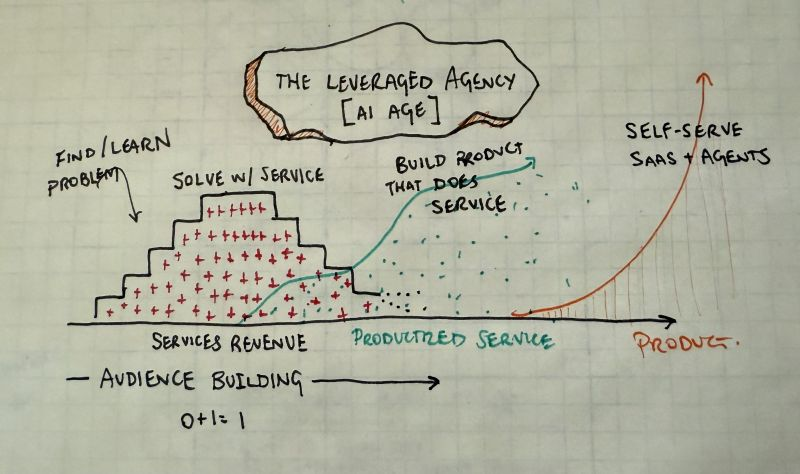
The framework is called a leveraged agency.
Here's how it works, step by step, so you can do it.
1. Pick a specific niche and do the work manually. (services)
2. Document everything as you go. Turn chaos into SOPs
3. Start automating the repeatable parts with AI.
4. Shift from "done for you" to "done with you." You have the systems now, train your client's teams on how to use them. (serve more customers at a lower price, but high margin)
5. Productize into self-serve software Take everything you automated in Steps 3-4 and wrap it in a UI, CLI, API or MCP.
6. Create content, case studies, lead magnets, workshops, to bring in more customers. Lather, Rinse, Repeat.
Sell manually, learn the problem deeply, document it, automate it, productize it, then scale it.
I coined leveraged agency in 2023 after I had my agency get acquired for double the industry multiple because of these systems.
It's even more valuable in the land of AI.
You get paid to learn the problem, build your audience, build your product, and build your customers.
You don't need startup capital or VC. Your customers is the capital.
Let the cash flow.
Seen some people highlight how Anthropic uses Salesforce to downplay the effect AI will have in SaaS.
Dumb argument, they could also build their own email client, payroll system... Heck even their office furniture.
The reason they don't isn't that CRMs are still way too hard to build, just not a priority.
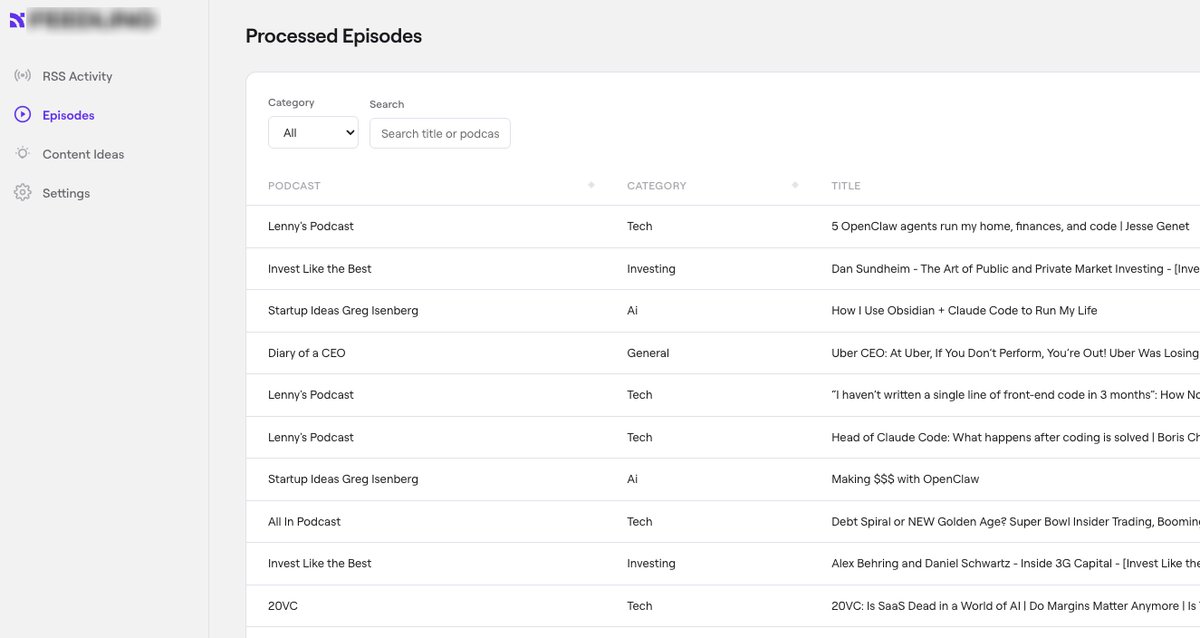
Spent time last couple of weeks building a pod transcription feed that gets a full transcript of your favorite podcasts ++ summarizes highlights.
You link the RSS, set transcription cadence and it runs automatically.
What would be some cool features to add?
If it serves as any hope I think smaller companies with 10x engineers that know how to use AI will do way better than top-down "let's use AI" orders from big cos CTOs/CIOs
Way more likely that a mid sized SaaS pivots into AI than huge cos do
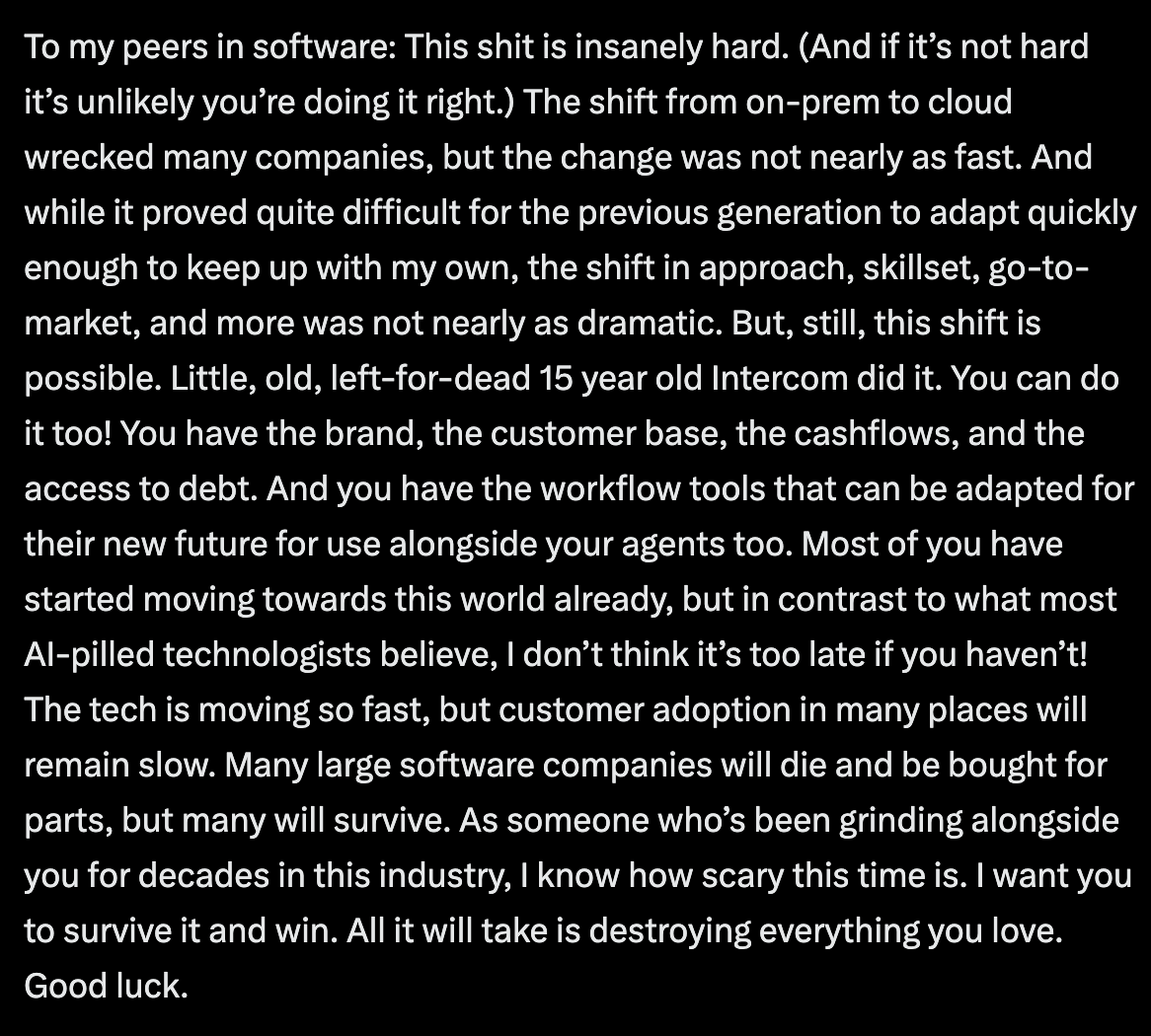
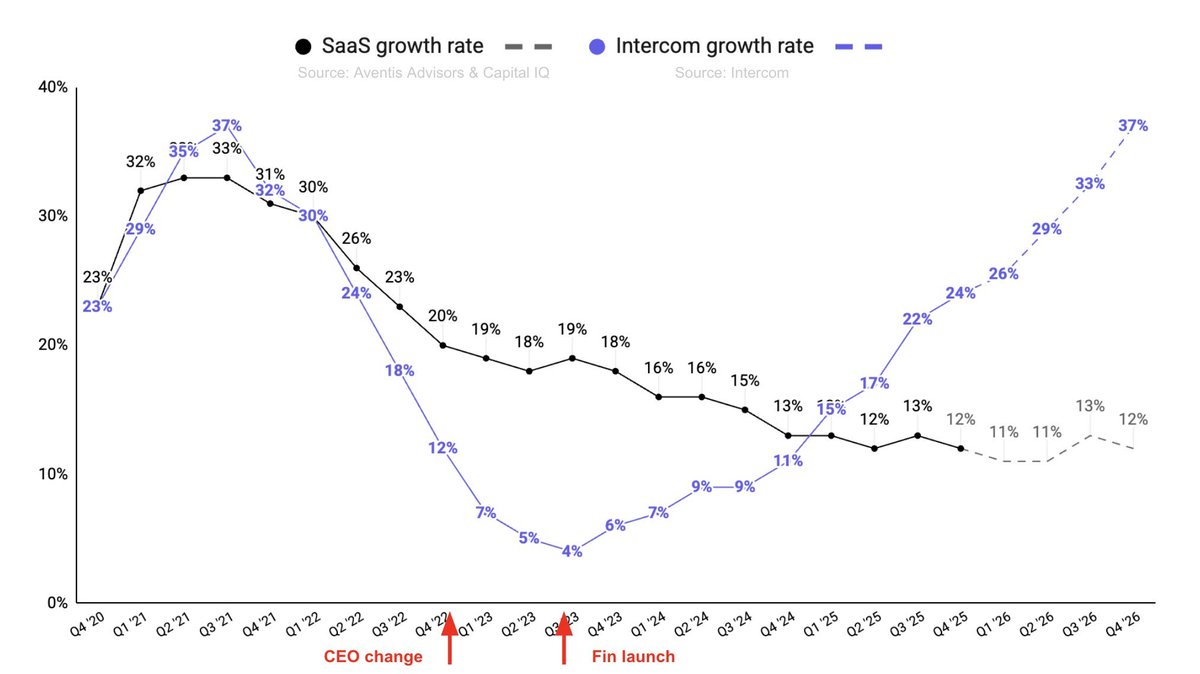
Intercom was in a bad spot a few years ago.
We invested well before that and didn't think we'd see a meaningful return.
Now they're doing $400M ARR.
@eoghan's message to SaaS incumbents:
"I know how scary this time is. I want you to survive it and win. All it will take is destroying everything you love. Good luck."
Been thinking about this:
UC Berkeley study embedded in a 200-person tech company found AI users worked faster, then took on more stuff.
Speed seems to become the expectation.
Interesting findings over their 8 month analysis:
• faster pace
• broader scope
• work stretched into more hours
• People felt more productive ++ more stressed/burned out
That's an n=1 etc etc but important to see one of the possible ways this can play out broadly.
Link to study: https://t.co/vDKEJBVSwE