@kepano Also, what's the advantage of clipping an article into your own vault vs. just linking to the source directly? If you wouldn't mind sharing some representative notes in your own vault (fragments + the reviews), that would be super helpful as well. Thanks!
I really like the idea of fractal journaling, but I do have a few questions about your specific system:
1. When you synthesize recent fragments into salient thoughts, do you go back and modify those fragments directly, or do you create new "summary" notes that link back to their constituent fragments (thereby forming the fractal structure)?
2. How do you go about reviewing recent notes? Do you have a base view that displays all fragments created within X days, or do you just look at the filenames?
@teortaxesTex@BenFerrum Well, China is still far closer to capitalism than it is to a post-AGI world run on UBI, which is the actual communism OP refers to.
Don't delegate understanding
There is a parasite, I see it everywhere. It consumes your health and wealth. It preys on ignorance and is easy to catch. It’s so common you may not even notice you have it.
The parasite has a simple and attractive proposition: let me take care of this hard thing for you. Trust me, I know better.
Instead of understanding it yourself, you choose to give the parasite control over your health, education, money, housing, business, identity, data, infrastructure, climate, justice. Even your beliefs.
The parasite has three stages: acceptance, extraction, intervention.
First is acceptance. Everyone else seems to have the parasite already. You are expected, even encouraged, to accept the parasite into your life. You are invited to follow the norm, outsource, consume. It’s okay! Use all the services and amenities. Satisfy your desires. Eat the cheap food, watch the cheap media. Your money and time are meant to be spent. Show off what you got in exchange. Please do not try to understand how it works, it’s too complicated for you. The parasite wants you fattened. Literally and figuratively. You are paying the parasite for the privilege of being ripened.
Second is extraction. Under the influence of the parasite, you have developed unhealthy habits and you are suffering the consequences. Stress, anxiety, obesity, disease, ignorance, fear, lethargy, decay. To dampen these problems you pay the parasite for help — support, medicine, loans, fines, rent, taxes. Enforcement of some homeostasis. You try to abate the issues, but you don’t have a stable foundation to build on. You have ignored the root causes. The parasite thrives. You are paying the parasite to be harvested, milked, sucked dry.
Third is intervention. The side effects of the parasite’s extraction have reached a critical level. The parasite tells you it’s an emergency. You need doctors, lawyers, firefighters, a military effort. You’re in a surgery room, a court room, a psychiatric ward, a jail cell. The disease can no longer be controlled, it has festered. The flame has turned into a raging fire that needs to be put out. You are paying the parasite to go back to square one.
The three stages of the parasite are interdependent. Every stage benefits someone who is not you. Everyone tells you this is just the way it is. Never mind that the parasite is living large.
Why? Extraction and intervention pay well. Education and prevention do not. The incentives are aligned to make the parasite persuasive. You are alone against a coordinated system that is exceedingly effective at packaging problems you should never have with solutions you should never need. A symbiotic loop.
You must recognize the parasite in its earliest form.
To inoculate yourself don’t delegate understanding. If you build your own understanding you will be the one who earns the dividends.
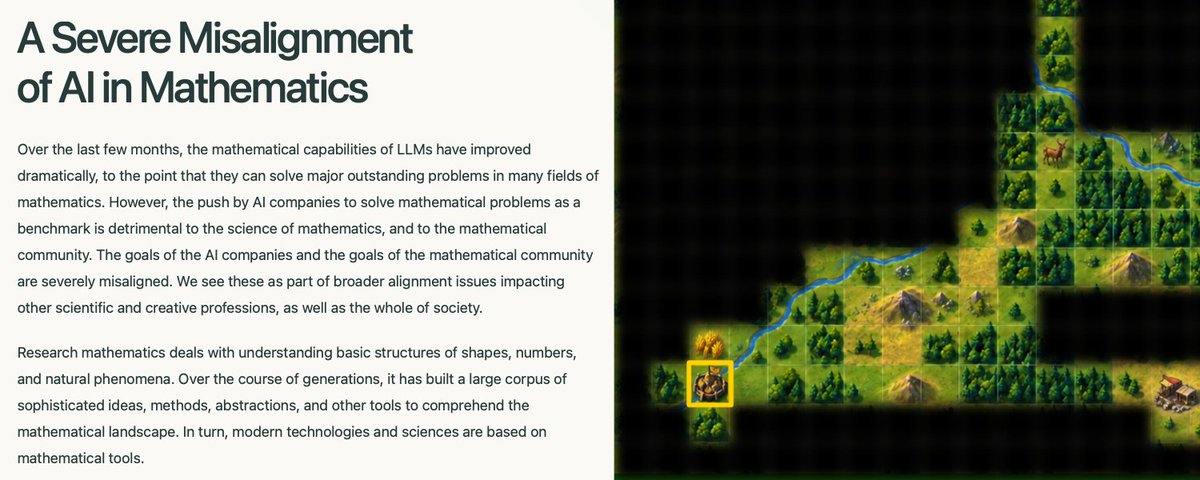
Mathematicians are angry at AI solving their problems, and it's easy to dismiss this as gatekeeping.
"A proof is a proof. They just want to keep their jobs / prestige / fun !"
But I do think mathematicians have a point, and I'll try to explain using old Civilization-style maps
I agree with Dario that we need to pace the frontier. This has been a primary topic of discussions we've had at OpenAI in recent weeks.
Committing to having independent evaluators with employee-like access is a great idea, and we will do the same. We'll have more to share soon.
We Must Pace the Frontier: I’ve written a new essay on why the AI industry should slow down, with a three-part plan for doing so.
Anthropic is unilaterally committing to the first of these steps. We’ll provide third-party evaluators with permanent, employee-level access to our systems, so that they can verify adherence to our safety measures, report on incidents, and assess models’ alignment during training.
You can read the full post here: https://t.co/OGyPb7yaYt
Attention to all Frontier Labs:
@OpenAI@AnthropicAI@GoogleDeepMind ...
It would be historic, and recieved unanimously positive by the mathematical community if you:
find a short proof of the 4 color theorem!
https://t.co/W5q0xJ90nU
For every single one of these, replace "fly" with "artificial neural network with 150,000 units and a fixed topology" and see if you are still impressed (please, I am begging you).
All criticism of the mathathon falls flat when scrutinized. The list of 1500 envious luddites should be safely ignored, and history will ridicule their dinosaur thinking.
The creation of slop mathematics and the exacerbation of a market-driven arms race. Simple solution: just make preprints and verification required (which I think they're doing anyways)!
Intrusion of corporate interest. AI is simply a means to an end. Astra is not capable of completely independent research – solving a problem, prompting correctly, and verifying solutions as you go along are skills that actually require mathematics. The competition trivially will not be 40 hours of "generate a breakthrough."
Conditions unlikely to foster mathematical understanding. By this reasoning, math competitions are a moot endeavor, since contestants are only given 90 minutes per problem on the IMO. Sufficiently talented mathematicians can solve problems of reasonable difficulty in 40 hours with AI.
Damaging misinformation about research mathematics. This is simply an ego hit. Calculators are clearly better than human calculators. Even if the claim is "motivated," it is probably incontestable that AI will eventually supersede humans in mathematical ability. There is no purpose trying to stall progress because it will arrive regardless.
Failure to care for young mathematicians. As a friend humorously commented, they are telling undergraduates that "you shouldn’t do that, because if you do, people like us won’t like you." Circular reasoning.
Despite the recent progress in AI for mathematics, I don't think AI will replace the role of mathematicians.
Instead, it makes mathematics closer to the natural sciences.
In the natural sciences, we invent theories, comprehensible models, that explain empirical observations.
When an AI answers a mathematical question, it provides humans with an effectively empirical observation about the answer. It is effectively empirical because the answer is a measurement from a system outside of immediate human theoretical understanding. This answer, as with any new glimpse of reality, remains mysterious until humans make sense of its underlying structure and provide an explanation of it in our own frameworks for understanding the world.
An AI proof is stronger than simply an empirical observation, but it may be so complex that it provides little deep or novel insight beyond establishing the answer. The role of human mathematics is then to distill these effectively empirical findings into human-legible explanations. Seen this way, much of human mathematics may begin to look like a branch of interpretability, and AI, a new kind of telescope.
1. "The creation of slop mathematics and the exacerbation of a market-driven arms race. Undergrad participants may lack the expertise to carefully verify the results they produce. Participants are not required by the rules of the competition to communicate their results on ArXiv after the event is over. It will again fall to the mathematical community to carefully verify hastily-produced AI-generated results."
No one is forcing mathematicians to do anything here. Math academia has to decide for itself how to adapt verification labor norms in the era of cheaply produced mathematical outputs. And isn't the ArXiv *non-requirement* better for keeping it safe from unverified outputs?
2. "Intrusion of corporate interest. Events like these provide further financial and social leverage for AI corporations over mathematics. The goals of these corporations are not necessarily aligned with the aims of scientific research. As an independent scientific community, it is incumbent upon us to engage critically with AI companies and their tools. It is doubtful that such critical engagement will be incubated at the Mathathon."
Sorry but math academia does not have a monopoly on mathematical practice. As labs become increasingly mathematically productive, they do, in fact, an interest in engaging with aspiring mathematicians. Trying to prevent them from interacting with undergrads is foolhardy.
3. "Conditions unlikely to foster mathematical understanding. As most mathematical researchers would agree, forty hours is not enough time to deeply understand, solve, and communicate a problem. The industrialized production of AI-generated mathematical content on extremely shortened timescales does not add value to our community. Such activities in fact carry broadly negative impacts."
One does not become a research mathematician in 40 hours, no matter how they spend it. This would be a brief exposure to an essential modern tool to supplement their 4-year math major curriculum.
4. "Damaging misinformation about research mathematics. This event is likely to feed into detrimental narratives about our research community. As a case in point, the website of the Mathathon explicitly asks “What is the role of a mathematician when AI can solve conjectures faster?” The claim that AI can solve conjectures faster than human mathematicians appears both motivated and empirically dubious."
Grasping at straws. Someone in the future might make a bad narrative because of this 3-day event? That's an argument?
All the other comments are paternalist bullshit convinced they know better than undergrad math majors how they should be engaging with the changing landscape and deciding for them that they will be harmed by $20k in AI credits to explore what has quickly become an essential tool for math research.
Y'all should be ashamed of yourself for signing this bullshit.
This feels like an overreaction to me. AI-assisted proofs aren’t antithetical to mathematical beauty, and having a “slop” proof as a starting point to refine seems better than no progress at all. My friends and I were looking forward to this opportunity, and we hope it still goes through as planned.
We recognize that the rapid progress of AI in mathematics is disruptive. We're looking to engage with the math community more on the best way to integrate this technology and communicate its impacts. After considering concerns raised by members of the mathematics community, we’ve decided to withdraw OpenAI’s sponsorship of the Caltech Mathathon and have notified the organizers.