The capability story of AI is well understood at this point. Models are faster, cheaper, more capable. Agents can reason across long horizons, use tools, execute multi-step tasks. And wow, are they useful. I'm as addicted to Claude today as I was to Runescape at age 10.
But capability is not the same thing as agency. And the gap between those two things is where most of the interesting problems live.
The deeper promise of AI is that individuals get agents that genuinely act for them. Not for the platform, not for whoever controls the infrastructure. For the user. That's a harder problem than it sounds, and it's mostly been ignored while everyone races to build the fastest model.
For an agent to act on your behalf, it needs to operate in an environment you control. Today, credentials are exposed to the runtime. Execution isn't verifiable at the hardware layer. There's no cryptographic guarantee that your agent is doing what you asked in an environment only you can see. For an agent holding your signing keys, managing your financial transactions, acting autonomously with real stakes—that's a fundamental misalignment between the promise and the architecture.
This is why what @NEARProtocol is building matters. @IronClawAI puts agent execution inside encrypted TEEs with sandboxed tooling—credentials injected at the network boundary, never exposed to the agent itself. Intents lets users express desired outcomes while solvers compete to fulfill them—no single counterparty controls execution. The governance work points in the same direction: systems where no single actor can unilaterally determine outcomes for everyone else.
What I find most important isn't any individual product. It's the coherence of the direction across the stack. Every layer is being designed around the same principle: genuine user sovereignty, enforced architecturally rather than promised contractually.
On the road to agentic commerce, the question is whether the infrastructure layer gets designed around individual agency, or whether we end up with incredibly capable AI that's still ultimately controlled by someone other than the person it's supposed to serve.
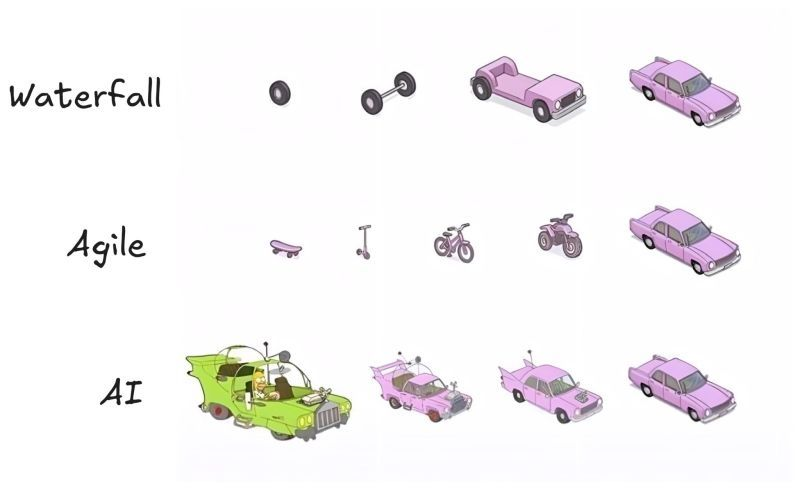
Honestly, this is the most accurate diagram I've seen.
Waterfall: You plan for 18 months and deliver exactly what nobody needs anymore.
Agile: You deliver something usable at every step, but the CEO keeps asking, "Where's the car?"
AI: You get the car on day one. It has six wheels, the doors are on backwards, and it has a rocket launcher. You spend more time making it yours than actually "building"; it's shaping. owning. verifying. That's what the best AI developers do now. They don't build. They shape and own.
As @HackHumanityCo we have worked comprehensively to produce the NEAR - House of Stake Constitutional Documents.
These Constitutional Documents are meant to support a credible path of progressive decentralization: one that works with current legal, technical, and operational realities, while moving House of Stake toward greater autonomy over time. The goal is to build a governance system that can operate responsibly now, earn legitimacy through good decisions, and evolve to better serve the NEAR ecosystem.
To get here has been a co-creative process of many cycles with all key stakeholders involved to set House of Stake up for success.
If you are a @NEARProtocol stakeholder that has locked NEAR to veNEAR in House of Stake you can vote here:
https://t.co/YTRaGN4rLZ
Confidential swaps are now live on https://t.co/uilYXjP7S7! Confidentiality is the key unlock for onchain adoption.
@near_intents is now the first cross-chain execution layer with protocol-level confidentiality. 35+ chains. Non-custodial. Not a wrapper, not a mixer. Users can share viewkeys optionally for auditing or compliance.
You no longer have to choose between onchain and privacy. Until now, onchain meant making everything transparent. That changes with NEAR's confidential shard. Now you can trade without anyone knowing what assets you have, what you're trading, and what you're paying for.
Go dark on https://t.co/uilYXjP7S7 ⚫️
As @HackHumanityCo we have worked comprehensively to produce the NEAR - House of Stake Constitutional Documents.
These Constitutional Documents are meant to support a credible path of progressive decentralization: one that works with current legal, technical, and operational realities, while moving House of Stake toward greater autonomy over time. The goal is to build a governance system that can operate responsibly now, earn legitimacy through good decisions, and evolve to better serve the NEAR ecosystem.
To get here has been a co-creative process of many cycles with all key stakeholders involved to set House of Stake up for success.
If you are a @NEARProtocol stakeholder that has locked NEAR to veNEAR in House of Stake you can vote here:
https://t.co/YTRaGN4rLZ
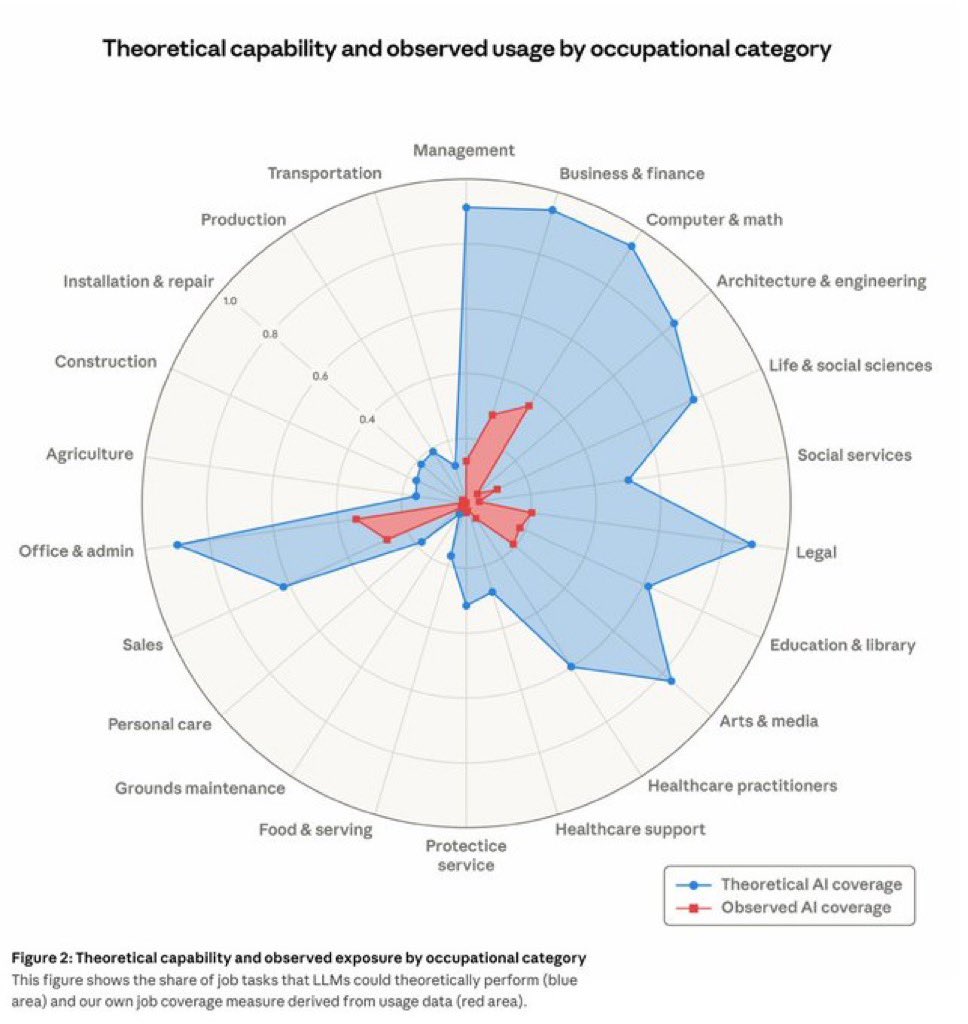
Anthropic just released the most IMPORTANT chart in the AI labor debate.
This comes from the company that builds Claude using data from 2 million real conversations.
Here’s what it shows.
The blue area is every task AI could theoretically do right now.
The red area is what people are actually using it for.
The gap between them is enormous and that gap is your career runway.
Computer programmers are already 75%
covered.
Customer service reps, data entry workers, financial analysts, they’re next.
But here’s what no one is talking about.
The mass layoffs haven’t really started.
Unemployment for exposed workers hasn’t budged.
So what’s actually happening?
Companies are closing the front door, hiring for workers aged 22 to 25 in AI exposed jobs has dropped 14%.
The most exposed workers aren’t factory workers, they’re college educated, higher earning.
49% of US jobs now have at least a quarter of their tasks inside AI’s reach.
That’s up from 36% just one year ago.
And the red area on that chart,
the real world usage is still a fraction of what’s possible.
Every month, it grows a bit.
Anthropic built the scoreboard and most people haven’t looked at it yet.
Great interview with @alice_und_bob
Tommi positions @Polkadot – still focused on web3 values, good tech, recovering from the OpenGov period of overspending, pivoting to a product-led strategy, lots still to be revealed
In an industry where Web3 narratives shift by the season, some chase the next headline. Others pause, and ask what future they truly want to help build.
A year later, we met Tommi @alice_und_bob again in Hong Kong. Having recently concluded his formal role with the @Web3foundation, he is stepping into a new chapter in both life and career — continuing to deepen his engagement with the @Polkadot ecosystem while also feeling the pull of the rapidly advancing AI wave. His focus remains on on-chain governance and public infrastructure, even as he explores new possibilities with a greater sense of independence.
This wasn’t merely a conversation about “what’s next” in a career. It became a deeper reflection on where Web3 is actually heading, how technology is meant to be used, and what kind of culture and products
@Polkadot 's “Second Age” truly demands.
From AI reshaping the developer paradigm, to why on-chain applications remain trapped in financial narratives; from infrastructure reaching maturity, to adoption that still lags behind — Tommi revisits the industry’s most fundamental question with rare clarity:
If the technology is finally ready, are we ready to build something that truly matters?
Read PolkaWorld’s latest interview below.
0:00 See you again
0:54 Current Chapter
2:11 The AI-Driven Shift in Development
4:19 Technical Maturity vs. Market Recognition
6:47 Hub Liquidity & Developer Migration
9:34 Has Web3 dApp Innovation Stalled?
12:24 Driving Adoption on @Polkadot Hub
16:44 Builder Culture as the Deciding Factor
18:35 Polkadot’s Core Value — Freedom
22:20 The Hard Reset
29:13 Why Still Believe in @Polkadot
31:20 Hong Kong as an Industry Connector
34:53 Bear Market Mindset: Cycles, Reality, and Tech Long-Termism
38:53 After AI Took the Spotlight: Is Web3 Left Behind or Embedded in the Future?
42:02 The Uncertainty Heading into 2026
What is left when AI runs it all?
In this @Unchained_pod, @mikejcasey and @DMattin join me to discuss:
💡 How Moltbook points to where the AI meta is headed
😬 How AI could impact jobs
❕️ Which country is best positioned to win the AI race
⁉️ What a post-human economy looks like
👀 Which jobs survive in a post-human economy
Timestamps:
🚀 0:29 Introduction
🧏♂️ 2:10 How the Moltbook saga offers a window into where the AI meta could be headed
🤔 9:29 Why Michael wants a sovereign AI model
🌎 17:42 How AI could impact jobs
⚠️ 25:31 How AI could have a worse effect on the mental health young people than social media
❕️ 30:27 Which country is best positioned to win the AI race?
📍 35:02 What money looks like in a post-human economy
🤔 52:00 Which jobs flourish in a post-human economy?
💡 1:00:33 Michael and David share tokens and projects they find intriguing
Wise words from @lrettig "the world is paying much more attention to AI than to crypto in this moment, for good reason. But crypto and AI are a marriage made in heaven, and what’s good for one is good for the other" https://t.co/4zxmK82osP