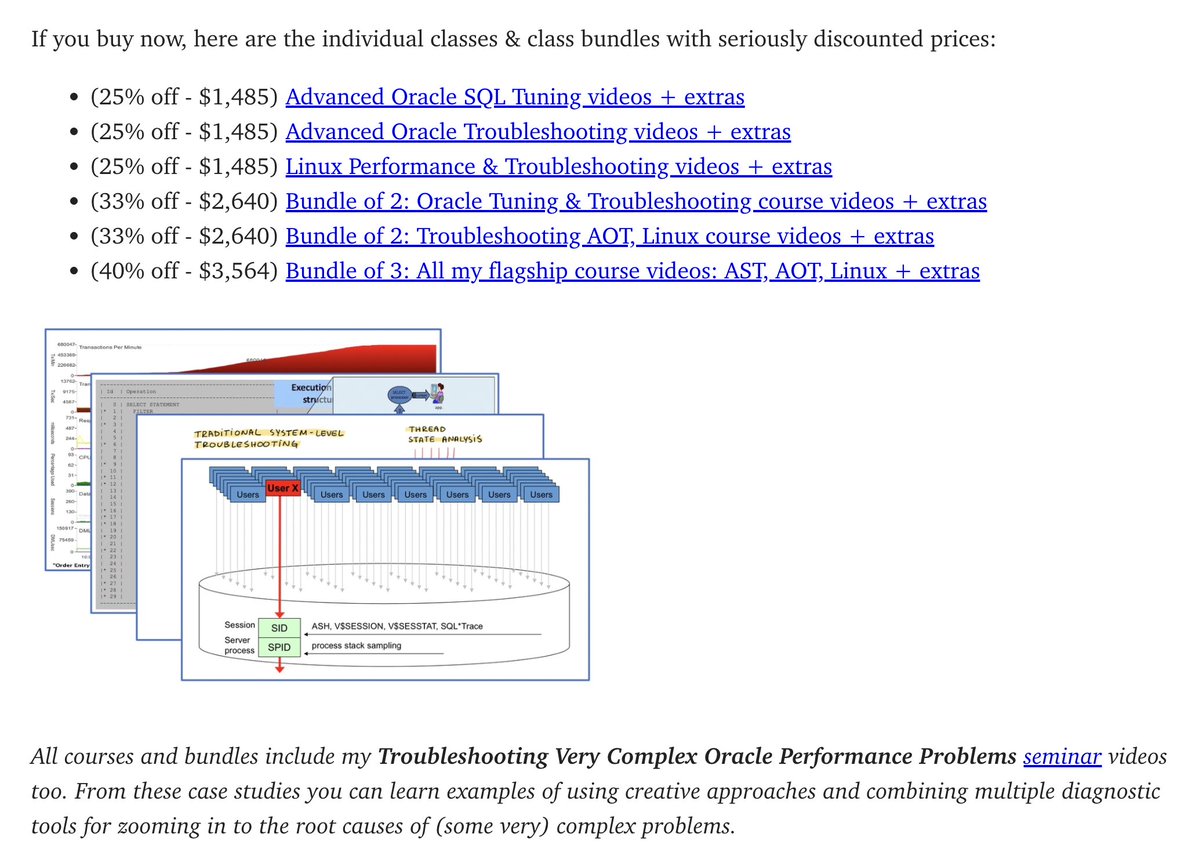
Almost Summer Sale 2026: All my flagship video courses discounted until end of May!
Plus *free* Exadata Internals & Advanced Performance Metrics seminar videos!
https://t.co/86p5MLJicb
Why is the AI backlash growing?
Outside of coding (where there is clear value), and a handful of other domains (e.g. brainstorming), Generative AI has been a net negative for society.
GenAI has been undermining secondary and college education, opening up mass surveillance, increasing disinformation, delusions, impersonation, phishing, and other forms of cybercrime, nonconsensual deep fake porn, bias in employment and other domains, and economic disparity, drowning the world in slop and unwanted, over-leveraged environment-damaging data centers that risk causing a recession.
Simultaneously it has empowered a bunch of people who want to privatize almost all the gains while leave all the downsides to society, taking almost zero responsibility.
I don’t think we are better off than we were four years ago.
Some of this is technical (LLMs aren’t reliable), some of it is political/economic (such as the utter lack of responsible regulation). Most of this was predictable.
Almost none of it is good.
All that said, I honestly believes some future form of AI might be great. But Generative AI has hurt more than it has helped, and been managed irresponsibly.
It’s no wonder many people have had enough.
One of the best PostgreSQL backup solution is now no longer being maintained. A lot of companies are using this but made little or small contributions.
What if we could run Postgres as a single file, and take advantage of the best SQLite has to offer?
Today I am announcing pg-micro, a crazy experiment I've been undertaking to make this happen.
pg-micro is different than other approaches because it is fully local, and expected to be fast: there is no concurrency limitation and no statement translation.
Here's how it works: we use the actual postgres parser to parse the statement, but compile that to the Turso AST. The Turso AST is then compiled do bytecode, and from there everything executes natively, as it'd do in SQLite. This makes it a perfect target to run in any environment.
There is traditionally a mismatch between Postgres and SQLite in terms of functionality. But @tursodatabase has been hard at work to close this gap: things like MVCC and a rich, strict type system are present in Turso. There are PRs for things like lateral joins, etc. This means that the gap can be closed until it theoretically reaches zero.
What you could do with it? Just imagine for example a primitive like Durable Objects by @Cloudflare, but with a postgres interface? Or imagine you could use the same pattern of local databases for agents that SQLite gives you, totally ephemeral and free, but with a Postgres interface? Or even that you could execute remote postgres in platforms like @vercel but with the unmatched density of the Turso Cloud?
Expect lots not to work at this point. But as usual, this is done in the full spirit of OSS, so PRs welcome!
To get started: npx pg-micro
we just released 𝚙𝚘𝚜𝚝𝚐𝚛𝚎𝚜-𝚋𝚎𝚜𝚝-𝚙𝚛𝚊𝚌𝚝𝚒𝚌𝚎𝚜, inspired by Vercel's 𝚛𝚎𝚊𝚌𝚝-𝚋𝚎𝚜𝚝-𝚙𝚛𝚊𝚌𝚝𝚒𝚌𝚎𝚜
these are the Agent Skills that we use on the supabase platform - including performance, security, & schema design
details ↓
https://t.co/7GOYpuin6e
.@abigale_kim's paper is unleashed! It's the most complete eval of DB extensions/plugins. We analyze @PostgreSQL, @MySQL, @mariadb , SQLite, @duckdb, @Redis.
TLDR: Postgres ecosystem is fraught w/ footguns. Other DBMSs have fewer extns but less problems. DuckDB has cleanest API.
What Cristian Diaconescu, the head of the Chancellery of the President of Romania's Office, conveyed yesterday is no less than a historic event all NATO states that acceded NATO after 1997. On this occasion, the whole of our society should be aware of what Cristian Diaconescu said.
Firstly, the fact that the head of the presidential chancellery was able to make the following statements means that he had the approval of the President of the Republic.🧵
@tom_doerr Creating objects in PostgreSQL PUBLIC schema is not a good practice! The recommended way is to create a dedicated schema for all the database objects.