Absolutely insane.
Nvidia, $NVDA, just guided $108 BILLION in revenue for Q3 alone.
And, this guidance assumes ZERO data center compute revenue from China.
This builds on the record $96.2 billion in revenue posted for last quarter for a projected total of $204.2 billion in 6 months.
We now have a $5+ trillion company is seeing +106% year-over-year revenue growth.
There has never been anything like what we are seeing right now with AI.
This is arguably the biggest technological revolution of all time.
"Protocols to embed AI agentic payments into blockchain-based apps already exist and could create a flywheel effect for new issuances.
Users will be able to instruct their agents to handle the payments for their transactions, eliminating the need for an individual to set up a wallet, and purchase and manage alt coins and cryptocurrencies.
To the user, the experience of working with a Web3 app will look and feel no different than a Web2 offering, but they will be able to obtain more financial benefit by working within the Web3 ecosystem where the tokens provide both utility and ownership."
Stablecoins are transforming how value moves, and interoperability is the key to institutional scale.
We're proud to join Open USD as a day-one integration partner, reinforcing Ripple's commitment to open, multichain infrastructure that supports institutional adoption across the digital asset ecosystem.
Most work conversations are now being recorded by default. You should probably assume that everything you say at work is getting recorded from here on out.
What’s emerging is a new category of enterprise software, organized around voice instead of text.
The system of record today is structured data: CRM entries, tickets, docs. But the highest-value context lives in conversation: the nuance on a customer call, the real argument in a product review, the offhand comment in a leadership meeting that quietly changes the roadmap.
LLMs are uniquely good at taking that unstructured voice data and making it structured, searchable, and queryable. That’s a large enterprise opportunity, and we’re still early in understanding what the software layer looks like and who owns it.
a16z GP David Haber on what AI recording means for the future of work: https://t.co/02zEZZWMMr
Hedera Chief Policy Officer @nilminirubin is on the Hill today as part of @BlockchainAssn's Member Fly-In. Hedera is proud to be among the voices making the case for smart, clear digital asset legislation.
The U.S. has an opportunity to lead, and moments like this matter.
The private investors already made their money on SpaceX.
Imagine being in private circles when it was valued in the millions and billions.
And now the public is waiting to get in at a trillion dollar evaluation.
Wealth is often created in private networks and realized in public markets.
🚨JPMORGAN, CITI, BOFA AND WELLS FARGO TO LAUNCH TOKENIZED DEPOSIT NETWORK BY 2027
The four largest U.S. banks are building blockchain payment rails through The Clearing House to keep deposits from migrating to stablecoins, per WSJ.
🚨HUGE: Nvidia has officially launched its N1X, marking its debut in the Windows PC processor market, challenging Intel, AMD, Apple and Qualcomm.
“This reinvention of the computer is as big of a deal as the reinvention of the phone into what we now know as the smartphone,” CEO Jensen Huang said.
Rule changes for the SpaceX $SPCX IPO:
Index providers waived the profitability requirement and cut the seasoning window from 90 days to 5.
This forces over $30 trillion in passive 401k and retirement money to buy SpaceX at IPO valuations.
Bloomberg Intelligence estimates S&P 500 funds must absorb 19% of SpaceX's float within 6 months.
Russell 1000 and Nasdaq 100 funds will absorb 24%.
The rules built to protect passive investors:
1. S&P 500 has required 12 months of trading and 4 quarters of GAAP profitability since 2002. Both waived.
2. Nasdaq cut its inclusion window from 90 trading days to 15.
3. FTSE Russell cut its to 5.
All three benchmarks are now structured to buy SpaceX at IPO pricing.
US inflation is red hot.
1. CPI Inflation: 3.8%, highest since May 2023
2. PCE Inflation: 3.8%, highest since May 2023
3. PPI Inflation: 6.0%, highest since March 2023
4. Services Inflation: 3.4%, highest since Sept 2025
5. Shelter Inflation: 3.3%, highest since Sept 2025
6. Energy Inflation: 17.9%, highest since Sept 2022
7. Gasoline Inflation: 28.4%, highest since June 2022
Inflation is reaccelerating across nearly every major category of the US economy.
Are you positioned accordingly?
DTCC just announced it’s connecting its tokenized securities platform directly to Stellar $XLM, targeting live integration in 2027.
For those who want the full picture, I’ve been mapping this out for a long time.
AI is increasingly driving market profitability:
The S&P 500's net profit margin excluding financials is up to a record ~15%.
At the same time, the S&P 500's net margin excluding the Magnificent 7 and tech is down to ~8%, near the lowest since the 2020 pandemic.
This marks a ~7 percentage point gap between tech and non-tech sectors, the widest on record.
This comes as margins for companies outside of tech have been trending down since 2022.
Meanwhile, Magnificent 7 and tech firms have seen a rapid increase in margins over the last several quarters.
AI is all that matters right now.
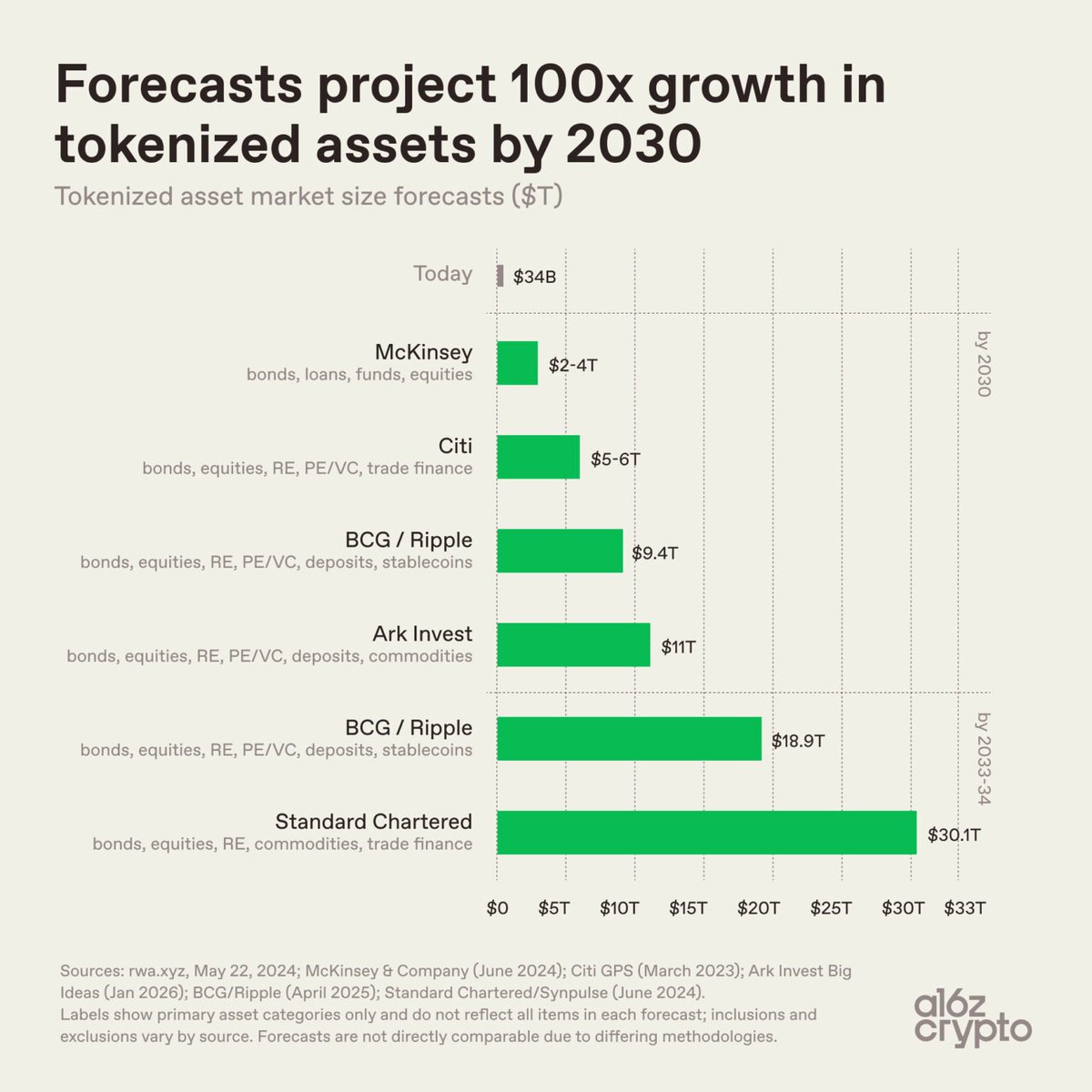
Looking ahead, forecasts for tokenized assets vary a lot but they all point in the same direction: growth.
McKinsey: $2–4T by 2030.
Ark Invest: $11T by 2030.
BCG/Ripple: $9.4T by 2030, $18.9T by 2033.
Standard Chartered: $30T + by 2034.
The gap between $2 trillion and $30 trillion is more about definitions than adoption.
Different institutions are measuring different things. McKinsey focuses mostly on bonds, loans, funds, and equities. Standard Chartered adds commodities and trade finance. BCG and Ripple include deposits and stablecoins alongside more traditional asset categories.
Despite these differences, the broader trend is consistent: Asset tokenization is expected to expand.
What is happening here?
The US birthrate is now down -30% since pre-2008 levels while financial wealth is at record highs.
Why? Because only asset owners are able to afford this economy.
As shown in our below analysis, this crisis accelerated in both 2008 and 2020.
And, with every recession and every round of inflationary economic stimulus, the crisis simply accelerates even further.
Now, we are seeing the biggest divergence between the S&P 500 and the US birth rate in history.
The result? Tons of young Americans simply cannot afford to have kids in another sign of the "K-Shaped" economy.
The US is facing a massive demographic crisis.