you dont have to believe in existential risk or job loss for this to be scary: ai is real, you can replicate human thought in machines. it is redefining what it means to be human. even if they are strictly corrigible tools that do what we ask, this can be traumatic
1/n
A physical book is a real object, anchored. If you read a particular edition, you remember not only the contents but the object itself: its cover, typography, smell, even where a passage sat on the page.
Books organize themselves in memory by place --the ancient method of loci.
Digital text does not exist.
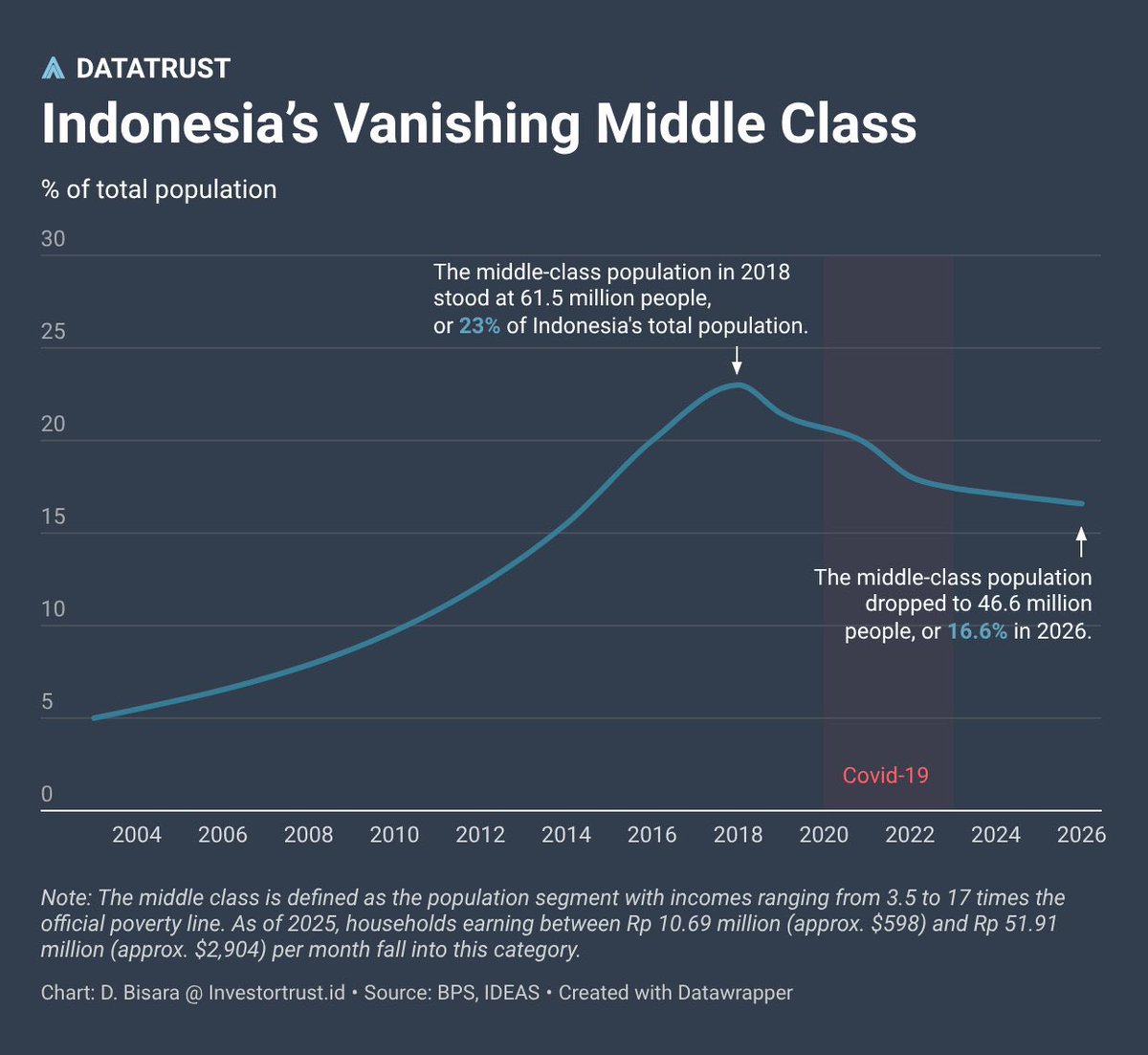
This chart should terrify policymakers. Indonesia’s middle class did not merely slow down. It went into reverse.
After two decades of expansion, the middle-class population peaked at 61.5 million people in 2018, representing 23% of the population. By 2026, that figure had fallen to just 46.6 million people, or 16.6%. That is not a cyclical slowdown. That is structural deterioration.
For years, policymakers celebrated GDP growth, infrastructure projects, commodity booms, and headline investment numbers. But the ultimate scorecard of an economy is whether ordinary people become wealthier over time. This chart suggests millions of Indonesians are moving in the opposite direction.
The middle class is the economic engine of every successful country. They buy homes, cars, insurance, consumer goods, education, travel, financial products, and healthcare. They generate tax revenue. They create small businesses. They drive domestic demand. When the middle class shrinks, the economy loses its most important customer.
The uncomfortable question is simple: where did the gains go? If GDP is growing, if conglomerates continue expanding, if commodity exports remain large, then why are fewer Indonesians qualifying as middle class than eight years ago?
More importantly, if you are born poor in Indonesia today, what ladder exactly are you supposed to climb?
If you are exceptionally good looking, perhaps you can monetize attention through social media. If you are academically gifted, perhaps you can break into an ultra-competitive institution like MBB, survive years of brutal expectations, and eventually use that platform to do something bigger. If you are entrepreneurial, maybe you build a business against overwhelming odds. If you are lucky, perhaps you benefit from family connections, inheritance, or access to opportunities unavailable to most people.
But an economy cannot rely on exceptionalism. A healthy economy creates millions of pathways upward, not a handful of lottery tickets.
The situation becomes even more concerning when you consider that well-paying white-collar jobs are becoming increasingly scarce. Many multinational companies that once established regional operations, technology centers, shared-service hubs, and professional offices in Indonesia have either downsized, relocated, or shifted future expansion elsewhere.
Those jobs were not valuable merely because of the salaries they paid. They were valuable because they transferred knowledge, management expertise, technical skills, global best practices, and professional networks into the local workforce. Over time, they helped develop intellectual capital that could later be recycled into entrepreneurship, leadership positions, startups, and domestic businesses.
When those opportunities disappear, the loss is not limited to employment. The country also loses a training ground for future managers, engineers, consultants, analysts, and business leaders. Human capital compounds just like financial capital. Once that pipeline weakens, rebuilding it can take years or even decades.
The bigger risk is that social mobility slows. When people stop believing hard work leads to a better life, trust in institutions weakens. Aspirations decline. Consumption slows. Talent leaves. The country’s most productive people increasingly look elsewhere for opportunity.
This is why Indonesia’s biggest economic challenge is no longer growth. It is upward mobility. A country cannot thrive without a growing middle class, a steady pipeline of high-quality jobs, and a clear path for ordinary people to join it. And right now, all three appear to be moving in the wrong direction.
CEOs are uniquely prone to AI psychosis because they’re sufficiently distant from the last mile of work that still has to happen to generate most value with AI.
So when they play with AI, they see the happy path results, often not considering the next 10 or 20 things that have to happen to get sustainable results from agents.
“Look I made this awesome product prototype”. Yes but you didn’t have to review the code before it went into production and fix a bunch of issues.
“Look I generated a contract”. Yes but you didn’t verify all the terms before it goes out to the counterparty and didn’t have to wire up all the past contracts to work with.
The best thing you can do as a CEO is to use AI a *ton* to figure out the real implications of agents in the enterprise, and come out the other side with an appreciation for both the upside and the real work that goes into them.
Bot replies
Bot replies
Bot replies
Bot replies
No need to use Browserbase - playwright/chromium does it better
Bot replies
Bot replies
Bot replies
Bot replies
I’ve been using this for months
Bot replies
Bot replies
Bot replies
Bot replies
😂😂😂Ai noise killing the real Ai momentum 🤦🏻♂️
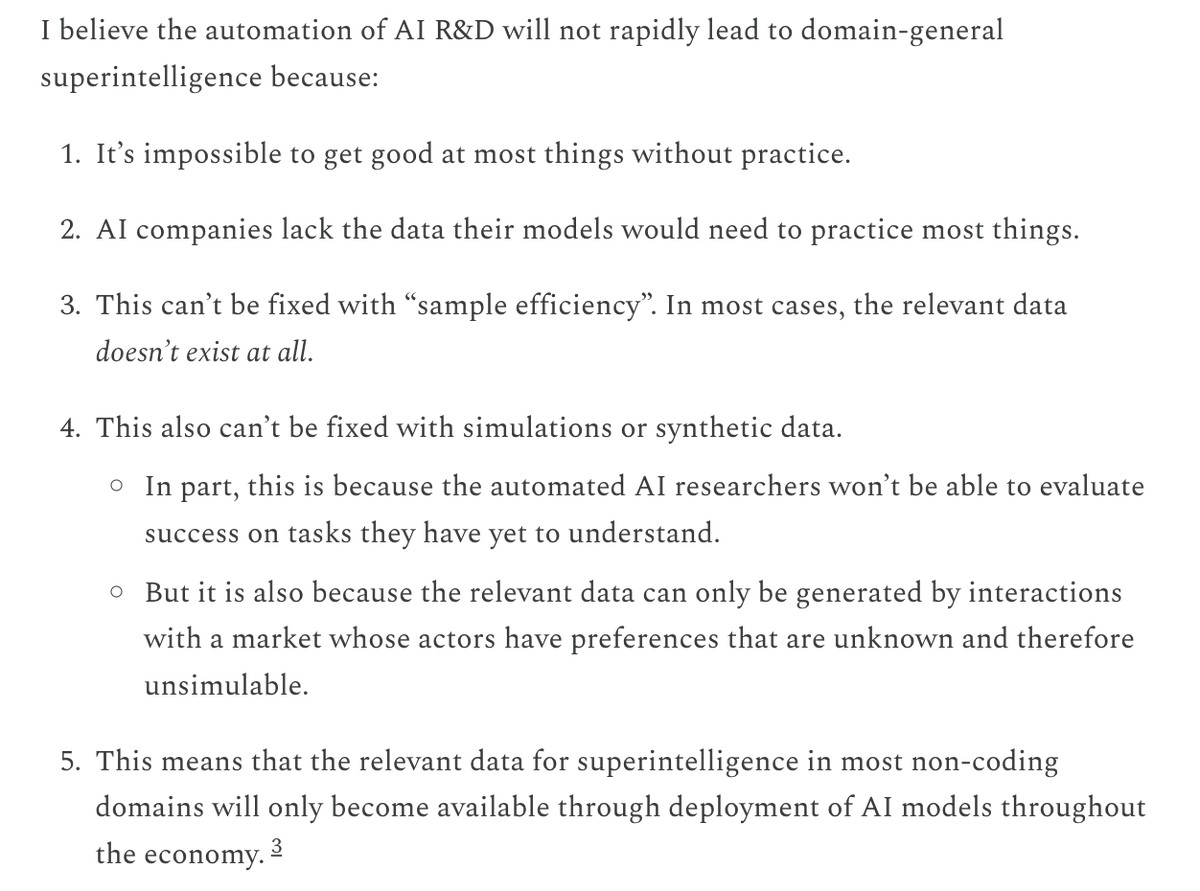
In many ways the argument I'm forwarding isn't new: I basically think that AI companies won't have the data to produce domain-general superintelligences.
But I think this holds even if "sample efficiency" improves dramatically.
I also don't think the missing data can be simulated.
Single claude.md does not prevent anything, even opus with max effort does not remember shit after only around 15-20% context nowadays
You need to push harder using hooks, accumulating wiki for lessons learned and using another llm model like gpt 5.4 as advisor to audit claude's outputs/reasonings if you cant review by yourself what it is doing
@ml_yearzero@akshay_pachaar@karpathy I m absolutely convinced that one day @karpathy will tweet a simple “hello there !” And some stupid guys will find that so wonderful and will opensource “How Karpathy said Hello There “ in a GitHub repo 🤣
Tulisannya bagus banget (membuat lu semakin berfikir untuk mengurungkan niat untuk FOMO dengan agentic tools dan mulai mengembangkan "workflow" sendiri)
https://t.co/C0CA0ywh3Y
This is the spec quality problem all over again. You write constraints in natural language and hope a probabilistic system actually follows them. Same energy as writing a design doc your team half-reads. fchollet said specs are basically datasets for agents and he was right... we're all just training on bad data rn.
@TurnerNovak I was investigating a guy running 30 accounts with Indonesian IP addresses and I was trying to figure out what tools he was using.
I found out it was AI: Actual Indonesians.