Cathie Wood says she avoids memory stocks like $MU and $SKHY because she still sees HBM as the most cyclical and commoditized part of the semiconductor stack.
Her bigger point is that inference architectures from $CBRS and $NVDA via Groq can reduce or eliminate the need for HBM which makes today’s memory pricing surge look more temporary than structural.
As she puts it when technology costs “triple or quadruple” engineers eventually design around the bottleneck and she believes inference is already starting to do exactly that.
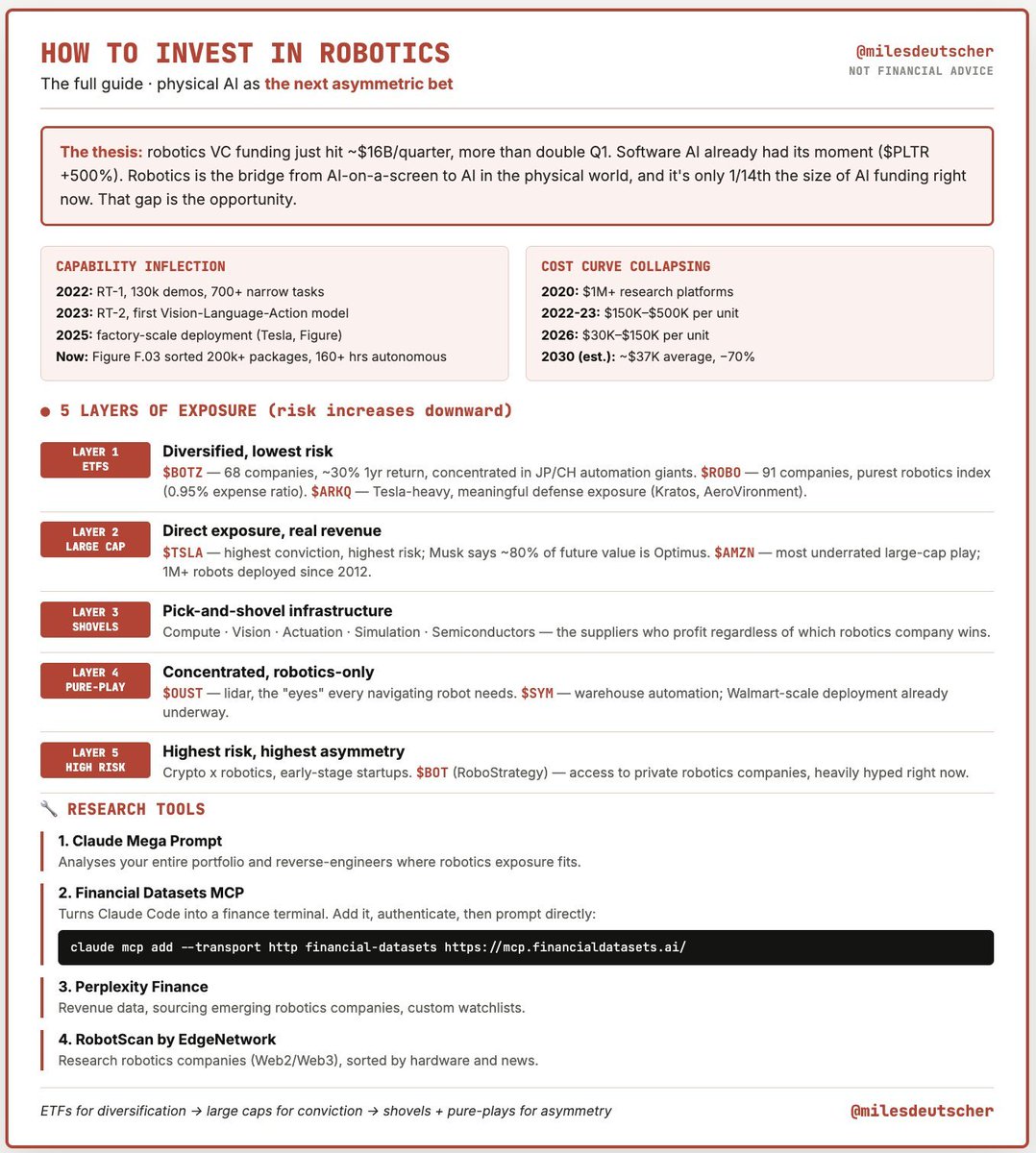
This robotics trade is the most asymmetric bet of the next decade.
Over the past year, I've slowly built portfolio exposure to this emerging sector.
How to invest in robotics for the average person (full guide - nfa):
A lot of people on X are new to the markets. So I'll make this as simple and harsh as possible.
The economy is not going up. It is not going down. It is doing both at the same time. This is called a "K-shaped
economy" and almost nobody talking about affordability on your timeline understands what it actually means.
If you own assets, stocks and real estate, you are on the upper arm of the K. Your wealth has compounded aggressively since 2020. The S&P is at all-time highs. Home prices are up 50% since the pandemic. Your 401k is the best it has ever been.
If you do NOT own assets, you are on the lower arm. Rent is higher. Groceries cost more. A home that cost 2.2x the median income in 1960 now costs 5 to 7x. You are working harder and falling further behind, and it is not your imagination.
The top 10% of Americans own 93% of all stocks. The bottom 50% own 1%. The top 10% hold 68% of total wealth. The bottom 50% hold 2.5%. This is not an opinion. This is Federal Reserve data.
When the S&P goes up 25% in a year, the people who own stocks get 25% wealthier. The people who don't own stocks get nothing. That is the K. Same economy.
Two completely different outcomes based on one thing: whether you owned assets before the run started.
This is why your timeline is split in half. Half the people saying the economy has never been better. The other half saying they can't afford to live. Both are telling the truth. They are just on different arms of the K.
How long does this last?
The honest answer is that it has been going on for decades. The Richmond Fed traced this pattern back 30 years. It happened after 2001. It happened after 2008. It happened after COVID. Each time the gap widened and never fully closed before the next shock hit.
The last time wealth concentration looked like this was the Gilded Age, 1870 to 1900. That lasted 30 years before structural reform changed anything.
What does this mean for you?
The K-shaped economy is not a reason to panic. It is a reason to understand where you sit and what you can control.
The people on the upper arm did not get lucky. They owned assets. That is the entire difference.
Change your life and start small. No matter how small your account balance is. I only started with $10K, twenty years ago. This is your time to retire your whole family. They are counting on you.
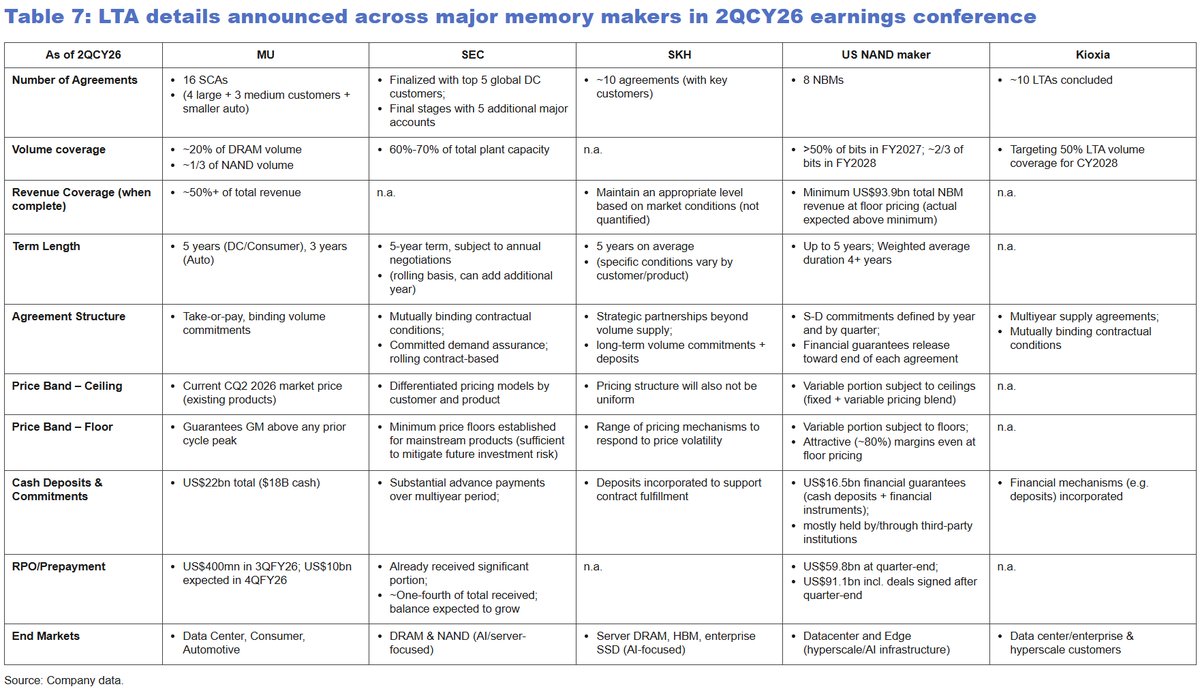
Memory stocks are going higher and this table is the clearest proof yet that the entire industry has changed at a structural level (Save this).
This table shows how Micron, Samsung, SK Hynix, an unnamed US NAND maker and Kioxia each disclosed massive long term agreement programs on their second quarter 2026 earnings calls and the details reveal a memory industry that no longer behaves like the boom bust commodity business it's been for decades.
Micron signed 16 Strategic Customer Agreements covering roughly 20% of its DRAM volume and about a third of its NAND volume, with 14 of those deals worth a combined $100 billion in minimum contracted revenue running from 2026 through 2030.
These are take or pay contracts, which means customers are contractually obligated to buy specific volumes and pay for them regardless of whether they actually take delivery, a structure Micron's own executives describe as non cancellable.
Samsung is running an almost identical playbook at even larger scale.
Samsung finalized agreements with its top five global data center customers and is in late stage talks with five more and once complete, these deals are projected to cover 60% to 70% of Samsung's total memory production capacity.
Samsung has already collected about a quarter of its total expected deposits from customers and some contracts include price floors that guarantee minimum pricing even if the broader market weakens.
SK Hynix has locked in roughly 10 agreements with its key customers, including a three year DDR5 supply deal with Microsoft and a discussion with Google for up to a five year general-purpose DRAM contract that could extend to seven years if tied to next-generation HBM supply.
SK Hynix is also structuring advance payments of 10% to 30% of total contract value on these deals, which is a dramatic jump from the sub-5% advance payments that were standard just a year or two ago.
The scale of this shift becomes clearer when you zoom out.
South Korea's presidential adviser confirmed that SK Hynix and Samsung have collectively committed to $950 billion in long term memory supply partnerships with US tech companies, split between $750 billion from SK Hynix, largely tied to Nvidia and $200 billion from Samsung's partnership with Broadcom, both running through 2030.
Even the US NAND maker referenced in the table has locked in 8 long term agreements guaranteeing a minimum of $93.9 billion in total revenue at floor pricing, and Kioxia is targeting 50% long term agreement coverage by 2028.
Why does this actually make memory stocks a better investment than in past cycles?
In the old memory model, customers pulled back the moment demand softened, leaving suppliers stuck with excess inventory, collapsing prices, and vanishing margins during every downturn.
Take or pay contracts flip that dynamic entirely, since customers are now financially penalized for walking away, which removes the demand side volatility that used to wreck memory makers' earnings every few years.
The pricing structure embedded in these deals protects the downside while preserving upside exposure.
Micron's contracts include price floors and ceilings, with the floor set high enough that management says it guarantees gross margins well above our peak quarterly margins in any past cycle, while the ceiling caps pricing only at recent elevated market levels rather than historical lows.
That means even in a hypothetical downturn, Micron's largest customers are contractually locked into paying prices near the top of the historical range, a mechanism that structurally raises the floor under the entire industry's profitability.
This is exactly why we’ve stayed so bullish on the memory trade at Milk Road, and subscribers are already up massively on some of the positions we’ve made around this supercycle.
If you want to see exactly what we’re buying and trading across Micron and the rest of the memory supply chain, come join us for just $1 using the link.
https://t.co/thIhK9ZH4E
Just some TLDRs of stuff I found interesting:
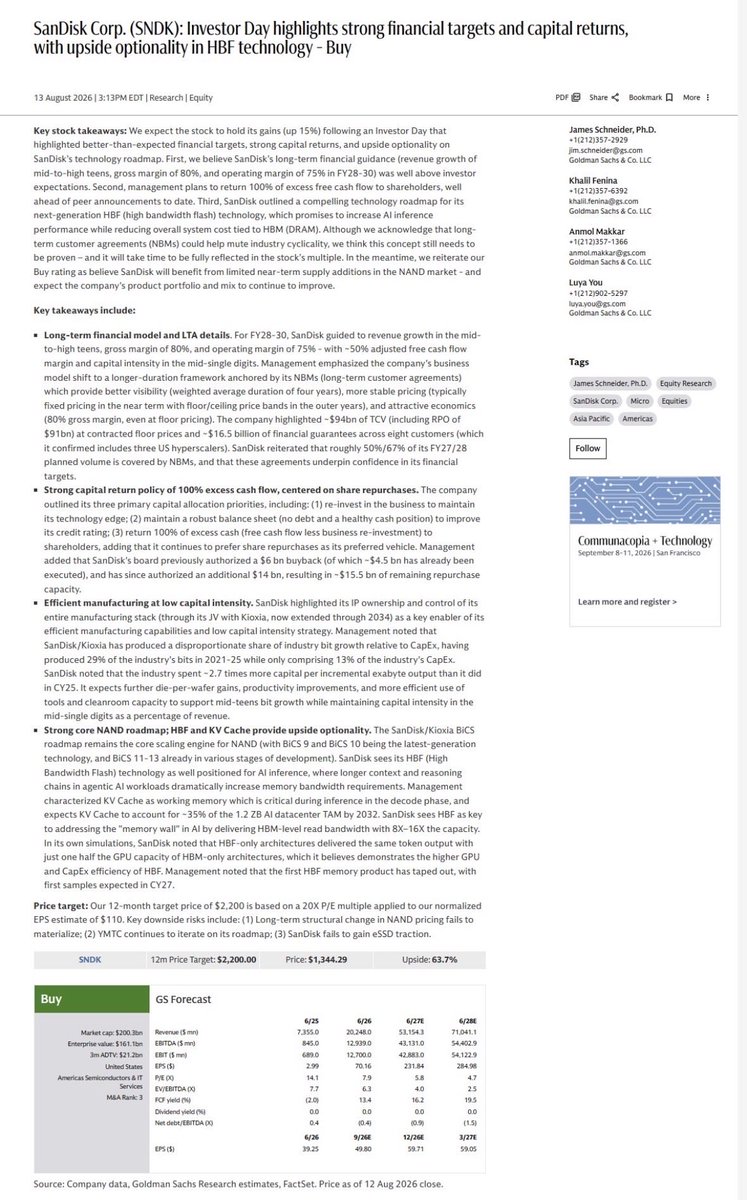
- $SNDK 80% adjusted gross margins projections through 2030, ~75% operating margins and ~50% adjusted FCF margins from investor day.
LTAs already 2/3rd of 2028 output. Minimum contracted revenue reaches $93B (MC is currently ~$239B)... Hard to be a cyclical stock when your revenue/targets are expected to continue 4Y later into 2030.
- $CRWV signs contracts for 6Y old $NVDA A100 GPUs through 2029.
For Neoclouds like Nebius/Iren, this is positive, since it's a counterargument for eg. Burry depreciation short thesis
- conventional DRAM gross margins eg. Micron is estimated to reach an unprecedented 95% by 2027, surpassing HBM GMs per UBS
read through for legacy/standard dram players like Nanya/Winbond should go brrrr if projections are correct.
- Anthropic reportedly achieved 14x+ YoY growth and roughly 2.4x sequential revenue growth q2 to >$11.5B,. estimating growth to $190–200B in 2028r evenue numbers.
Your frontier labs keep growing at stupidly fast paces, it would be worrisome if they didnt.
- $NVDA reportedly in talks to invest $3B in SB Energy (Softbank subsidiary), creates a >$500B compute financing push with Apollo, BlackRock, Blackstone, Brookfield, Goldman, and others. $NVDA Feynman reportedly moves to TSMC A16 + SoIC + custom HBM + CPO in H2 2028
Just more nvidia news every day
- $MSFT Maia 300 discussed $TSM capacity for >300k units in 2027, with expansion to 1m+. Unveils as soon as September.
Likely $MRVL should be more happy from this news. For what's happening right now:
- maybe GUC for Microsoft current ASIC ramp.
- For the Amazon party, stuff like Alchip (I do own shares), likely is ramping now with $AMZN ASIC program H2 2026...
So might be a good idea to look at hyperscaler ASIC ramp timelines + their beneficiaries.
- $TSM VP of Advanced Packaging stated "the industry is likely to face not only memory shortages but also tight ABF substrate supply over the next few years"...
Emphasis on few years for memory + ABF substrates for bottlenecks.
Even upstream abf substrate equipment providers are happy, eg. Eternal Precision which uses vacuum lamination equipment stated orders surged, their plants have been running at full capacity, and 20%+ price hikes.
- $AMAT expects advanced packaging revenue to grow >70% in 2026, versus prior >50%, and said customer discussions now extend all the way to 2030
(not too familiar with this company, but found their growth rate from 2025 Q4 $6.8B ->$7.01B -> 7.91B -> $9.12B -> $10.25B Q4 2026 projections pretty interesting)
- Google said at OCP APAC said conventional 48V is running out of headroom. $NVDA detailed an 800VDC MGX-compatible rack H2 2026 (timeline, Delta / Lite-On beneficaries)
- Aside from $SNDK, Nanya LTAs cover 50% of capacity. CXMT signed multi-year DRAM agreements last month, so entire memory industry seems to be following same playbook as ur big 3.
- Probe cards remain a bottleneck, MPI(6223) said their probe card capacity remains fully utilized because demand exceeds supply.
Already covered the CW laser bottleneck with $AAOI, $SIVE, and $LITE earlier this week, but that's another fun one.
- some MLCC/component lead times have hit 36 weeks per Nichidenbo.
Your Samsung Electro-Mechanics, Taiyo Yuden, Murata, players should be very happy to hear this.
TLDR: AI supply chains go brrr.
$MU $SKHY Bookmark this thread the next time the Chinese memory and $AAPL headline trends.
Unfortunately, Market loves headlines about Chinese memory going into iPhones sold in China. Whatever happens here, it's a nothing burger.
First. Chinese $DRAM is NOT cheap. They cost almost the same, sometimes more expensive.
“A 64GB DDR5-5600 RDIMM based on memory from Samsung or SK hynix costs 18,595 CNY ($2,745) at JD, whereas a module featuring the same capacity and specification, but using DRAMs from CXMT is priced at 18,999 CNY ($2,805)…”
“According to data from semiconductor analysis firm SemiAnalysis, the average selling price of CXMT's DRAM in the first quarter was only about 5% lower than that of the three major players”
“CXMT produces memory chips using an outdated fabrication technology, its DRAM ICs consume more power than those made using the latest manufacturing processes, have lower performance potential, and mediocre overclockability.”
“CXMT's DDR5 die is roughly 40% larger than Samsung's equivalent, which means fewer usable chips per wafer and a structurally worse cost base, not a better one. … Its cost per bit remains more than 30% above the three leading suppliers…”
DRUCKENMILLER 13F DROP
1) Druck sold memory stocks before the July semiconductor crash.
He exited $MU $AVGO $BE $NET $SNDK $LITE
Extremely well timed.
2) He rotated into cloud businesses like $AMZN and $GOOGL
We agree, these names got way too cheap.
3) He invested in datacenter storage name $STX . We prefer $WDC. Same theme.
Data storage does not have the same DRAM or HBM pricing volatility risk.
3) He bought $FOXA. We picked this up 2 weeks ago when it sold off after $ROKU acquisition news.
Was sub 10x forward PE, and their earnings will grow sharply as we see WorldCup hit and Mid Terms and a Presidential $15 Bn+ election spend.
4) He bought cybersecurity names. These are a bit pricey, but they are one of the few areas that have maintained momentum.
5) Interestingly, he picked up $PURR which is a bet on Hyperliquid. We re-established a small position in $PURR a few days ago.
6) He picked up $RDDT. We like that as an indirect AI play (licensing revenue).
7) He added to medical devices. If you want a quality category on sale with value there’s a lot to do here. He bot $DHR.
8) He bought $CDW. This is a mean reversion high free cashflow and capital return story. This was surprising to see.
I attached the bull case on this name.
9) He bought a semi name that is under the radar: $STM. This one is also a surprise.
That business is experiencing a decline in revenue, but the Lumida Invest app says they are re-positioning to get into Autonomous Vehicles.
10) Druck added to airlines which sold off due to SoH. We like this theme as a bet on Baby Boomer travel demand.
Overall, he has a thoughtful portfolio.
THE NEW AI INFRASTRUCTURE STACK
Piper Sandler mapped the new AI infrastructure stack across 8 layers from the power grid all the way to the agent as AI scaling creates bottlenecks across power, cooling, networking, storage, cloud & inference:
Layer 1 | Power, Grid & Real Estate
• $NEE building renewable power backbone hyperscalers need to scale AI
• $CEG monetizing 24/7 nuclear power AI data centers increasingly require
• $TLN building behind the meter nuclear power model for AI campuses
• $IREN turning scarce power & interconnects into hyperscale AI capacity
• $DLR owning physical real estate underneath global AI infrastructure
• $EQIX owning interconnection layer where AI networks & clouds meet
Layer 2 | Physical Datacenter, Shell & Cooling
• $VRT building 800V DC powertrain needed for next jump in AI rack density
• $SMCI assembling liquid cooled rack systems that turn GPUs into usable compute
Layer 3 | Silicon & Hardware
• $NVDA building compute platform underneath AI economy
• $AMD building second full stack accelerator platform at hyperscale
• $AVGO designing custom AI silicon behind Google TPUs & Meta MTIA as hyperscalers move deeper into proprietary compute
• $GOOGL turning TPUs from an internal advantage into a hardware business sold directly into customer data centers
• $INTC turning 14A into a real external foundry business with $TSLA as an anchor customer and its largest reported foundry deal yet
• $ARM moving into full server CPUs & capturing the full value of the chip instead of dollars per core
Layer 4 | Scale Up & Scale Out Networking
• $ANET building Ethernet backbone connecting hyperscale AI clusters
• $CSCO extending enterprise networking into AI data center fabric
• $CLS manufacturing physical networking hardware connecting AI clusters
Layer 5 | High Performance Storage
• $PSTG using DirectFlash to reclaim power & rack space for AI infrastructure
• $DELL bundling servers & storage into an integrated enterprise AI stack
• $NTAP connecting enterprise data estates to cloud AI workloads
• $HPE bringing enterprise storage into an infrastructure as a service model
Layer 6 | Orchestration & Workloads
• $IBM turning Red Hat OpenShift into enterprise control plane for private & hybrid AI deployments
• $NTNX bringing AI infrastructure stack into private & on prem environments
Layer 7 | GPUaaS & Cloud
• $CRWV proving GPU residual value with fully priced A100 capacity contracted through 2029
• $NBIS building an AI cloud around 5GW of contracted power with customers prepaying 50% of capex
• $DOCN bringing AI compute & inference below hyperscale cloud layer
• $MSFT turning Azure into one of largest distribution layers for AI compute
• $AKAM pushing AI inference closer to where users consume it
• $AMZN monetizing AI through hyperscale cloud infrastructure & its own silicon
• $ORCL building AI cloud capacity against a heavily concentrated backlog of large customer commitments
Layer 8 | Model Execution, Tokens & Agents
• $NET becoming distribution layer between AI agents and the internet as non human traffic crosses more than 50% of its network
• $FSLY moving inference closer to the end user through edge compute
I feel like AI investing is simpler than what people expect.
Because $NVDA + Jensen literally tells everyone what's coming.
But somehow. Almost every. single. time. Markets dismiss it until it actually happens?
Be Nvidia in 2025: Buys up EML and laser capacity.
Markets dismissing it: "Photonics is a bubble and like quantum! ____ company is a scam with shady management"
1 year later: $LITE +678%, $AAOI +475.12%, $COHR +260.7%, $AXTI +3,843.9%.
_
Nvidia in 2026:
Buys up CW/EML capacity with LTAs. 800V shift. Extraordinary explicit about CPO shift. States Physical AI as the next theme.
Markets now: "CW players are meme stocks! 800v, CPO is not coming anytime soon, Humanoids are not profitable!"
Yeah... We'll see what happens in 2027.
I think I'm putting my money on Jensen/Nvidia as the leading indicator.
Open-source models will pressure frontier lab margins, but the proliferation of cheaper models will ultimately drive greater demand for AI infrastructure.
The *AI trade* has come back to life and we're on watch for a multi-month rally.
If you’re a memory investor, you have to bookmark this and read it. This is Goldman Sachs’s take on $SNDK investor day…
We’re still early in this cycle folks!
Grok Bot has taken over the entire internet. And for good reason
It is an EXCELLENT AI agent
But you HAVE to set it up the right way
Here are the first 5 steps to make your Grok Bot agent team SUPER powerful:
1. Brain dump everything about yourself, goals, passions, and career into the initial agent. This is going to give it the context it needs to set up your agent team
2. Next, prompt the agent "Based on what you know about me, what do you think would be the best set up of this Grok Bot app? Which bots should I make and what should their responsibilities be? This should enable the best workflow and productivity" This will give you the perfect plan for setting up Grok Bot
3. After reviewing the plan, ask the Bot to set up your workspace for you. It will create the agents, give the right context and descriptions, and make sure your setup is built for productivity
4. Next, ask it for which routines each agent can set up to help you out the most. This should give you a list of cron jobs (routines) that each agent can do on a regular interval
5. Ask the agent to implement these
And just like that, you have the most powerful AI agent on the internet all set up.
You have an entire fleet of agents ready to go and do work for you.
And in fact, because you set up the routines, they're ALREADY doing work for you
Enjoy the AGI
If you’re a memory investor here’s your latest take from Bank of America’s trading desk. Super important for the bearish heads on here and wall st. This week.Bookmark and read word by word and tell me why $MU is not trading at $2000 already? Korea opens in a few hours let’s see
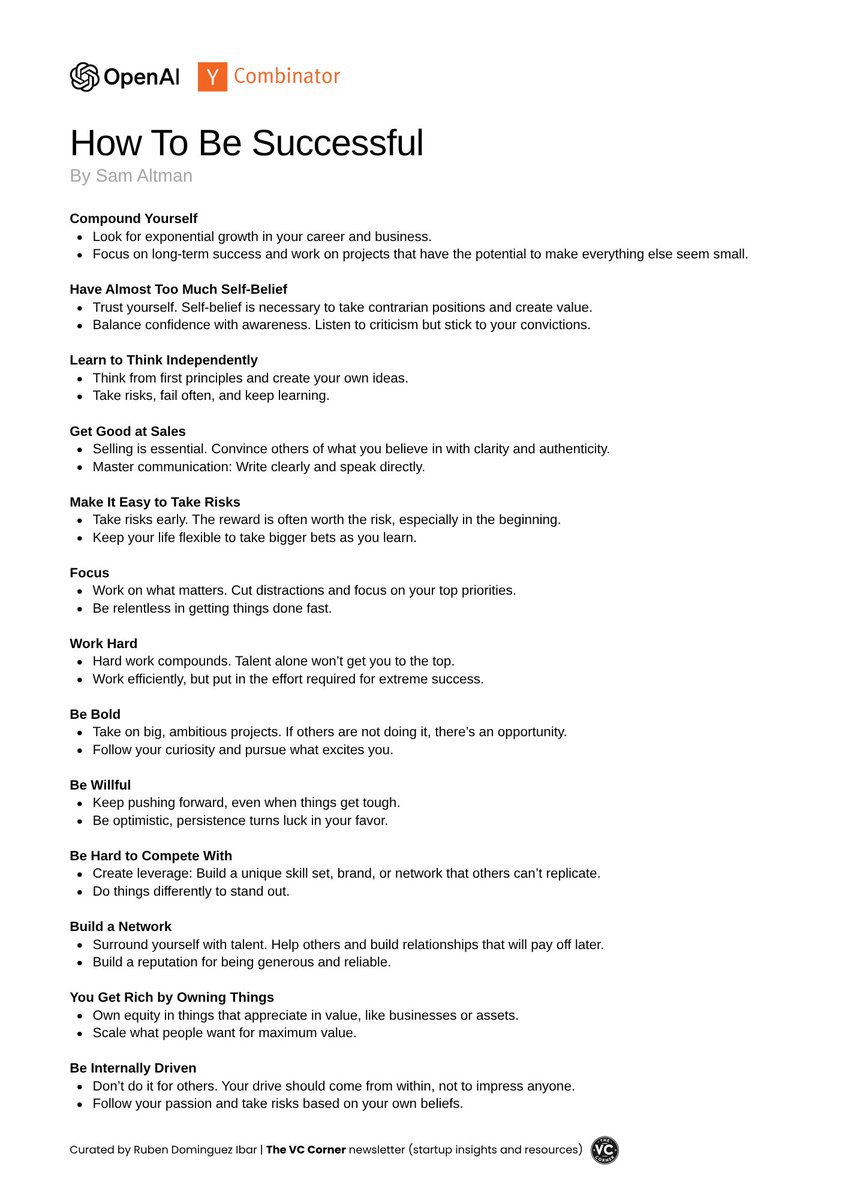
Sam Altman's entire success playbook in one line: compound everything
career, skills, relationships, capital. the people who win just let the right things stack for years