@ExtremeCen80240@conciergeophto Agree on pricing. I practice in the Cleveland area. ATIOL fees are a lot like politics, eh? Local. Only LAL is $4000 w/out FLACS in our area, even at the large ACO's.
I struggle w/the dental analogy. Non-ATIOL option? Insurance covered IOL. Implant option? No tooth.
@ExtremeCen80240@conciergeophto Only a naif is unaware of this. My experience is that the super-majority of eye surgeons are risk averse and do NOT do this.
First of all, 70% overhead is on the high end. 55-60 is very doable. Also, we now have way more premium IOL options that are effective in patients with mild pathology than we did 5 years ago. Average conversion rate for premium IOLs is 10-15%. That’s an extra 2-4k cash per cataract.
Don’t get me wrong, the decline in reimbursement sucks, but to say it’s the death knell of ophthalmology private practice is absurd. Finally, this guy is selling a course. He’s trying to scare people into buying it.
@ExtremeCen80240@conciergeophto Majority of insurance-covered cataract surgery is MCR-compliant: corrected vision <20/40 or 50. Plus, the average cut to close time for an American cataract surgeon is roughly 15 minutes. Add in 90 days of care post-op.
@ExtremeCen80240@conciergeophto Sorry. Not in my neck of the woods. Only highly commercial, corporate practices cut LVC prices, and even there only in ads. Most were "bait and switch" programs with eventual prices near $2000/eye for comparable procedure.
@ExtremeCen80240@conciergeophto But we DIDN'T cut our fees. We just failed to increase them to keep up with inflation. I charged $2000/eye for LASIK in 1996. My fee today is...wait for it...$2000/eye. My advanced IOL fee has increased from $1995 to $2995 over the last 15 years.
Senator Sanders @SenSanders I am a surgeon, and I DONT get any tax breaks, nor do any of my patients get any tax breaks.
A hospital making $5 billion a year pays LESS property tax than a pizza shop.
HERE’S WHERE YOUR MONEY ACTUALLY GOES:
2 days ago I showed you hospital prices
are up 281% since 2000. Everyone asked the same question: where did it go?
Here's the answer, in one picture 👇
Hospital prices: +281%. Healthcare administrators: +131%. Four times faster than the number of doctors.
Nonprofit hospital CEO pay: +92% in a decade. The CEO-to-nurse pay gap went from 23:1 to 44:1.
Medicare's payment to the physician: +7% in 25 years. After inflation, -33%.
That's where it went. Not to the bedside. To the C-suite and the org chart.
Now the part that should make you angry.
Most big hospitals are "nonprofits." That means no income tax. No property tax. No sales tax on what they buy.
A hospital system doing $5 billion a year pays less property tax than the pizza place across the street.
The deal was supposed to be: we don't tax you, you take care of the community.
Here's the scorecard: The tax break is worth $37 billion a year. The average nonprofit hospital spends 2.3% of its budget on charity care. The exemption is worth 4.3% of its budget.
80% of them get more in tax breaks than they give back. The gap: $25.7 billion a year.
$25.7 billion, every year, that didn't go to patients, didn't go to doctors, didn't go to your city's schools or roads, and didn't go to the IRS. It went into the building.
And the CEOs running these "charities"? Average pay is six times what a CEO makes at any other kind of nonprofit. Some make $20 million. The research found their pay rises with profits and has zero relationship to charity care.
The only people in this system who pay no taxes are the ones with the biggest buildings and the biggest bonuses.
A nonprofit that pays its CEO $20 million and spends less on charity than it saves in taxes isn't a charity. It's a corporation with a halo.
Ask your hospital one question: what did you pay in property tax last year?
#medicareforall @lowninstitute
Memories of love and loss abound this week, notably my mother-in-law and my wife's goofy mutt, Tiny Tim. Thoughts in this Midweek Memory of a Random Thoughts "classic": https://t.co/ccEMV4h1oR
Imagine working 80–120 hours a week, performing life-saving neurosurgical procedures that can last 3 to 18 hours or more, only to receive Medicare reimbursement that doesn't even cover the cost of delivering care.
Now imagine decades of Medicare payments failing to keep pace with inflation.
Neither can we.
Yet @CMSGov keeps finding new ways to pay physicians less while demanding more, taking little input from those on the front lines.
And then wonders why independent practices are disappearing.
Read the press release 👉: https://t.co/FhYu4KL4L0
@councilsns@spinesection@cvsection@TumorSection@AANSNeuro@CNS_Update
Be the person who is remembered for making the people around them shine brighter. Thoughts on the passing of Dan Hicks in this week's "Sunday musings..." https://t.co/KlqRGPkThq
With due respect to @LivingstonMD, the part we surgeons sometimes fail to explain what that payment also covers 60/90 days of routine postoperative care.
At the roughly $1,200 quoted here, that means 4 to 6 hours in the operating room, plus postoperative visits, wound care and related phone calls.
The surgeon’s professional fee, also, has to cover our time, training and expertise, along with staff, malpractice insurance and practice overhead.
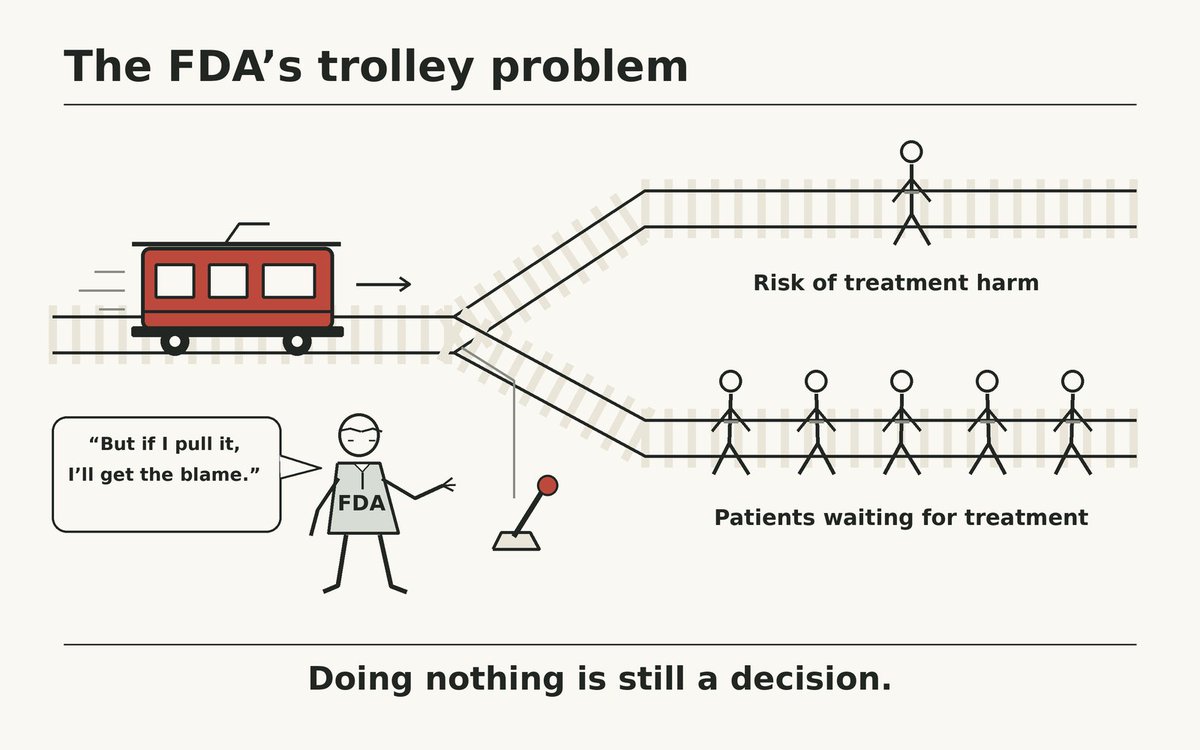
The FDA has a trolley problem.
Imagine you can pull a lever to save five people, but doing so carries a risk of killing someone else. Pull it, and that death becomes your responsibility. Leave it alone, and the five deaths become “just what happens.”
That’s the incentive problem in drug approval. the public scrutinizes the harm from approving a drug. The harm from withholding a useful one is much less visible.
we need to build a open-source dashboard that makes those invisible costs visible. I think the FDA would work a lot more efficiently if everybody could track how many deaths are occurring because of the bureaucratic slowness in each drug approval.
I don’t have deep expertise in this field so any help or advice from clinicians, researchers, patients, and regulatory experts would be vital. If you can help or think I’m full of shit, I’d like to hear from you.
Inspired by @VitalikButerin’s “My techno-optimism” and @ATabarrok’s writing on the invisible costs of FDA caution. @b1shtream
"I never apply the sword when the lash suffices, nor the lash when my tongue is enough. If there is even one thread binding me to my fellow man, I do not let it break. If he pulls, I loosen. If he loosens, I pull."
- Muawiya
@bambam1729 Probably saw this saying in a lousy crime family movie, relates to the second affair with the direct report employ: never sh!t in the kitchen.