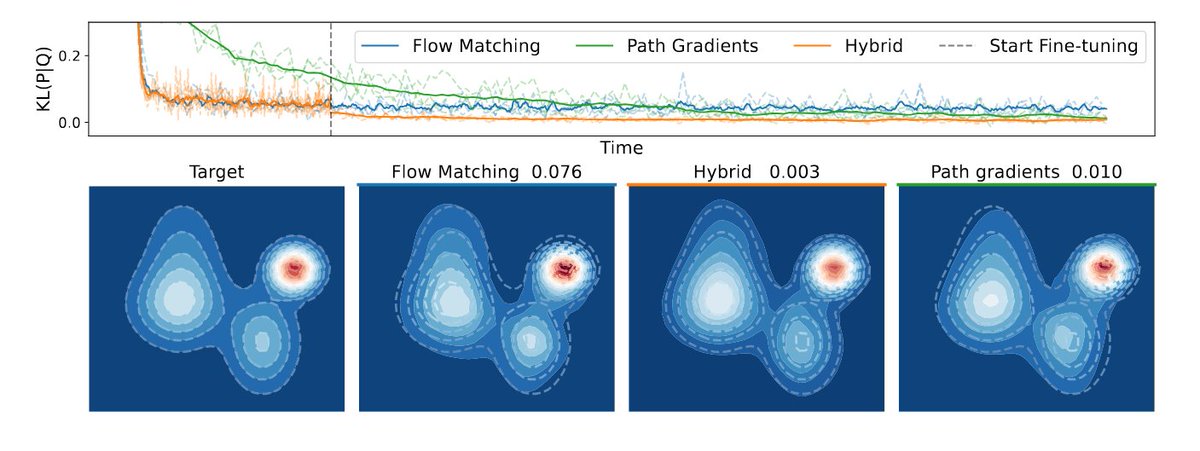
IPF-based Schrödinger bridge samplers are prone to instabilities and mode collapse. Surprisingly, IPF does not need full steps: we use γ-IPF with adaptive stepsize γ, chosen by a trust region, so each step moves a fixed KL distance. #NeurIPS2026 in Sydney: https://t.co/rsGM3R4kI5
MIMOSA: Guiding De Novo Antibody Design with Natural Interaction Fingerprints
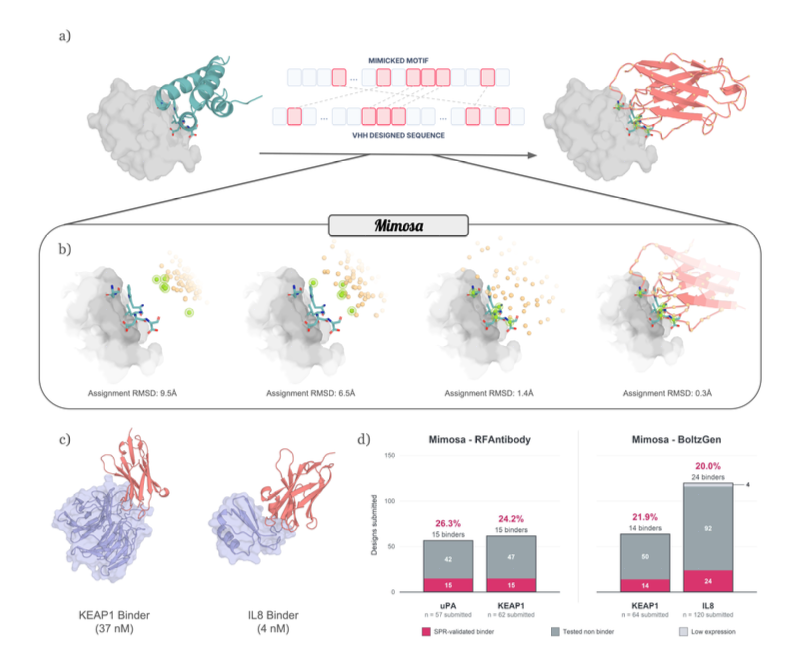
1 MIMOSA (MIMic-Oriented Structural Antibody generation) is an inference-time framework that turns “known binder structures” into actionable constraints for de novo antibody/VHH design, aiming to avoid the common failure mode where diffusion generators produce many plausible structures but zero validated binders.
2 The core idea: instead of searching for a binding interface from scratch, MIMOSA forces generated antibodies to reproduce a target’s proven interaction fingerprint (hotspot residue geometry and, optionally, chemistry) taken from a structurally characterized cognate binder–target complex, while letting the generative model complete the rest of the paratope.
3 It is model-agnostic and requires no retraining: the same steering method was applied directly to two architecturally different diffusion pipelines (RFAntibody and BoltzGen), demonstrating that the approach is portable across generators.
4 Mechanistically, MIMOSA adds a differentiable “mimic potential” during diffusion denoising: at each step, gradients push selected CDR coordinates toward the reference hotspot coordinates (after aligning the reference complex to the generated target pose). It also uses particle-based steering (Feynman–Kac resampling) to reduce local-minimum trapping.
5 A key technical novelty is dynamic residue-to-residue mapping during generation: MIMOSA does not require a fixed, pre-defined grafting map. It assigns motif residues to compatible CDR positions on the fly using (i) a sliding-window strategy for contiguous motifs that fit within one CDR loop, or (ii) a Hungarian per-residue assignment for spatially scattered hotspots spanning multiple CDRs.
6 After structure generation, MIMOSA can “sequence-fix” successfully placed hotspots during inverse folding: residues whose Cα positions land within 2 Å of assigned motif positions keep the cognate amino-acid identity, while the remaining CDR sequence is designed (ProteinMPNN for RFAntibody; BoltzIF for BoltzGen). This separates geometric anchoring from chemical preservation.
7 Experimental validation across three targets where unconstrained methods struggled: KEAP1, uPA, and IL-8. Unconstrained BoltzGen produced 0/32 binders for KEAP1 and 0/60 for IL-8, while MIMOSA-guided BoltzGen achieved 22% (14/64) on KEAP1 and 20% (24/120) on IL-8; MIMOSA-guided RFAntibody achieved 24% (15/62) on KEAP1 and 26% (15/57) on uPA.
8 Affinity outcomes highlight practical impact: best reported binders reached 37 nM for KEAP1 and 4.1 nM for IL-8 (SPR-based apparent KD fits). For IL-8, most fitted binders were <100 nM (median ~51 nM), showing that partial hotspot mimicry can still yield strong binding when the model completes surrounding contacts.
9 The paper dissects when sequence-fixing helps: for KEAP1, fixing the ETGE motif was critical (large hit-rate jump), consistent with essential glutamates driving salt-bridge chemistry; for uPA, fixing the full SARMAP loop did not help and may over-constrain, consistent with only one residue (Arg-346-like positive charge) being essential while neighbors are permissive.
10 Beyond hit rates, MIMOSA changes exploration in an interpretable way: it focuses sequence diversity (up to ~20% reduction vs unconstrained cohorts) without collapsing to duplicates (all submitted combined-CDR sequences remained unique), and it can redistribute which VHH frameworks are favored, suggesting guidance acts as a targeted restriction toward binding-competent regions rather than a single solution.
📜Paper: https://t.co/XJTD3FD1Tp
#AntibodyDesign #ProteinDesign #DiffusionModels #ComputationalBiology #StructuralBiology #DeNovoDesign #Biophysics #SPR #GenerativeAI #DrugDiscovery
we're hiring a Ph.D. intern! join us @genentech in South San Francisco for a summer advancing ML & statistical approaches for clinical trial design & analysis 📉💊DMs are open, feel free to reach out! 🔗https://t.co/4LRO9UkpnW
Will be presenting JAMUN, our conformational ensemble sampling method bridging molecular dynamics and diffusion models, at #NeurIPS2025 at 11 AM PT (Poster #1616) today!
Will be presenting JAMUN, our conformational ensemble sampling method bridging molecular dynamics and diffusion models, at #NeurIPS2025 at 11 AM PT (Poster #1616) today!
Really pleased to share what I have been working on for 2 months: 🇬🇧 UK SovAI are today announcing our £8m seed investment into OpenBind - A consortium that will actually make AI for drug discovery great by generating 500k experiment protein-ligand complexes!!
Explainer 🧵 (1/n)
Ever felt like Boltzmann Generators trained with Flow Matching were doing fine, just not good enough? We slapped Path Gradients on top, and things got better. No extra samples, no extra compute, no changes to the model. Just gradients you already have access to.
I will be @iclr_conf in Singapore and I'm looking for a senior ML scientist to join my team @PrescientDesign @genentech! 🧬
If you have experience & interest in multi-modal biological foundation models and agents for science, reach out and let's meet up!
Link to apply 👇
Our new work https://t.co/WLBk0Y5KrK extends the theory of diffusion bridges to degenerate noise settings, including underdamped Langevin dynamics (with @DenBless94, @julberner). This enables more efficient diffusion-based sampling with substantially fewer discretization steps.
I am excited to announce that our paper on Stochastic Normalizing Flows for Entanglement Entropy has been accepted for publication in Physics Review Letters 🚀
-> https://t.co/fUgJX3Ek0L
Big up to Andrea Bulgarelli for his hard work and to the rest of the collaboration 👏
We are hiring an intern on generative models for proteins for 6-12 months and typically results in publication. Find out what science is like in a bio-ml industry research lab. Bonus: float along the Rhine to work (perfectly normal commute here):https://t.co/nj57Qn5Ygy
@k_neklyudov Ahh I see: the score is of the exact marginal density of forward/reverse process. The model only approximates this. This induces a bias. Correct?
@k_neklyudov Thanks! But this assumption is also necessary for the probability ode likelihood as the score enters the vector field. So would not seem like a disadvantage compared to it?