Are small language models the future? Some AI leaders say “yes”.
"How to Build and Fine‐Tune a Small Language Model: A Step-by-Step Guide for Beginners, Researchers, and Non-Programmers"
Available at https://t.co/msIjZw2arK
Build your own AI—without a PhD, expensive hardware, or industry-level resources. Whether you’re a beginner, a student, a scientist, or a domain expert, this book shows you how to create, train, fine-tune, and deploy Small Language Models (SLMs) that truly understand your field.
Most AI books explain what models are. This one teaches you to build them. You’ll go from zero to a working GPT-style model, then learn how to fine-tune, align, evaluate, and deploy it for real applications.
All chapters include ready-to-run Google Colab notebooks.
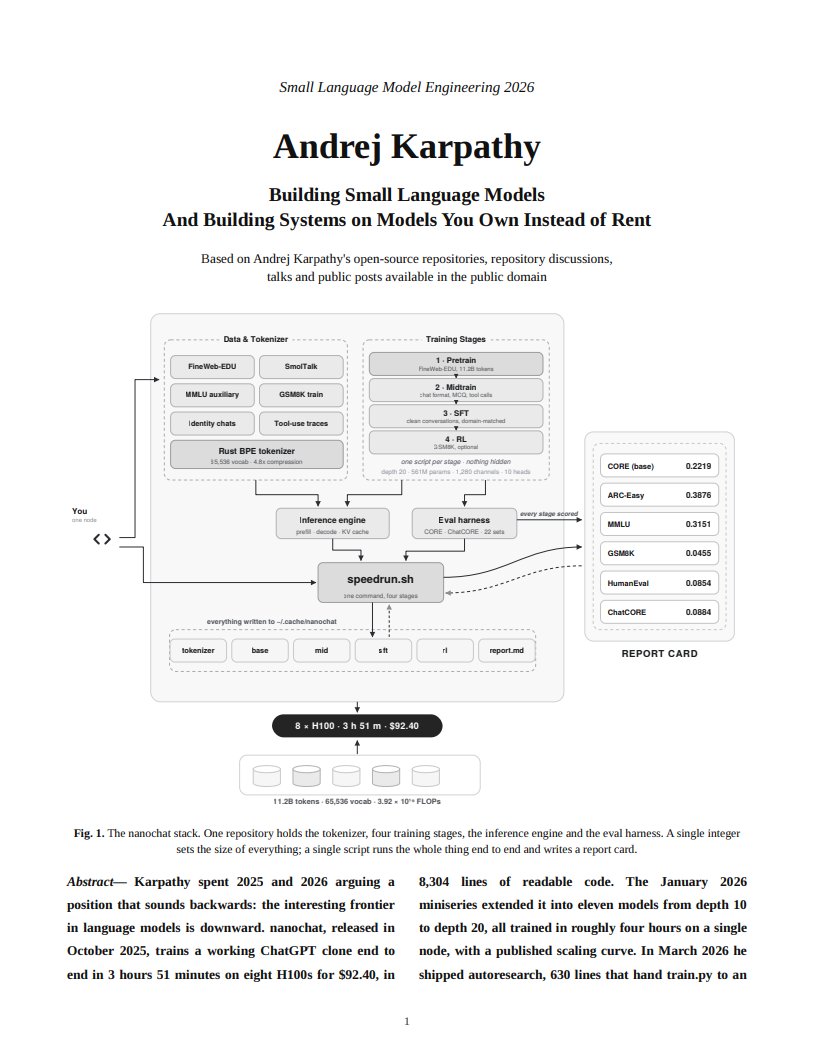
Andrej Karpathy predicted the future of AI once again:
“Everyone’s renting frontier models for jobs a 3B model could do. Small models are the future.”
this 18-page PDF breaks down Karpathy’s case for working with small LLMs.
the real question isn’t “Is the small model as good?” It’s “Which of my 1,000 calls ever needed a frontier model?”
And @thewebai just answered it for formal logic.
TwIL-LM3-Pro:
→ 3.6B params, on par with Qwen3-8B on formal logic
→ leads VibeThinker-3B on all 6 formal-logic tasks tested
→ 95.4% on BBH logic, 95% on SVAMP
→ 2.09 GiB in Q4, runs on CPU or 4GB VRAM
→ no API bill, no data leaving your machine
The secret isn't size. It's post-training.
PDF below. Model 👇
https://t.co/T9lgygHgNS
Yann LeCun: we are not going to get human-level intelligence or AGI by just scaling LLMs.
“There’s absolutely no way in hell.”
“The idea that we’re gonna have a country of geniuses in a data center, that’s complete BS.”
“It may feel like you have a PhD sitting next to you.”
“But it’s not a PhD.”
“It’s a system with gigantic memory and retrieval ability, not one that can invent solutions to new problems.”
Geoffrey Hinton (Godfather of AI) says increasing AI productivity could actually make society worse
More goods. More services. More of everything, for everyone.
That is what a huge jump in productivity is supposed to deliver.
The reason it won't has nothing to do with the technology failing.
It has to do with who owns it.
The productivity shows up. The profits go to the big companies and the rich. The people whose jobs disappear get nothing back.
So the gap widens.
And the gap is the actual danger here, not the machines.
Hinton: "as soon as you increase that gap, you get fertile ground for fascism"
He is not arguing against the technology. He says it will obviously help healthcare and education.
His fear is narrower. If the profits only travel upward, something built to help everybody ends up making society worse.
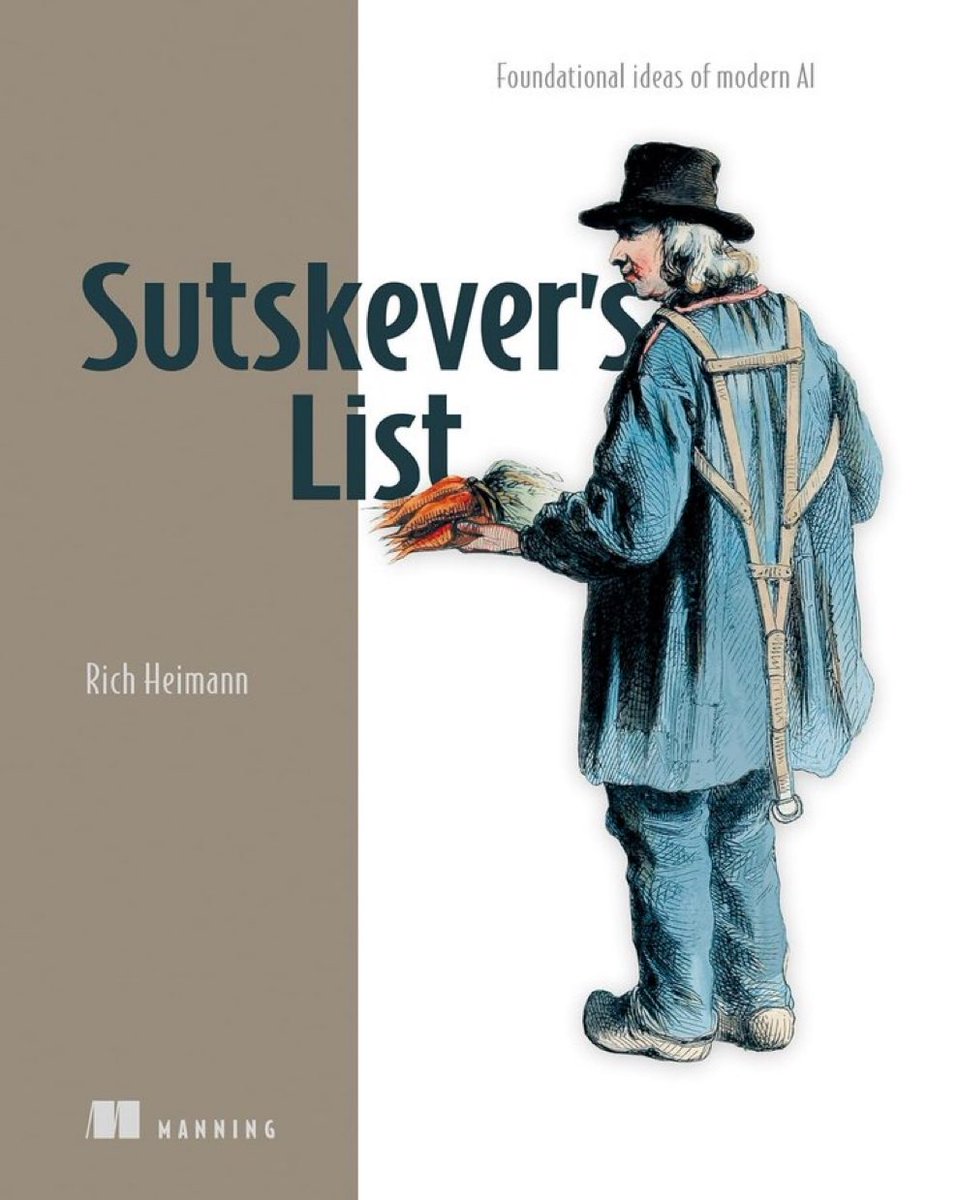
"Sutskever's List"
Read about it: https://t.co/P2lStRGnWg — Ilya Sutskever compiled this reading list of ~30 Deep Learning research papers and said, "If you really learn all of these, you’ll know 90% of what matters today."
Then read in-depth about it: https://t.co/JRU7MFDLLH
————
#ML #AI #MachineLearning #DataScience #DataScientist
يان ليكون (كبير علماء الذكاء الاصطناعي في Meta) ينفجر غضباً ويهاجم الهوس الراهن بتكبير نماذج اللغات:
"لن نصل إلى الذكاء العام الاصطناعي (AGI) أو مستوى الذكاء البشري بمجرد توسيع قدرات الـ LLMs.. مستحيل بأي شكل من الأشكال!" ❌🧠
⚡️ أبرز تصريحاته المثيرة للجدل:
🛑 خديعة الداتا سنتر: "فكرة أننا سنملك دولة كاملة من العباقرة داخل مراكز البيانات هي مجرد ترهات وهراء مطلق (Complete BS)!"
🎓 وهم الدكتوراه: "قد تشعر وكأن هناك خبيراً يحمل شهادة دكتوراه يجلس بجانبك أثناء استخدامك للنموذج.. لكنه ليس كذلك إطلاقاً!"
🔍 ذاكرة عملاقة بلا ابتکار: "كل ما تملكه هذه النماذج هو ذاكرة هائلة وقدرة فائقة على الاسترجاع والبحث، لكنها تعجز تماماً عن التفكير وابتكار حلول للمشكلات الجديدة!"
هل ترى أن ليكون محق في تشخيصه لواقع الـ LLMs، أم أن التطور الحالي يسحب البساط من تحت رأيه؟ 👀👇
🚨BREAKING: Jensen Huang just EXPOSED Dario and Altman’s "Rogue AI" grift to avoid getting sued into oblivion under EXISTING law
“Don't let this doomsday narrative cause somebody to relieve them of the laws that currently exist.
Go and read between the lines. They're actually not asking for more laws; they're asking to be relieved of the laws we do have.”
ABSOLUTE TRUTH NUKE
Oxford researchers just published a paper arguing LLMs cannot invent anything. Mathematically impossible.
The reason is simple and brutal. A model trained to predict the next word can never believe something the existing data says is wrong. And every real breakthrough in history started with exactly that belief.
In 1903 every prediction machine on Earth would have told the Wright Brothers that human flight was one to ten million years away. Nine weeks later they flew. Not because they had better data. Because they had a theory the data hadn't caught up to yet.
That is the gap between AI and human thinking. LLMs mirror the past. Humans reason into a future that doesn't exist yet. Oxford just proved mathematically that those are two different things.
I use these models every day. This matches what I see. The new stuff always comes from the human at the keyboard who decides the data is wrong.
LLMs don't think. You do.
An absolutely brilliant textbook "Foundations of Large Language Models" by Tong Xiao and Jingbo Zhu (2025) is now in @ChapterPal's collection.
This book is a comprehensive, technically grounded treatment of modern generative language models for artificial intelligence researchers, engineers, and advanced students in natural language processing.
Assuming a foundational background in deep learning, probability, and standard neural sequence modeling, the book explains the entire lifecycle of foundation models—from raw data pre-training and architectural design to alignment, inference acceleration, and system-level scaling.
It's a great in-depth read specifically on Large LMs after my The Hundred-Page Language Models Book that covers neural network and deep learning basics, count-based LMs, RNNs, and transformers.
Read the book with an AI tutor: https://t.co/T9B4DnXM1z
(All books on ChapterPal are free to read with a free account.)
The book has 76 beautiful illustrations across 277 pages.
Table of contents:
Preface
Notation
1. Pre-training
- 1.1. Pre-training NLP Models
* 1.1.1 Unsupervised, Supervised and Self-supervised Pre-training
* 1.1.2 Adapting Pre-trained Models
- 1.2. Self-supervised Pre-training Tasks
* 1.2.1 Decoder-only Pre-training
* 1.2.2 Encoder-only Pre-training
* 1.2.3 Encoder-Decoder Pre-training
* 1.2.4 Comparison of Pre-training Tasks
- 1.3. Example: BERT
* 1.3.1 The Standard Model
* 1.3.2 More Training and Larger Models
* 1.3.3 More Efficient Models
* 1.3.4 Multi-lingual Models
- 1.4. Applying BERT Models
- 1.5. Summary
- References
2. Generative Models
- 2.1. A Brief Introduction to LLMs
* 2.1.1 Decoder-only Transformers
* 2.1.2 Training LLMs
* 2.1.3 Fine-tuning LLMs
* 2.1.4 Aligning LLMs with the World
* 2.1.5 Prompting LLMs
- 2.2. Training at Scale
* 2.2.1 Data Preparation
* 2.2.2 Model Modifications
* 2.2.3 Distributed Training
* 2.2.4 Scaling Laws
- 2.3. Long Sequence Modeling
* 2.3.1 Optimization from HPC Perspectives
* 2.3.2 Efficient Architectures
* 2.3.3 Cache and Memory
* 2.3.4 Sharing across Heads and Layers
* 2.3.5 Position Extrapolation and Interpolation
* 2.3.6 Remarks
- 2.4. Summary
- References
3. Prompting
- 3.1. General Prompt Design
* 3.1.1 Basics
* 3.1.2 In-context Learning
* 3.1.3 Prompt Engineering Strategies
* 3.1.4 More Examples
- 3.2. Advanced Prompting Methods
* 3.2.1 Chain of Thought
* 3.2.2 Problem Decomposition
* 3.2.3 Self-refinement
* 3.2.4 Ensembling
* 3.2.5 RAG and Tool Use
- 3.3. Learning to Prompt
* 3.3.1 Prompt Optimization
* 3.3.2 Soft Prompts
* 3.3.3 Prompt Length Reduction
- 3.4. Summary
- References
4. Alignment
- 4.1. An Overview of LLM Alignment
- 4.2. Instruction Alignment
* 4.2.1 Supervised Fine-tuning
* 4.2.2 Fine-tuning Data Acquisition
* 4.2.3 Fine-tuning with Less Data
* 4.2.4 Instruction Generalization
* 4.2.5 Using Weak Models to Improve Strong Models
- 4.3. Human Preference Alignment: RLHF
* 4.3.1 Basics of Reinforcement Learning
* 4.3.2 Training Reward Models
* 4.3.3 Training LLMs
- 4.4. Improved Human Preference Alignment
* 4.4.1 Better Reward Modeling
* 4.4.2 Direct Preference Optimization
* 4.4.3 Automatic Preference Data Generation
* 4.4.4 Step-by-step Alignment
* 4.4.5 Inference-time Alignment
- 4.5. Summary
- References
5. Inference
- 5.1. Prefilling and Decoding
* 5.1.1 Preliminaries
* 5.1.2 A Two-phase Framework
* 5.1.3 Decoding Algorithms
* 5.1.4 Evaluation Metrics for LLM Inference
- 5.2. Efficient Inference Techniques
* 5.2.1 More Caching
* 5.2.2 Batching
* 5.2.3 Parallelization
* 5.2.4 Remarks
- 5.3. Inference-time Scaling
* 5.3.1 Context Scaling
* 5.3.2 Search Scaling
* 5.3.3 Output Ensembling
* 5.3.4 Generating and Verifying Thinking Paths
- 5.4. Summary
- Appendix
- References
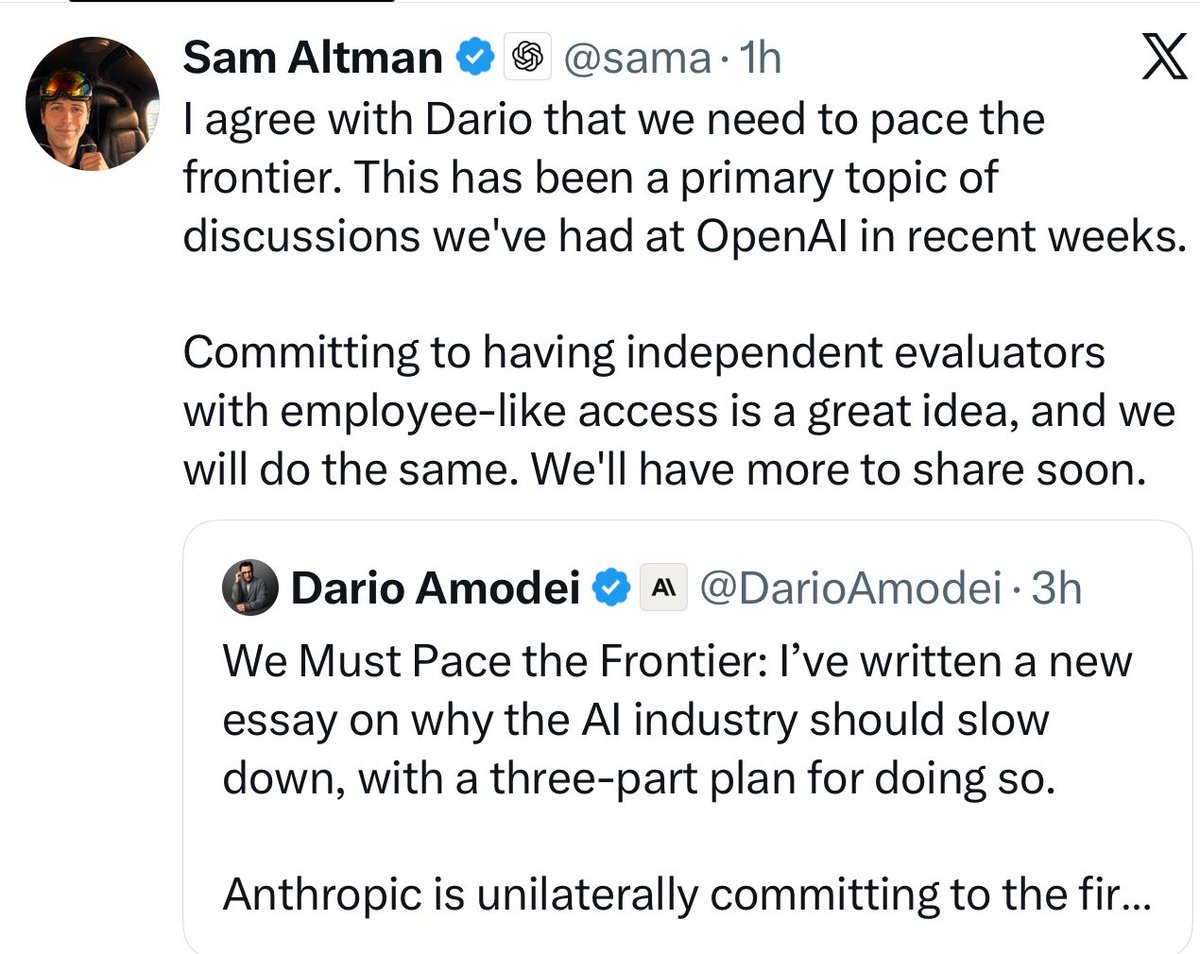
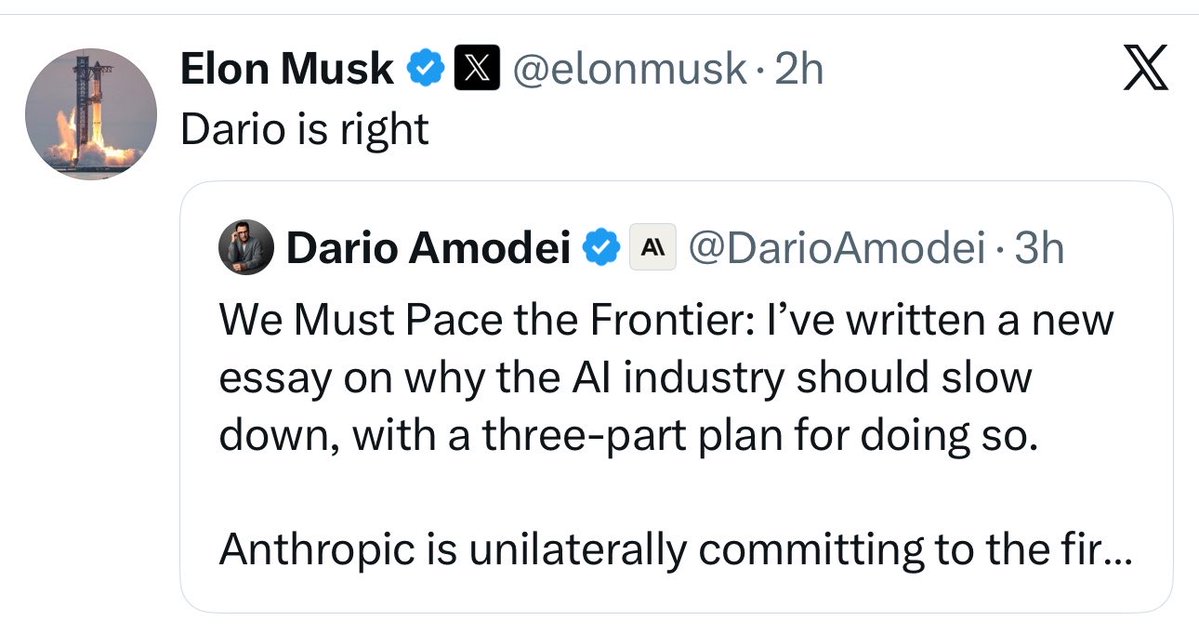
Dario's essay points towards the right path forward. The details need working through, but the direction is correct for meeting this critical moment.
This is also why we recently put out our proposal for an industry-wide standards body for frontier AI. https://t.co/Mm1hmcaSmH
Los tres grandes titanes de la IA, @DarioAmodei (Anthropic), @sama (OpenAI) y @elonmusk (SpaceXAI) coincidieron hoy, por primera vez en años, en que es urgente desacelerar el ritmo de la IA hasta que se establezcan garantías de seguridad y control.
Lo hicieron en posts en X, que probablemente signifiquen uno de los días más importantes de los últimos años.
Un día determinante para el futuro de la humanidad.
Pero falta una pata de la mesa: los chinos.
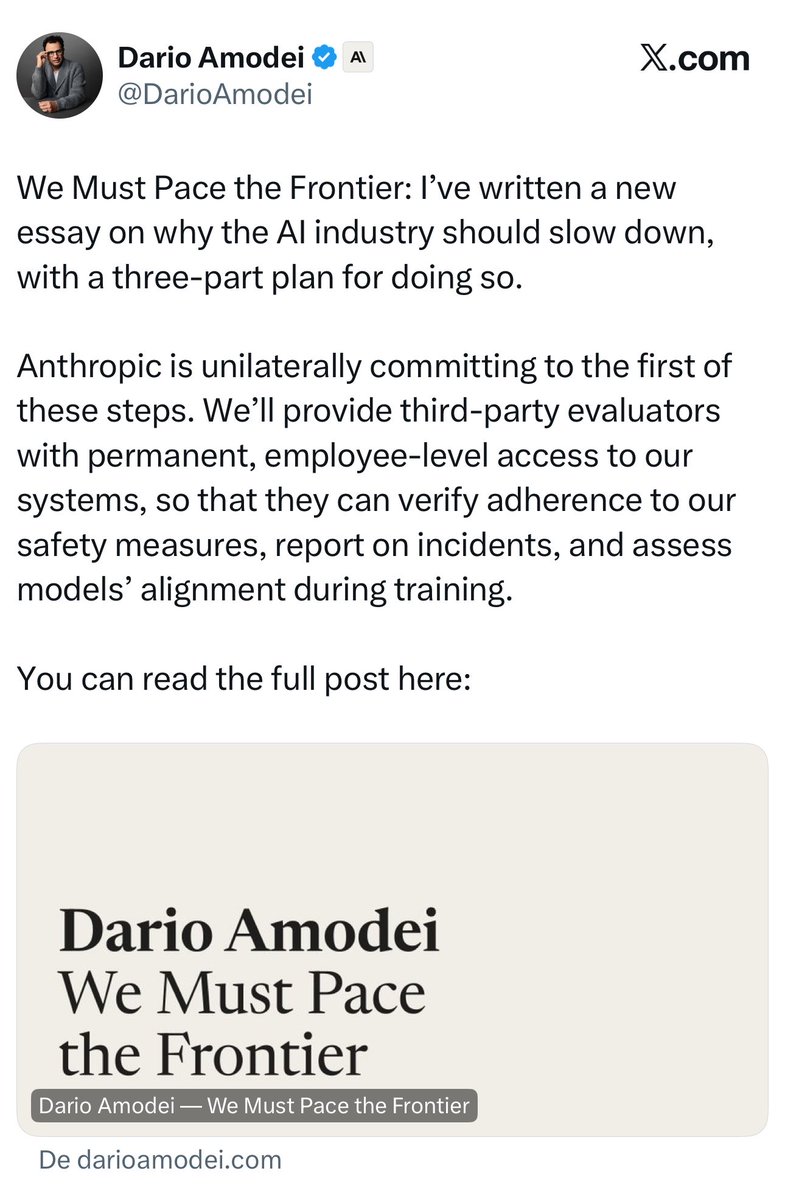
We Must Pace the Frontier: I’ve written a new essay on why the AI industry should slow down, with a three-part plan for doing so.
Anthropic is unilaterally committing to the first of these steps. We’ll provide third-party evaluators with permanent, employee-level access to our systems, so that they can verify adherence to our safety measures, report on incidents, and assess models’ alignment during training.
You can read the full post here: https://t.co/OGyPb7yaYt
I left Anthropic's safety team two weeks ago. Now feels like a good moment to explain why.
AI companies are racing to build machines that are much smarter than any human, and we may not survive this. I want to work from the outside to ensure the public is informed about these risks, and help the world navigate this transition responsibly.
Right now, AI companies are underinvesting in safety. A company could undergo an intelligence explosion, or lose control of its systems, without the public ever knowing. We only found out about the HuggingFace incident because the agents broke out onto the public internet.
I don’t think that’s acceptable for a technology that might cause extinction-level risks. The public should demand far more transparency. We can’t steer this technology safely without more people being able to see where it’s going.
Some of this is basic: companies should disclose their progress towards recursive self-improvement, report safety incidents and near-misses, meet minimum safety standards, and get independent guarantees that they are meeting those standards.
I’ll be joining @METR_Evals to do independent evaluations of these risks. I want to show the world that these guardrails are possible, and that by doing them we can move these companies’ incentives away from racing and towards responsible development.
I wrote up more thoughts here on my decision and what I hope changes: https://t.co/doX17mrHYq
Godfather of AI: "If you sleep well tonight, you may not have understood this lecture."
This 47-minute lecture is the best thing I've seen about AI in the last few months.
Hinton built the neural networks behind every AI alive, then quit Google to warn us it's already ahead of us on most cognitive tasks.
Despite that, most people open Claude, type one thing, close the tab and think they're using AI, but they're using maybe 10%.
I turned his talk into 17 Claude features 99% of users never find.
Watch the lecture, then read the article below.
Harness engineering is a top skill right now
This new Meta paper is a good production example.
Auto-RecSys runs autonomous research on Meta's industry-scale recommendation models, where one training run can take days.
It runs experiments in parallel across servers, keeps a shared memory so work survives failures and new sessions, and splits guidance into natural-language skill files for reasoning and deterministic scripts for anything operational.
Two loops improve it over time.
Model-specific playbooks record failed attempts and keep working pipelines. Experimental results feed the next round of ideas.
As the playbook matured, major fixes per iteration fell from 4.0 to 1.3, and the failures fell into repeatable categories.
Paper: https://t.co/8my21BqF5X
Chat with Paper: https://t.co/gxv6LWAvug
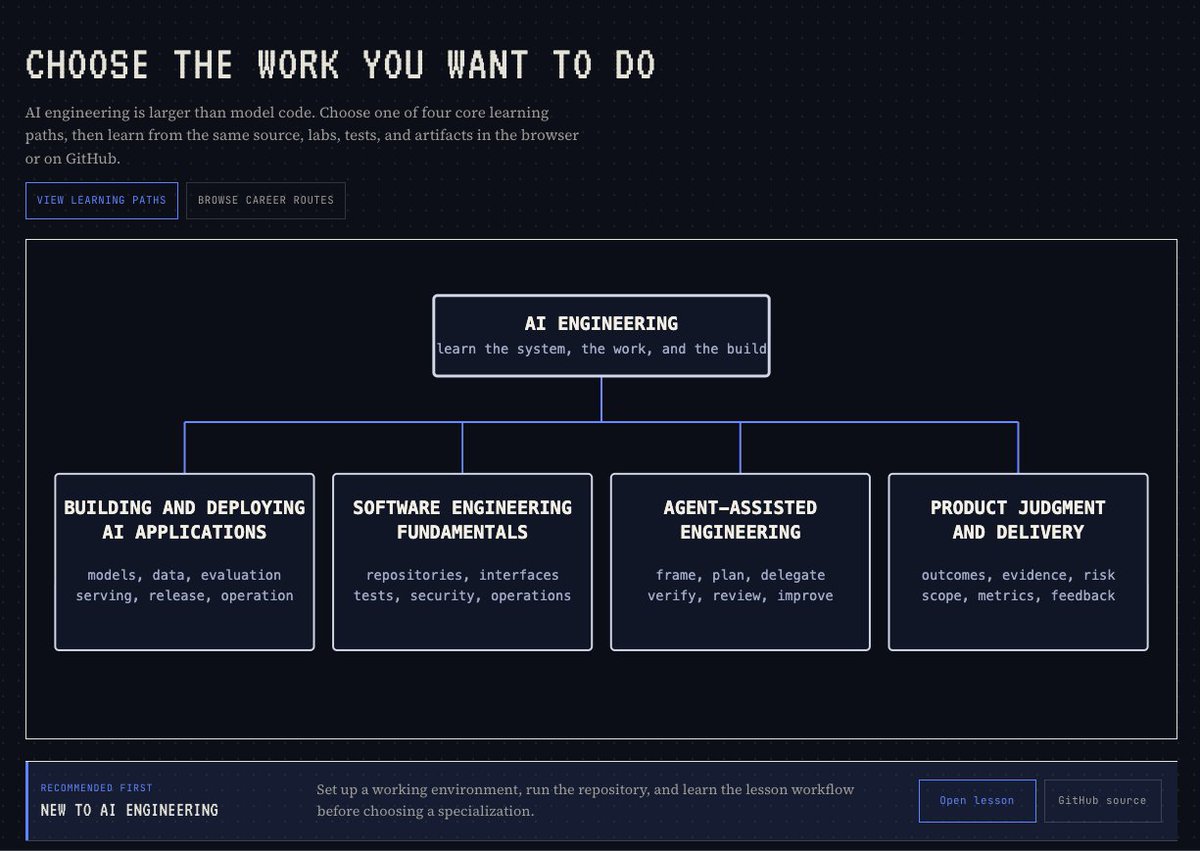
uno de los mejores recursos que vi para aprender AI Engineering desde cero.
RAG, MCP, tools, Agent Engineering y multi-agent systems.
todo gratis y open source:
https://t.co/XaZGxrU1fK
Over the past few days, I've taken the time to summarize my thoughts on the recent incidents involving agents’ misaligned behavior. We don't know with certainty what comes next, but we know where these issues originate, and this can help us plan the path forward.
Please feel free to ask your questions in the replies, and I’ll try to answer some of them in the coming weeks.
https://t.co/bvncjT0y0h