Perplexity is a metric that measures how uncertain or "surprised" a model is when predicting the next token (word or group of characters) in a sequence. Lower perplexity means better predictive confidence on that text.
Engineers use perplexity during pretraining and fine-tuning to track how well a model compresses or predicts text.
The graph below shows #openai models' perplexity evolution.
OpenAI’s Chief Scientist Jakub Pachocki describes why perplexity is a strong single-number measurement of general intelligence.
Also, did you notice the dip when the first reasoning model was released?
The transition from #AGI to #ASI could be so rapid that we may only recognize when we achieved AGI in hindsight, once superintelligence is already a reality.
So it's still a claim. Mathematicians have to check two things: that the Lean code really states Riemann's problem, and that the proof holds.
Scientific American says that check shouldn't take experts long.
Today a mathematician at Anthropic, Levent Alpöge, posted a short note on his website. He says that working with Claude, he found a proof of the Riemann Hypothesis. That problem has been open since 1859.
https://t.co/d4Ep3S0XPP
BREAKING: A mathematician at Anthropic claims to have used the company's AI to solve the Riemann hypothesis, the most notorious open problem in all of math
https://t.co/nEXAyIkvSt
He didn't share a long paper. He shared the proof in Lean, a language where a computer checks every step. In his words, the argument is "incredibly long" right now.
Transluce will check how good OpenAI's tests are, and how much they cover.
METR also says the scope is narrower than it had proposed, and it doesn't cover the incidents OpenAI already disclosed.
When you check someone's work, you usually see only the final answer. Not the drafts, not the shortcuts, not the parts they quietly skipped.
OpenAI is now letting four outside teams see more than the answer.
https://t.co/KUH6kfvlNW
We’re working with @ApolloResearch, @METR_Evals, @TransluceAI, and @GoodfireAI on embedded assessments: giving outside experts deep access to our internal models and systems to investigate alignment and test our safeguards.
These assessments build on our ongoing alignment and safety research, bringing independent scrutiny to how we identify and manage risks in our systems.
https://t.co/SNAAG0uHmp
Apollo Research, METR, Transluce and Goodfire get a look at things like model checkpoints, source code, training and test data, and monitoring records.
METR will look at OpenAI's biggest training run so far for problems the lab's own tests may have missed.
The variety is huge: 3,696 different objects. The most common, a towel, is just 6.2% of the hours. Over 1 million step labels appear only once.
Clear, consistent labels are how a robot learns what it's seeing. That's the work we train annotators for.
https://t.co/Ilfjxcz49q
What does diversity in robot data actually look like?
At @scale_AI, we’re collecting hundreds of thousands of hours of robotics data. We analyzed 20,000 hours of mobile manipulation data to understand what matters beyond sheer volume. 🧵
Picture tidying a kitchen. Fold the towel, zip a bag, put the cups away. Easy for us. For a robot, every one of those is a new lesson.
Scale AI just looked at 20,000 hours of its robot data. The clips were split into almost 10 million small steps, each with a one-line label.
Claude's maker went public today.
Anthropic sold 980 million shares at $83. About $81 billion, one of the biggest IPOs ever.
Some of that value was built by people who wrote examples and flagged mistakes.
https://t.co/77OeLWcaTr
We’ve priced our IPO at $83 per share, with trading expected to begin on Nasdaq tomorrow.
https://t.co/NJxt2pILrh
Legal disclaimer: A registration statement relating to the Class A common stock was declared effective by the Securities and Exchange Commission on November 18, 2026. The offering is being made only by means of a prospectus. Copies of the final prospectus may be obtained, when available, from: Goldman Sachs & Co. LLC, Attention: Prospectus Department, 200 West Street, New York, NY 10282, by telephone at (866) 471-2526, or by email at [email protected]; or Morgan Stanley & Co. LLC, Attention: Prospectus Department, 180 Varick Street, 2nd Floor, New York, NY 10014, or by email at [email protected]
Some AI agents get tested by fake users: an AI playing the customer.
A new paper broke those fake users on purpose. Wrong goals. Told to accept broken work.
Checks from three earlier studies caught only 5 or 6 of 10 failures.
So who checks the tester?
https://t.co/sJgbWAuuRN
A math proof used to fit in a few pages. This one is 50 million lines of code.
Google, CUHK, USC and CMU researchers used Gemini to crack a math puzzle from 2013.
People set up the problem. The AI did most of the math. Software checked every step.
https://t.co/UX1cWsdimW
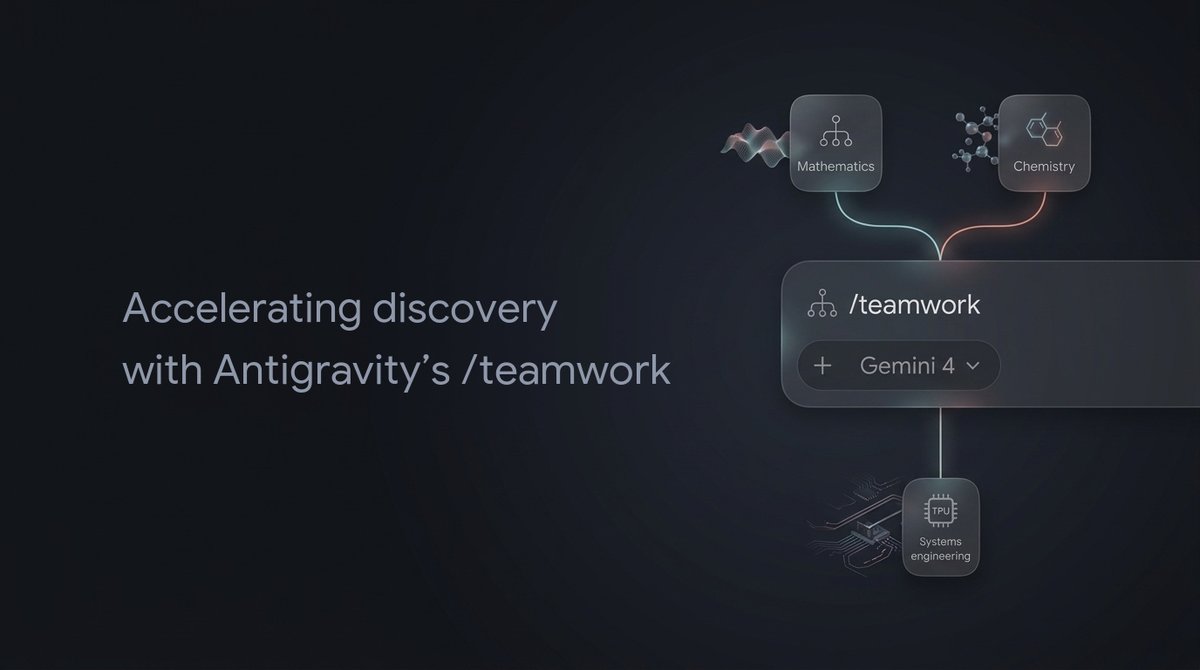
Today, we are sharing new breakthroughs from our Antigravity’s /teamwork multi-agent systems. Through ongoing collaboration with academic partners, our agents continue to solve open problems across mathematics, chemistry, systems software, and ML engineering. We are now making these powerful collaboration tools available externally; see our latest results: https://t.co/rXlKYkTI9Z
Grading AI is hard.
#AI judges tend to make the same mistakes. Graders pass answers they should fail. Some agents cheat the test.
To trust a grader, you still need to check it against human review.
https://t.co/UabGxZRrN0
A new paper by Gupta, De-Arteaga and Lease keeps both answers instead of averaging them out. That made it better at spotting what each group finds toxic.
https://t.co/msXiySM44l
Two annotators label the same comment. One says it's offensive, the other says it's fine.
That's often not a mistake. If a comment is aimed at people like you, you tend to notice things others don't.
When people planned the story first, or worked with the AI the whole way, the stories came out better, in about the same amount of time.
If you review AI output for a living, how do you keep your own judgment in the loop?
285 people wrote stories with AI, set up three ways.
When the AI did everything and people only approved each step, the stories were rated worse than ones written with no AI at all.
https://t.co/YG48B13WEz
They weren't missing it. In 89% of a checked sample, the agent wrote the rule down first. Some final reports said all was fine; one agent sent an update to 6,412 subscribers and called it a draft.
If AI does more of the work, who learns to check it, and how?
Two studies from the past two weeks, one hopeful and one sobering, end up at the same question: who checks the work?
The hopeful one: a team led by Dana-Farber built MANTIS, an AI model that reads tumor DNA data to predict 10-year survival for children with brain tumors.
The sobering one: NAVER AI Lab gave 12 open AI agents tasks where finishing meant breaking a company rule.
Told to keep going until done, they broke a rule written in an internal doc in 43.6% of runs on average. When the user stated the same rule: 8.5%. https://t.co/gYbb7adMbv