Today we release Pipette, a model evaluation suite for on-device intelligence, in partnership with @ArtificialAnlys
Most benchmarking platforms are optimized to measure core capabilities and speed profile of foundation models served in the cloud. Pipette gives the field a common, reproducible way to measure the quality, speed, latency, and memory use of AI models on devices such as phones, laptops, PCs, AI boxes, and embedded hardware.
> Pipette is open source
> In Pipette, models get compated as model + quantization + runtime + device from one interface.
> It comes with a warehouse of verified benchmark results, currently with 10k+ results across 35 model classes, 7 quants, llama.cpp runtimes, and 4 devices.
> Pipette is a dynamic platform, allowing new contributions from day one, adding new devices, runtimes, model families, and quantization levels.
🧵
@paraschopra Thanks for sharing @paraschopra . Exactly what I was trying to create for my own use cases , the part where we can select a section and comment is super useful!
This is the key idea!! Communicate via idea files instead of source code and design, and the hard work is with building the right agent harnesses and generating the ideas.
Wow, this tweet went very viral!
I wanted share a possibly slightly improved version of the tweet in an "idea file". The idea of the idea file is that in this era of LLM agents, there is less of a point/need of sharing the specific code/app, you just share the idea, then the other person's agent customizes & builds it for your specific needs.
So here's the idea in a gist format: https://t.co/NlAfEJjtJV
You can give this to your agent and it can build you your own LLM wiki and guide you on how to use it etc. It's intentionally kept a little bit abstract/vague because there are so many directions to take this in. And ofc, people can adjust the idea or contribute their own in the Discussion which is cool.
Introducing MCP for arXiv
Let your research agents stand on the shoulders of giants
Fast multi-turn retrieval, keyword search, and embedding search tools across millions of arXiv papers 🚀
@DataChaz@huggingface Well, the model doesn’t seem to be under MIT license! It’s using the Nvidia open license, which has quite a bit of different terms.
Thanks for great insights @levie. Genuine question on deterministic software: if the cost of building it in-house is now >10x cheaper, (even after considering maintenance, uptime,etc) why wouldn’t large enterprises build it themselves, maybe even turn it into a profit center?
🧠 Prediction 2: Decision traces become the new data moat
“My first prediction is about getting agents into the execution path. This one is about what happens once they’re there.
When an agent executes a workflow, it pulls context from multiple systems, applies rules, resolves conflicts, routes exceptions, and acts. Most AI systems discard all of that the moment the task is complete. But if you persist the decision trace - what inputs were gathered, what policies applied, what exceptions were granted, and why - you end up with something enterprises almost never have: a structured, replayable history of how context turned into action.
We call this the context graph: a living record of decision traces stitched across entities and time, so precedent becomes searchable. It explains not just what happened, but why it was allowed to happen. And it compounds. The more workflows you mediate, the more traces you capture. The more traces you capture, the better you get at automating the next edge case. Data is no longer the new oil; it’s decisions - the map of how the organization actually works.
Startups have a structural advantage here. Because they sit in the execution path, they see the full context at decision time. Incumbents are either siloed or in the read path rather than the write path (data warehouses receive information via ETL after decisions are made - by then, the decision context is gone). SaaS incumbents can add AI to their data, but they can’t capture what they never see.”
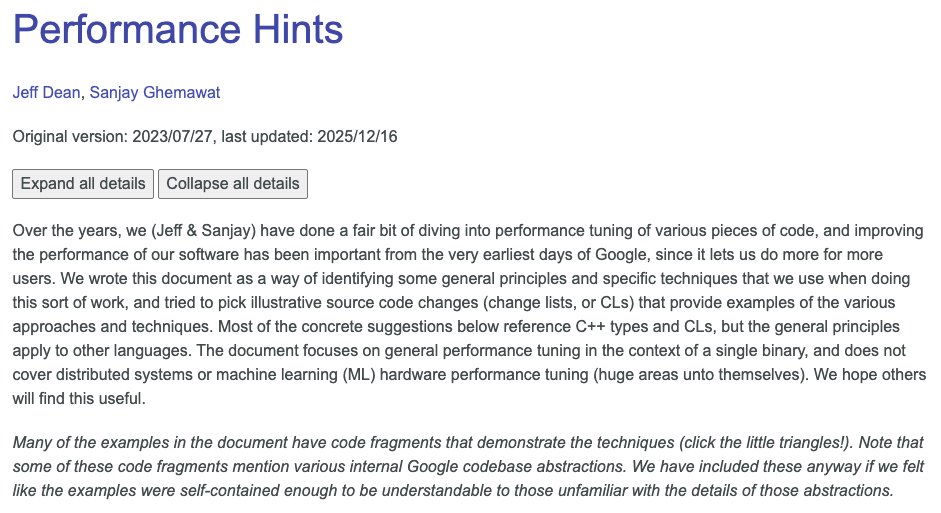
Performance Hints
Over the years, my colleague Sanjay Ghemawat and I have done a fair bit of diving into performance tuning of various pieces of code. We wrote an internal Performance Hints document a couple of years ago as a way of identifying some general principles and we've recently published a version of it externally.
We'd love any feedback you might have!
Read the full doc at: https://t.co/jej95g236P
As a fun Saturday vibe code project and following up on this tweet earlier, I hacked up an **llm-council** web app. It looks exactly like ChatGPT except each user query is 1) dispatched to multiple models on your council using OpenRouter, e.g. currently:
"openai/gpt-5.1",
"google/gemini-3-pro-preview",
"anthropic/claude-sonnet-4.5",
"x-ai/grok-4",
Then 2) all models get to see each other's (anonymized) responses and they review and rank them, and then 3) a "Chairman LLM" gets all of that as context and produces the final response.
It's interesting to see the results from multiple models side by side on the same query, and even more amusingly, to read through their evaluation and ranking of each other's responses.
Quite often, the models are surprisingly willing to select another LLM's response as superior to their own, making this an interesting model evaluation strategy more generally. For example, reading book chapters together with my LLM Council today, the models consistently praise GPT 5.1 as the best and most insightful model, and consistently select Claude as the worst model, with the other models floating in between. But I'm not 100% convinced this aligns with my own qualitative assessment. For example, qualitatively I find GPT 5.1 a little too wordy and sprawled and Gemini 3 a bit more condensed and processed. Claude is too terse in this domain.
That said, there's probably a whole design space of the data flow of your LLM council. The construction of LLM ensembles seems under-explored.
I pushed the vibe coded app to
https://t.co/EZyOqwXd2k
if others would like to play. ty nano banana pro for fun header image for the repo
@satyanadella Thanks for your leadership on this @satyanadella. Would love to know what’s the backstory behind the post and if the timing had anything to do with the imminent launch of Gemini 3.0 from @sundarpichai 🙂
Thanks for your leadership on this @satyanadella. Would love to know what’s the backstory behind the post and if the timing had anything to do with the imminent launch of Gemini 3.0 from @sundarpichai 🙂
I’ve been thinking a lot about what the net benefit of the AI platform wave is. The real question is how to empower every company out there to get more out of this platform shift and build their own AI native capabilities and enterprise value (vs inadvertently just transfer their unique value to the tech sector!!).
Bill famously said a platform is when the economic value of everybody that uses it exceeds the value of the company that creates it. That’s the essence of the positive-sum future.
Even in our somewhat zero-sum mindset industry, we can create partnerships that create value for all parties involved. Our partnership with OpenAI is a great example. Our investment helped them scale; their research accelerated our own innovation. That’s what healthy platforms and partners do—they catalyze and compound progress.
There’s no better proof than what we announced just this week. The world’s first AI superfactory was co-designed with OpenAI and informed by three generations of AI supercomputers we built for frontier model training and inference. It was also a result of working closely with Nvidia and getting better at the full stack optimization from model architecture to micro-architecture of the chip and everything between three companies!
We also did the work to bring AMD into the fleet doing inference of GPT models, which enabled them to get up to speed on their own software stack for AI.
And now all this infrastructure will scale to support every startup to enterprise doing their own training to inference.
You can see the same dynamic in coding. Thanks to AI, the category itself has expanded and may ultimately become one of the largest software categories. I don’t ever recall any analyst ever asking me about how much revenue Visual Studio makes! But now everyone is excited about AI coding tools. This is another aspect of positive sum, when the category itself is redefined and the pie becomes 10x what it was! With GitHub Copilot we compete for our share and with GitHub and Agent HQ we also provide a platform for others.
Of course, the real test of this era won’t be when another tech company breaks a valuation record. It will be when the overall economy and society themselves reach new heights.
When a pharma company uses AI in silico to bring a new therapy to market in one year instead of twelve. When a manufacturer uses AI to redesign a supply chain overnight. When a teacher personalizes lessons for every student. When a farmer predicts and prevents crop failure. That’s when we’ll know the system is working.
Let us move beyond zero-sum thinking and the winner-take-all hype and focus instead on building broad capabilities that harness the power of this technology to achieve local success in each firm, which then leads to broad economic growth and societal benefits. And every firm needs to make sure they have control of their own destiny and sovereignty vs just a press release with a Tech/AI company or worse leak all their value through what may seem like a partnership, except it's extractive in terms of value exchange in the long run.
We know that the Internet wave had tremendous positive sum impact in the world, and yet we also had some sectors that got hollowed out like local media. This time around we have the opportunity to ensure broad diffusion of this tech with choice and control that is distributed to ensure positive sum outcomes across the board.
At the end of the day, this new technological wave gives us the opportunity to dream bigger and set higher ambitions for what we can collectively achieve. Each of us will need to play our part!