Hosted by @uOttawa Legal Text Mining Lab. Created by @w_alschner. Free research & teaching resources on #AI#NLP#networkanalysis for lawyers @uOttawaTechLaw.
Interested in applying #AI, #networks, #NLP to judicial decisions?
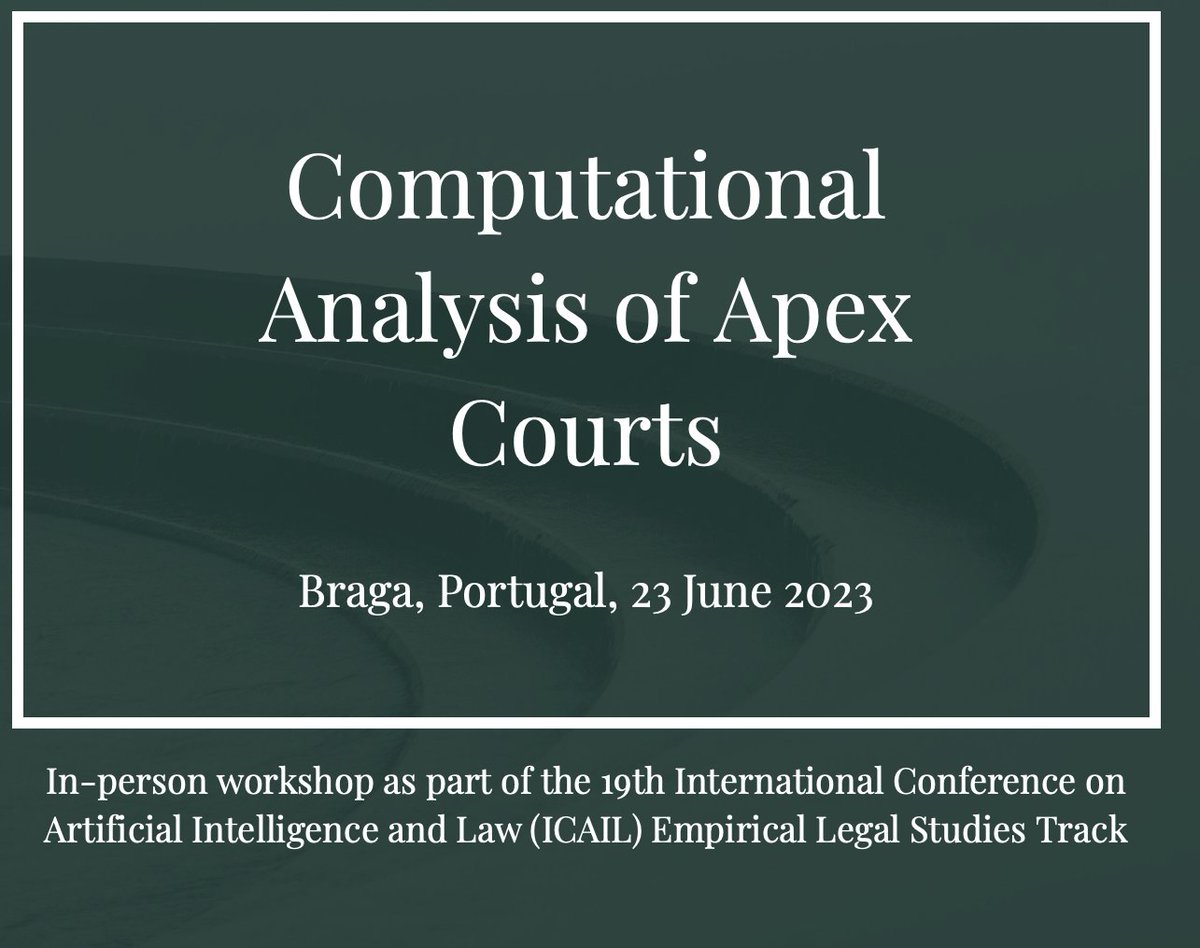
Submit an abstract to the "Computational Analysis of Apex Courts" Workshop, held in conjunction with #ICAIL2023, 23 June 23. Deadline 28 April. Remote participation possible.
More info: https://t.co/yoWeyvexIO
Do you have a PhD and are you interested in developing, applying, and testing computational methods in relation to legal data? Then join the Maastricht Law and Tech Lab as an Assistant Professor of Computational Law.
The vacancy can be found here: https://t.co/vbbmo18imL.
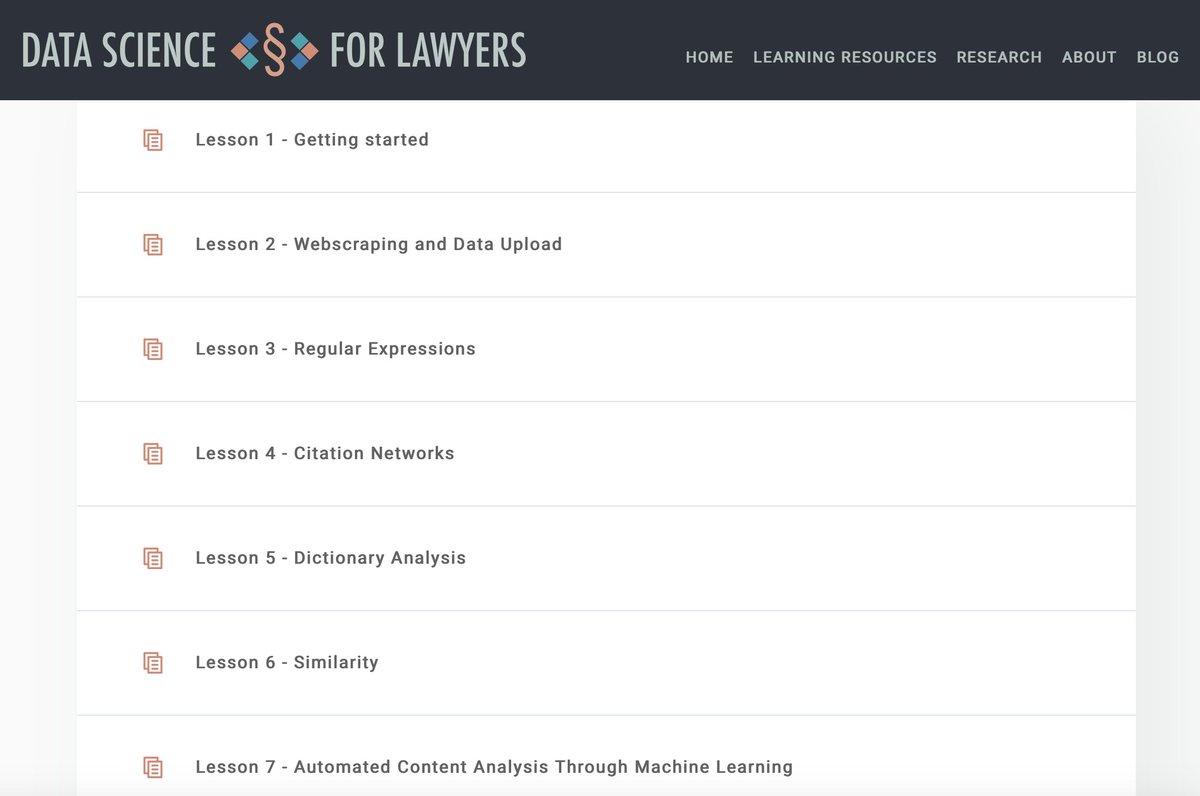
@stamourla@SCC_eng@uocommonlaw Part I (LegalTech and the Legal Profession) and Part III (LegalTech and the Legal System) are not. But all the @datascience4law learning materials are freely accessible online to learn how to do such analyses: https://t.co/LlBfpHtImv
Sandbox for #legaltech in Ontario.
An important development just as I am wrapping up another edition of my "Data Science for Lawyers" @datascience4law course. Students are shocked every year how hard it is (for structural and regulatory reasons) to get legal tech off the ground
📺 New video in the 'What I am Working On' series of the ITA Academic Council: Dr Wolfgang Alschner, University of Ottawa, on his forthcoming monograph on "Investment Arbitration and State-Driven Reform: New Treaties, Old Outcomes" (OUP)
https://t.co/QbQllFgt3p
NEW ISSP @uOttawa EVENT!
On Thursday, April 29, at 12:00 PM, the ISSP will host Prof. @MariamHu Faculty Affiliate, ISSP and Assistant Professor @Telfer_uOttawa@TelferResearch to discuss the emergence and resilience of Bitcoin.
#isspscience#uottawa
https://t.co/U5Q9TniPpn
Did you miss the amazing conversation we had with @CraigCarys, @grimmelm and @mgeist celebrating Ian R. Kerr on March 29?
The recording of “The Death of the AI Author” event is now available on YouTube!
🤖+🖼+🎓+❤️
https://t.co/BKoDjIDxzB
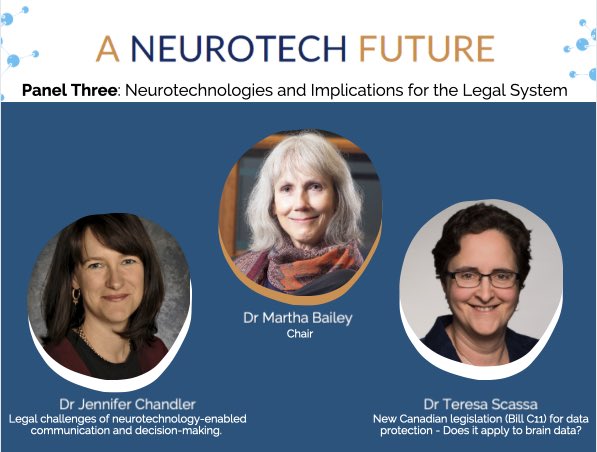
The Council of Canadian Academies has appointed Prof. @TeresaScassa as Chair of the Expert Panel on #AI for Science and Engineering! – and @cdoagoo as member!
› https://t.co/aCnk9ExiCm
I've just finalised the proofs for the revised paperback edition of my book, Online Courts and the Future of Justice (@OUPLaw). I've written a major update to take account of the widespread use of remote hearings during Covid. Out in June.
Super excited to announce the release of “Artificial Intelligence and the Law in Canada”, co-edited with @TeresaScassa and published by @LexisNexisCan that captures the diversity of law and policy challenges facing Canada when it comes to #AI!
https://t.co/XWNhtOiR5s
University of Cambridge announces the launch of the Regulatory Genome Project to sequence the world’s regulatory text through machine learning. @Cambridge_Uni@CambridgeAltFin#RegTech https://t.co/miUoC2VxzO
Interested in AI & law? Litigation analytics?
This blog post may interest. Re: unpacking the deep learning model I used on the dataset from lesson 8 in Prof. @w_alschner's fantastic course @datascience4law.
#coding4lawyers#datascience#lawtwitter
https://t.co/n2u5odso0z
Legal datasets are the foundation of the emerging field of legal analytics.
The CIRI Human Rights Dataset contains quantitative information on government respect for 15 human rights for 202 countries.
Check it out here: https://t.co/edURU39TcH
Great article by @bobambrogi on modernizing the delivery of legal services in 2020 and the year's top developments in #legaltech and innovation. https://t.co/OcZHtej3L2
Legal documents have their own peculiarities. Out of the box coding solutions don't always work perfectly.
The following article by @sereprz discusses some helpful techniques.
Learn more here: https://t.co/Cccn8DioWC
Fewer judicial resources would be used if more people chose to arbitrate small claims. This would improve access to justice.
The following project by @CodeXStanford discusses what will promote the use of online arbitration channels.
Learn more: https://t.co/pzCQcf3Cyw
Artificial Intelligence can automate repetitive tasks to help categorize information.
It can be about as accurate as a human using their intuition. Learn how to use the technology here:
https://t.co/GfeI6gmiSL