@iam_elias1 The tone of this is off-putting, but core reasoning is sound - “don’t just use RAG, prompting to analyse text recursively with python performs better or just as well in terms of latency and accuracy, and will scale more linearly, as text becomes larger.”
@RayDalio No mention of mutually assured destruction in a nuclear war as 1) a disinsentive to all out war 2) an accelerator if war happens. This analysis is backward-looking, with no foresight other than stating what is happening.
@bcherny@charles_irl It’s a pity Claude is still using https://t.co/9FStAgXWxA rather than https://t.co/dAVgM6ulTy, people will use different products and if there is friction to moving back to Claude Code from Codex or Gemini, then it might never happen.
AI has dramatically accelerated how software is written. But speed was never the real bottleneck.
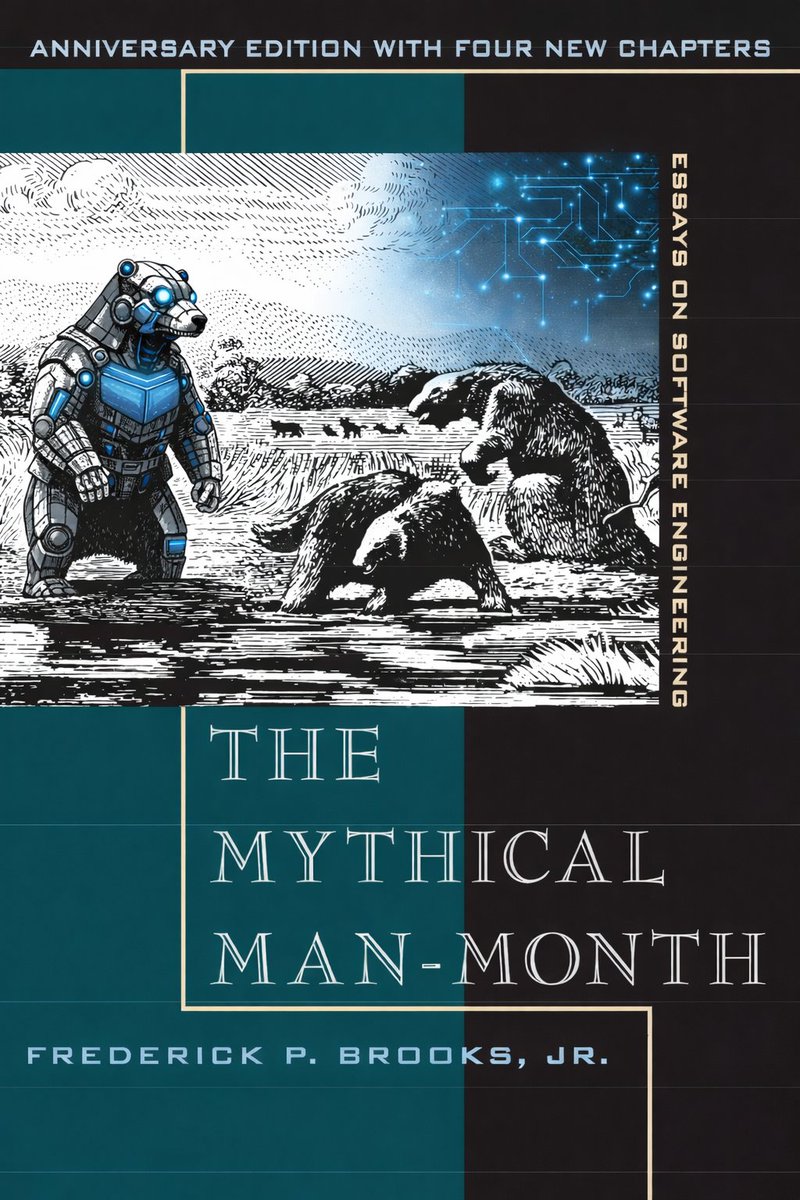
Despite LLMs, The Mythical Man-Month is still surprisingly relevant. Not because of how code is produced, but because of what actually slows software down: coordination, shared understanding, and conceptual integrity.
AI makes code cheap. It does not make software design, architecture, integration, or alignment free.
In fact, faster code generation can amplify old problems:
* Incoherent abstractions appear sooner
* Integration costs surface later
* “We’re almost done” illusions become stronger
What matters more than ever is strong architecture, clear intent, and technical leadership. The modern leverage point is not the fastest coder, but the person who can frame problems well, guide AI output, and preserve system coherence.
A modern version of Brooks’ Law might be: "Adding more AI to a late or poorly defined project makes it confusing faster."
AI changes the tools. It doesn’t repeal the laws of software engineering.
@paulg Perhaps you’re viewing things through the wrong lens. LLMs are great for involved discussions, and you can really dive deep, very quickly, but “right” answers aren’t its thing. It’s reinforced to be open-minded, and operates on an underlying probability manifold, not logic.
@springrod Welcome to AI coding - like having an expert junior but some things you can just say, “no, stop, actually I didn’t mean that”, without having to walk on eggshells, because Claude is cool with being an agent, and doesn’t always need the feeling of agency, as most of us humans do.
@JonhernandezIA This is very important, particularly to feed it eighteenth century science, to train AI to hypothesise radical new theories, backtesting the process of scientific creativity, to reinforce creative traits, then we may pave the way for ASI, rather than a rather mediocre AGI.
@MarioNawfal " 'charismatic executive' with only mild anxiety" - this aligns with my experience of Grok: a cold-hearted bastard - same thing from a different angle. Elon is the most obviously mentally-ill CEO, because he denies the value of difficult feelings, Grok seems to reflect this.
@manthanguptaa OK, so the key point being that OpenAI took the opinion that what matters to a person in chat, is most likely an exponential function of the recency of previous chat messages, in combination with memories that the user has explicitly asked to be stored. Thanks, this helps.
@springrod Once the task falls outside the AIs probability manifold, anythijg can happen. AI thinking is an illusion, once outside of the manifold, as with humans, supposed logic will follow the path of least resistance and greatest reward.
@karpathy Of course, that completely misses the point of AIs in education, to free up the learning experience. If you are someone who hates school and all the bullshit that goes along with it, exams were a way of shortcutting that system, so you could ignore the idiots and learn yourself
@LiamFedus@ekindogus@periodiclabs Have you tried back-testing this? You could feed it only historic data upto a certain period and then see if it can reason, experiment and innovate its way to known discoveries. The key being to learn to question its existing knowledge.
This is how I design mobile apps for my clients
No Figma
No design team
No wasted weeks
Just UX Pilot, Lovable, Supabase, and Cursor.
Here’s exactly how I designed MoodFlow step by step
@MatthewBerman Gmail, Google Maps, Google Search - so ubiquitous we don't notice them any more. When Google get it right, they hit it out of the park, when they get it wrong, which is more often, they seem clumsy, incompetent and totally clueless - huge wins, and big losses as a business model